


Shawn Bailey
Seeking fairness

Anyone who stopped by the Liquor Mart in Dauphin, July 19, looking for an adult beverage instead found Manitoba Government Employees Union members who are employed at the Manitoba Liquor and Lotteries facility on the picket line.
The local workers joined 1,400 of their peers in a one-day strike to draw attention to the fact the union has been without a contract since last March.
MGEU president Kyle Ross says the union is pushing for a fair and reasonable deal, including a 3.3 per cent wage increase, to provide frontline workers with fair compensation to keep up with inflation.
Manitoba Liquor and Lotteries said in a statement that negotiations were to resume later in the week, and that it remains committed to reaching a fair collective agreement.
This year’s CNUF to feature new and different attractions
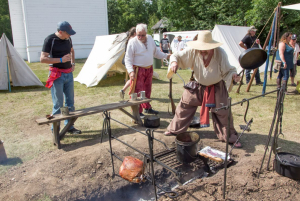
If you think after 57 years you know what Canada’s National Ukrainian Festival is all about, get ready to be surprised.
The annual celebration of Ukrainian culture and heritage has plenty of new and different attractions to keep fesitvalgoers interested and entertained.
And that is reflected in ticket sales.
“We are so excited. Actually our ticket sales are going phenomenal, so good, in fact, we had to release more upper camping spots,” CNUF president Kayla Gillis said. “We haven’t done that since our 50th anniversary, so we’re very excited to have a lot of ticket sales in advance and to need some more upper camping.”
One of the changes this year involves moving the showcase performance up in the schedule.
“Our extravaganza show is going to be on Saturday night instead of on Sunday night this year. The dance group can only make it for the Saturday night, they had to travel back to Alberta on the Sunday,” Gillis said adding ticket sales for Saturday are heating up. “So we’re just changing things up a little bit to see if it makes a difference. Our Sunday night show is going to feature something special, as well. So you’ll have to come to check it out and see what it is.”
The extravaganza show features the Edmonton-based dance group Shumka.
Established in 1959, the Ukrainian Shumka Dancers is Canada’s only professional Ukrainian dance company. Shumka presents dance-theatre touring productions, as well as intimate concerts across the country and around the world and has been seen by millions on international television broadcasts. The company has presented command performances for queens, prime ministers, and presidents, and has performed alongside many big name entertainers. Along with Alberta Ballet and Edmonton Opera, Shumka is a resident company of the Northern Alberta Jubilee Auditorium.
Fans will be treated to a first-class performance as more than 60 years of history has shaped Shumka’s signature music and dance style. While maintaining deep respect for their heritage, Shumka challenges conventional boundaries to define the experience of Ukrainian dance in the context of modern society. Shumka has completed nine cross-Canada tours, and toured China and Ukraine on two occasions, including with one of its biggest productions, Shumka’s Cinderella which premiered in 2000.
Shumka will share the festival stages throughout the weekend with many other top-notch entertainers including Vohon Ukrainian Dance Ensemble, Trembita, Zirka Ukrainian Dance Ensemble, Zabutnyy Dance Company, DJ Gordo, Mashyna, Tyt i Tam, Chaban Ukrainian Dance Group, Druzhba Ensemble, Prairie Fire, Rushnychok Ukrainian Folk Dance Association, Bratstva, Lyra Vocal Group, The Sparkling Tones, Party Time Orchestra and Sche Raz, among others.
Between performances, Gillis said patrons can check out some of the other changes being made this year, including the Farmers’ Market on Saturday afternoon in the cultural village.
Another change includes holding the talent competition on Friday only this year, due to a low number of entries.
“And then on Saturday to replace it, we are offering a dance workshop with our adjudicators, so that’s pretty large for all the young dancers,” Gillis said. “We just needed to do what we had to, to make sure that everybody still had something to do on the Saturday morning.”
Another attraction this year involves the 50th anniversary celebration of Canada’s Riding and Dancing Cossacks and Company.
“They’re having a celebration on the Saturday in the Cultural Village, as well in their Cossack Camp and all alumni are invited to join in,” Gillis said.
Another new attraction this year is the Friday Night Festival Social.
“A next-gen social at our Polka Party stage, trying to get that younger crowd to come up to the hill,” Gillis said.
Of course, there will still be five amazing grandstand variety shows in the spacious amphitheatre, she added, as well as four sponsor stages with ongoing hourly entertainment all weekend, evening zabavas and polka parties, ongoing entertainment in the heritage village, a vendors pavilion, food booths, early morning pancake breakfasts all three days, a return shuttle service from Dauphin and on-site shuttle service, children’s entertainment and activities, fresh clay oven bread, Saturday fireworks, a perogy eating contest and the popular Festival Parade, Saturday at 10 a.m.
It all adds up to an exciting weekend at Selo Ukraina, Aug. 4 to 6.
“Obviously we’re doing a little bit of shuffling. I don’t know if that’s the reasoning for our ticket sales to be significantly higher or if everybody’s out of COVID and ready to party again, I’m not sure. I think probably a little bit of both,” Gillis said. “We have new things and there are also some new things that I didn’t mention. So even if you’ve been before, come because it’s going to be different. We’re still going to honor our Ukrainian culture and heritage, but we’ve added a few new flares. Bring a buddy that’s never been and please come out and support us, so that we can keep going for next year and many, many more years to come.”
Iwanchysko lands prestigious Schulich Leader Scholarship

Every year more than 300,000 high school graduates across the country are whittled down to a list of 1,500 nominees for a Schulich Leader Scholarship, Canada’s most coveted undergraduate STEM scholarship.
From that list of 1,500 nominees, 100 scholarships are awarded to entrepreneurial-minded students enrolling in a science, technology, engineering or math program at 20 partner universities across Canada.
And Dauphin’s Talia Iwanchysko is one of those 100, receiving $120,000 to complete her engineering degree at the University of Saskatchewan.
The 2023 graduate is thrilled with how all of her hard work throughout high school is paying off in a big way, for her and for her parents.
“It is an amazing opportunity. My parents don’t have to worry about helping me out. They’re beyond thrilled. They were very happy for me when I told them,” Iwanchysko said, adding her parents were instrumental in making sure she makes the most of the opportunity. “They put some sense into me when I was unsure of what I wanted to do and how much of an amazing opportunity this was.”
Every high school in Canada can nominate one graduating student each year to apply for the scholarship, which focusses on volunteerism, leadership, extracurricular activities and an interest in the STEM field.
To receive the nomination from the Dauphin Regional Comprehensive Secondary School, Iwanchysko had to complete an essay outlining what she sees as her three biggest accomplishments and where she sees herself in 10 years.
For her accomplishments, Iwanchysko first looked to her life as a musician.
“I have been playing piano for 10 years, played and sang for a church choir, jazz band and then with the Royal Conservatory of Music. And that’s like festivals, exams, everything like that,” she said, adding her second biggest accomplishment was her service as student council president this past year.
“So that was organizing assemblies and fund-raisers and some of the more serious issues of the school, too. And then just getting the student body involved in activities.”
Finally, Iwanchysko pointed to her academic success, receiving the highest math mark for Grade 12 pre-calculus and maintaining an overall average of 98 per cent.
As for where she sees herself in 10 years, Iwanchysko has big plans.
“I put as a project manager, potentially with my own company, working on designing and building skyscrapers in a big city,” she said.
After receiving the nomination from the DRCSS, Iwanchysko shopped it around to the University of Manitoba and the University of Saskatchewan.
It was the U of S that responded first.
“They sent me an email saying that I had received the scholarship. So that was where I was going to go. I couldn’t turn down something like that,” she said, adding the funds will be forwarded to her in $30,000 installments annually to support her education.
But beyond having their tuition, books and living expenses covered, Schulich Leaders receive a few perks, such as campus welcome tours, regional networking events, learning opportunities with top faculty members, access to top STEM employers and mentorship from university leadership.
Iwanchysko’s academic year starts, Aug. 31, with the first year focussing on core engineering subjects before focussing on a specific area of engineering.
“It can be any type of engineering so I was more interested in the civil side of things,” Iwanchysko said.
“I’m really open to anything, honestly, but I’m leaning towards civil engineering.”
Iwanchysko added she will be sharing an apartment with two other Schulich Leaders who reached out to her after she received the scholarship.
Mavericks hold training session with former national team captain

A frustrating season for the Dauphin Mavericks got even more frustrating this past weekend.
The local men’s rugby side travelled to Yorkton, Saturday at the request of Sask Rugby, which reached out to Mavericks president Codi Harrigan about playing an exhibition game as part of the efforts to build a rugby program in that city.
But it was not to be.
“The team didn’t end up showing, so we just kind of hit the field there with some U18 players. They came with three players, so we didn’t really have a game,” Harrigan said, adding the trip was not a complete bust, however. “We gathered everyone and we took the opportunity to do some training.”
And that training was worthwhile as it included coaching from Jamie Cudmore a former professional rugby union player and captain of the Canadian national team, who played as a lock and as a flanker. Cudmore began his career with Capilano in B.C. He then played professionally in Wales for Llanelli and Llandovery, and in France for Grenoble, Clermont and Oyonnax.
“He was in the World Cup four or five times. Sask Rugby brought him down to do some development stuff,” Harrigan said, adding players present split into two sides and played a training game. “It was a great opportunity just to get his feedback and tap into some of his knowledge and his expertise. It was nice just making that connection.”
While the season has been difficult because Rugby Manitoba can not seem to find any competition for the Mavericks, there are still opportunities for the local club to play, with a game in Brandon scheduled for July 22, and a home game versus the Wasps set for July 29. But even that is presenting some hurdles for Harrigan.
“MARR (Manitoba Association of Rugby Referees) has pretty much said we’re on our own to find a ref, as well I don’t know why that is,” Harrigan said. “So that’s my next challenge I guess. I’m gonna make it my mission”
Harrigan is hopeful a refereeing clinic tentatively set for July 22 in Dauphin goes off as planned and adds to the pool of potential referees.
“I’m hoping we’ll have some newly-certified refs that can come to get their feet wet the weekend after,” he said. “There’s about 10 of us who did the online portion last year and we were waiting to do the clinical portion in person. They said they’d come out to Dauphin, but of course they didn’t. So we’re still after them.”
With the provincial U16 and U18 teams scheduled to play exhibition games in Dauphin July 22, it is the perfect opportunity to hold the refereeing clinic, Harrigan said.
“We’re trying to get it together for this weekend, but it just seems every road I take is a dead end,” Harrigan said, adding with Rugby Manitoba executive director Patrick Ryan stepping down, it is the perfect opportunity for the association to show it cares about rural programs.
“I would really like to see someone from rural Manitoba take that position over, because I think there’s a lot of potential outside the perimeter that just needs to get tapped into. We need to see that support from Rugby Manitoba.”
Exhibition
On July 22, exhibition games will take place at the Kinsmen Rugby Pitch at Vermillion Sportsplex between provincial U16 and U18 sides from Manitoba and Saskatchewan
The U16 girls get underway at 3 p.m. while the boys game starts at 4 p.m. On the U18 schedule the girls game starts at 5 p.m. while the boys kickoff at 6 p.m.
Local players taking part in the games include Felicity Salhuka and Paityn Bourgouin on the U13 roster along with Ben Miner, Colton MIner, Sully Fox and Kingston Stirling in the boys game.
On the U18 side Lars Gubjartson, William Miner, Rhett Thachyk, Joseph Lopez, Matt Zurba, Oliver Dandeneau and Scott Gower will compete with Manitoba’s U18 boys provincial squad. The girls roster will include Bree Walker, Brooke Miner, Chloe Fletcher, Mia Maguet, Emma Fox, Saje Marohn, Allee Hrechka, Raylyn Koshowski and Megan Thompson.
Ladies scramble draws a crowd

A total of 58 golfers braved less than ideal conditions to take party in the Dauphin Clinic Pharmacy Two person Lady Scramble at Dauphin Lake Golf Course, July 16.
Taking top spot in the first flight was the duo of Stephanie Remniak and Pearl Maksymetz with a 72, followed closely by Ashley Shaw and Cayley Mouck in second with a 76. The team of Gail Tycholiz and Martha Messinbird finished in third place with 81.
In the second flight the pair of Leanne Fedak and Diana Thorsteinson finished first with a 90. The second place team was Laurie Vandendool and Joan Vandendool shooting a 90, while Donna Campbell and Jan Pazuik finished in the third spot with a 91.
The third flight saw Donna-Leigh Davis and Donna Lesyshen finish in first with a 96, Colleen Johnson and Elise Karpiak capture second with a 98, and Lori Bourque and Margo Elliot finish in third with a 99.
Cheque in hand

The line up of Dauphin Consumer’s Co-op members looking for their equity cheques snaked its way through the produce section of the Dauphin Food Store last week.
Over 6,600 equity cheques were available to be picked up, July 11 to 13, as Co-op hosted its annual Equity Days.
A total equity allocation of $2.9 million, including $1.8 million in cash-back to members, resulted from a successful 2022.
Cheques that were not picked up during Equity Days have been mailed out.
GP/GV Fair and Rodeo delivers again

The rain might have come down in buckets on Saturday night, but it did not dampen the enthusiasm of the crowds at the 123rd annual Gilbert Plains/Grandview Agricultural Society Fair and Rodeo, July 14 to 16, in Gilbert Plains.
Heading into the weekend, organizers made some changes to the popular event to make it attractive to even more people, and it paid off in the end, according to society president Kevin Boese.
“I think it’s probably one of the best fair and rodeos that I’ve seen since I’ve been involved there,” Boese said. “We had great attendance, parking lots were packed full of cars, the stands were full the entire weekend, with the exception of the rain, I guess. But other than that everything was perfect.”
One of the major changes made was the expansion of the chuckwagon and chariot racing from two days to three. The reason was to provide extra entertainment on Friday when there is normally a lull following the parade.
Additionally, the Manitoba Pro Chariot and Chuckwagon Association prefers to have a three-day show, something which does not happen a lot, according to Boese.
“Talking with the association after, everybody loved it. They said it was really great having a three-day show. As far as the crowds go it was great. We had full stands. Everybody loves the chuckwagons and the chariots and everybody came and watched. There’s always something going on there with the wagons and carts. It’s great to watch and it’s a real thrill to see those horses come around that last corner,” Boese said. “Great crowds, everybody was very involved with cheering and we had quite a few compliments from the chuckwagon drivers. They said there’s not a lot of crowds that get in to it, or as involved as the Gilbert Plains crowd. We’re definitely a great chuckwagon town.”
The car show was also expanded this year to try and attract new people to the grounds, and Boese said that also proved to be a success.
“There was 25 old cars and trucks in the rink there. It was a great success. I would say the craft show was very good, too. Everybody was very happy and there was lots of people that came through,” he said.
But of course the rodeo, as always, was the star of the show, Boese said.
“Other than the rain, it was a great success,” he said. “Sunday afternoon made up for Saturday. The clouds disappeared and it was a beautiful day. It was a great rodeo and the stands were packed full.”
The key to hosting a successful event over the span of decades is the ability to adapt to the times and the changing expectations of crowds, adding and subtracting attractions as necessary.
“We definitely won’t be subtracting anything. There’s a few things that we need to change up and make better, of course. Every year we get suggestions from people that stop by and there’s always more things that we want to add for next year,” Boese said. “We’ll probably have a meeting in about a month and we’ll start planning for next year.”
When it gets to down to it, it is the support of volunteers and sponsors that make the event possible at all, Boese added.
“It takes volunteers and it takes man hours and we seem to get it done every year,” he said. “Without the volunteers this thing just wouldn’t happen. And it’s just amazing. People just show up out of the woodwork and volunteer and make it happen. And a huge thank you to all of the sponsors. Without all the sponsors and the volunteers this definitely would not take place.”
Humboldt students express sympathies
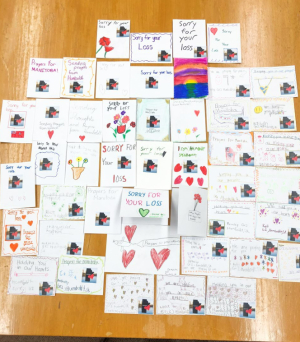
When Christine Letain went to pick up the mail for St. Viator’s parish last week, a special surprise was waiting for her.
“There was a package containing a letter from St. Dominic’s School in Humboldt, expressing their sadness and their condolences to the community, as well as Grade 2 and Grade 6 students made up a bunch of cards with messages on them saying they’re praying for us and they’re sad,” Letain said. “I just thought it was something really special, especially coming from Humboldt.”
The letter contained in the package read:
To the Community of Dauphin and the Surrounding Area,
We are deeply saddened by your recent tragedy and would like to offer our sincerest condolences on the loss of 16 community members. We continue to offer up our prayers for the 16 souls, their loved ones, for the injured and for all the people who have helped and continue to help moving forward. Please accept thses cards and distribute as you see fit as a reminder that we stand with you in your time of immense sorrow.
Much love and hugs from, St. Dominis School Students and Staff, Humboldt, Saskatchewan
_____
Right now Letain is trying to determine the best way to share the cards and the letter with the community at large.
“This isn’t just a message for St. Viator’s, it’s for the entire community” Letain said, adding the parish will try to determine the best way to share the messages with Dauphin residents.
“Right now I’ve just got them all here at the church. We actually have a funeral here on Saturday for one of those victims and so I thought it might be kind of nice if (the cards) are here for them to see. But after that I have no idea what to do with them.”
Tender issued for Main Street South reconstruction project

The tender for the $13.5 million Main Street South reconstruction project has finally been issued.
The province called for proposals for work on PTH 5A, the main access into the City of Dauphin from the south, as a result of expanded commercial development along the route which has brought with it increased traffic volumes and higher collision rates.
The 1.7-km project covers a section of PTH 5A from Whitmore Ave., south to Triangle Road, and includes surface reconstruction with the creation of a divided highway.
The plans call to improve safety in the commercial area by having all local accesses connect to service roads, and service roads connecting to PTH 5A at upgraded intersections. Those service roads will be constructed along both the east and west sides of highway from their existing points south to Triangle Road.
As well, a new intersection allowing access to Dauphin Market Place Mall will be developed, complete with traffic signals.
Improvements and restorations to the road will benefit the community and the region by enhancing safety and traffic flows along the high-volume, main thoroughfare that is an integral trade route to economic development in the area.
Included in the project is a new drainage system design for the south end. The plan includes the digging of two retention ponds, one on each side of the highway, which will collect spring runoff, as well as runoff from major weather events.
“They’re slow releases. So the intent is that they actually run dry in the summer months, or during drier times, but be able to fill up again in a big event,” said Mike VanAlstyne, director of Public Works and Operations, adding the installation of 830 metres of storm sewer pipe below ground is also included in the drainage plan.
“It’s a big project that’s very complicated, but it’s not really. It’s moving water from one place to another, where it wants to go. But just moving it on your timeline not nature’s.”
The cost of the drainage system has been pegged at $8.15 million which the city will debenture through the province.
The original plan called for a project extending over two construction seasons with the bulk of the construction work taking place in year one and the finishing touches being added early in the second year. That is obviously no longer the case, VanAlstyne said.
“The hope is that it would (start) this fall, or say late summer if it’s September. Construction would end next August,” VanAlstyne said, adding while the project was originally slated to begin this spring, the delay is not as bad as it might seem. “Not terrible. There’s a pretty aggressive work schedule tied to it.”
The issuing of the tender also clears the way for another long-awaited project as earth excavated to construct the retention ponds, or a portion of it anyway, will be used to construct the toboggan hill at Maamawi Park, VanAlstyne said.
“Approximately 25 per cent of the excavation material is going (to the development on the Dauphin Recreation Services grounds), the remainder is going elsewhere,” VanAlstyne said, adding the drainage project is going to produce about 30,000 cubic meters of excavation material. “These are big retention ponds.”
Final touches put on weekend rodeo plans

The Fair and Rodeo grounds in Gilbert Plains will be a beehive of activity this week as Gilbert Plains/Grandview Agricultural Society volunteers prepare for their annual Fair and Rodeo, July 14 to 16.
“We’re going to be at the grounds starting to set everything up and any evening next week, if there’s any volunteers that want to come out, there will be stuff going on every evening,” society president Kevin Boese said. “Setting up tents and getting things cleaned up and ready to roll.”
Boese said new this year there is three full days of chuck wagon racing with races getting under way Friday evening and continuing Saturday and Sunday afternoons.
“When the chuck wagons association goes around, they like to set up and be there for three days and there’s lots of places that they don’t do that. So we just wanted to give it a try this year and I think it should be a good success,” Boese said adding the races add another element to the first day of the exhibition.
“We have the parade Friday afternoon and Friday evening there was never really much going on. Everybody was in town already anyways for the parade, so we figured why not have chuck wagons on Friday evening and that gives something else to do.”
On top of the parade at 3 p.m. and chuck wagon and chariot racing at 7 p.m. Friday attractions feature a light horse show beginning at 11 a.m., a petting zoo from 4 p.m. to 7 p.m. and a beer gardens featuring an open mic opportunity at 4 p.m., a DJ beginning at 9 p.m. and karaoke.
On Saturday things get underway with a pancake breakfast at the Lions Club booth at 7 a.m. followed by slo-pitch and the light horse show at 9 a.m.
A trade and craft show kicks off at 10 a.m. as does a show and shine car show.
“Last year there wasn’t a lot of cars, however, we’ve had lots of interest this year, so we’re hoping for a lot bigger show this year,” Boese said. “We thought bringing that in would maybe bring a little different crowd than the agricultural stuff.”
Kids activities such as the petting zoo, face painting and the Kinds Zone run all day , as does the Kids Sand Pile under the Fusion Credit Union Tent where youngsters can bring a shovel and dig for buried treasure. A kids tractor pull takes place on the tennis court at 12:30 p.m.
At 3 p.m. those in attendance will be treated to something completely new when the Truco Trick Riders perform some amazing feats on horseback, Boese said, adding the group will perform again at halftime of the rodeo along with the popular Wild Pony Races.
“We had a few people commenting that there just wasn’t much going on at a half times, so that’s why we’re bringing in a little bit of entertainment for the halftime show,” he said. “I can’t remember anything like that ever being (at the rodeo) since I’ve been involved. That should be very entertaining. They should put on a really good show.”
Chuck wagons and chariots get back in action at 3:30 p.m. with a special Redneck Farmer Challenge scheduled for halftime. The competition will see teams of three people attempt to complete a series of farm chore related tasks in a timed event.
“We’re hoping to get four teams. We don’t have any time teams signed up yet, but we haven’t actually done a whole lot of advertising,” Boese said. “It can be anybody, it doesn’t matter who or what age. There’ll be some laughs involved in that, that’s what that one’s all about.”
Rodeo action gets underway at 7 p.m. and the day wraps up with a Party in the Dirt featuring After Dark Xtreme.
Things get going again early Sunday with rodeo slack taking place from 8 a.m. to noon, if needed.
Slo pitch, the light horse show, petting zoo, face painting, Kids Zone and Legion bingo are all back operation and a church service and free pancake breakfast are scheduled for 9:30 a.m. Donations are welcome.
Chuck wagons and chariots get underway at 1 p.m., followed by a gymkhana at 2 p.m. and the rodeo at 4 p.m.
It is a full weekend that would not be possible without the hard work of volunteers and the support of sponsors and the community at large.
“It costs a lot of money and a lot of man hours to put these things on. Way more than the average person ever knows and way more than I ever knew before I started helping with this,” Boese said, adding it is all worth it when you experience the final product.
“I think it’s going to be a great show there’s going to be tons of stuff. There’s a little bit of something for everybody. If you can’t find something to do there, you might as well just stay home.”