


Shawn Bailey
Local historians honoured for their efforts

Two Parkland residents have been honoured for their commitment to the preservation and promotion of local history and heritage.
Edward Stozek of Dauphin and Josephine “Jo” Bunka of Winnipegosis were both recipients of the The Lieutenant Governor’s Award for Historical Preservation and Promotion, during a ceremony at Government House, last week.
The award, initiated in 2011, is presented in consultation with the Manitoba Historical Society (MHS) to people who have rendered prolonged, meritorious service in the preservation and promotion of Manitoba’s history and heritage.
The awards are presented annually in a ceremony at Government House around Manitoba Day in May.
“The individuals selected to receive awards this year represent the many dedicated individuals throughout Manitoba who take such care in preserving and promoting this province’s rich and vibrant history,” Lt.-Gov. Janice C. Filmon said. “Whether through stewardship of the province’s historic buildings, museums and archives, the writing of books or creating programs to engage and inspire future historians, these outstanding Manitobans care deeply about the communities in which they live. It is a pleasure to recognize their efforts and achievements.”
A retired high school history teacher turned newspaper columnist, musician, and filmmaker, Stozek is active in promoting local history in the region. Stozek has authored three books to his credit including The Sawmill Boys, P.O.W.’s and Conscientious Objectors: Stories from the Parkland as well as A Slice Of The Parkland and Triumph And Tragedy From The Heart Of Manitoba. For more than a decade, Stozek has also contributed a biweekly column to the Dauphin Herald, “A Slice of the Parkland”, which earned him the Wes Rowson Memorial Award as Best Columnist from the Manitoba Community Newspaper Association.
Stozek has also produced four documentary films for MTS Television’s “Stories From Home”, serving as writer and narrator, on subjects ranging from German POWs in Riding Mountain National Park to Ukrainian settlers around Olha, Man. His films have been screened at Dauphin Culture Days, Dauphin’s Countryfest, Riding Mountain Film Festival and The Bend Theatre at Strathclair, Man. In addition, Stozek writes and performs original songs about Manitoba history at schools and public events, and is an active board member with Fort Dauphin Museum.
“I was really excited to have gotten the award. It was kind of a surprise,” Stozek said, adding he does not know who nominated him for the honour. “I feel honoured that I have received the award. All of the years of researching and doing the documentaries for the love of preserving the past.”
For Stozek, the ceremony, which included the presentation of the award and a luncheon, in the historic setting of Government House, was a highlight.
“It was just an amazing evening for me anyways because of the formalities and the governor’s house is sort of steeped in history, too,” he said, adding he was able to share the occasion with six guests. “I was kind of in awe of the building itself inside with all of the paintings and the tapestries. It was a really exciting evening. The Lieutenant Governor, she was a very hospitable host and very easy to talk to.”
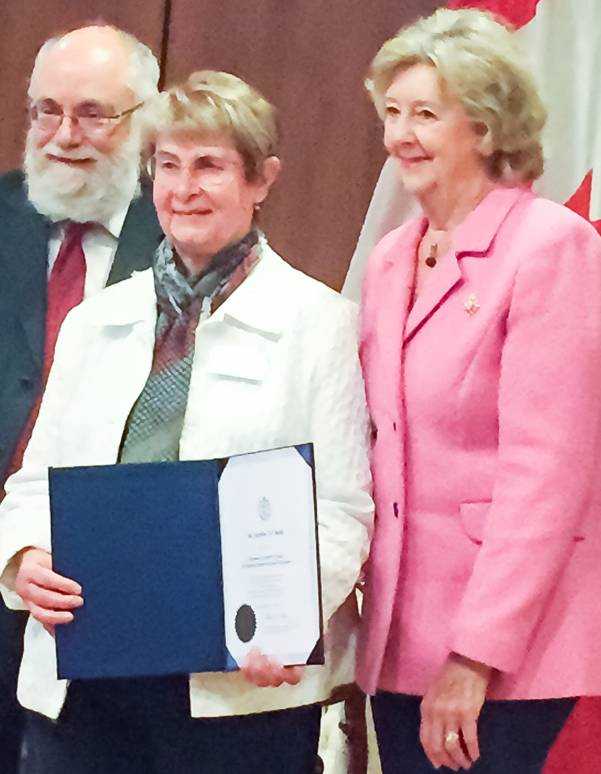
Also a retired school teacher, Bunka is currently the curator and president of the Winnipegosis Historical Society (WHS) and has been a tireless volunteer for many years. Her museum duties are diverse, ranging from the organization of tours to the hiring of summer students to the acquisition of grants to managing the museum’s Facebook page and its weekly blog entries. An indication of her dedication to the north Parkland’s history, to better curate and care for the museum’s artifacts, Bunks received training from the Association of Manitoba Museums. Bunka also presently serves on that organization’s board as one of two Parkland regional councillors. The association has also recognized Bunka with two Awards of Excellence.
In addition to her duties with WHS, Bunka mentored a community group, which in 2015, compiled the history book More Reflections from Little Muddy Waters: A History of Winnipegosis. Right from the initial call from Filmon to the ceremony at Government House, Bunka has been overwhelmed and humbled by the award. It is an honour she believes belongs to the WHS as a whole.
“This award, though it came to me personally, I sincerely believe it belongs to the Winnipegosis Historical Society board,” Bunka said. “I have been with them since 1985 and working together we have been so fortunate. We have preserved two marvelous buildings that are now our museums, the CN Station and the Medd House.”
To be honoured for something she loves so much is almost surreal for Bunka.
“I am passionate about history and I have made it something that I have always been involved in. It comes from my own family. I grew up in a family that tells and retells its history and stories,” she said. “I know that I am passing it on to my children and grandchildren because it is part of me, wanting to preserve that history.”
And the Parkland has a rich history that is being preserved by dedicated individuals for the future, so people can get a real sense of where they come from, Bunka said.
“I look at what Ed has done and it is just marvelous. What a talent to be able to preserve the written stories. And what I am trying to do is also preserve the stories, but it is artifacts and photos and research papers and those types of documentation,” she said. “We have such a strong Indigenous story here and we are fortunate that we have been able to work together and preserve that story.”
Like it was for Stozek, Bunka found the ceremony at Government House a highlight of the whole experience.
“Seeing the Governor’s house, 1883 it was built. I wanted to explore every nook and cranny. I was so excited. It had a beautiful curved staircase. I knew I couldn’t go up it, but I was dying to,” Bunka said, adding she invited fellow WHS board members Loretta Dyck, Terry Wood and Ruth Wright to be part of the evening, along with colleagues from the Association of Manitoba Museums. “The ceremony was beautiful. Her Honour was so gracious. She made us feel at home in her home. She spoke from her heart and truly I felt she was honouring us in such a kind and thoughtful way. Having the president of the Manitoba Historical Society there, Gordon Gouldsborough there really added to the ceremony. I was just so overwhelmed.”
The Manitoba Historical Society (MHS) receives award nominations from the public and recommends up to three people to receive awards each year. Nominations are welcome at any time. This year, Elva Simundsson of Gimli was also honoured with an award.
Further details of the award program, along with a nomination form are available on the MHS website at www.mhs.mb.ca and can additionally be accessed through the website of the lieutenant-governor at www.manitobalg.ca.
Imagine

Students a Ecole Macneill spread a message of love and peace to an appreciative audience during a noon hour performance to mark Music Monday, Monday.
Students from Kindergarten to Grade 5 performed a variety of songs including “Imagine” by John Lennon and “Blowing in the Wind” by Bob Dylan.
A silver collection was accepted prior to the performance with proceeds earmarked for the Parkland Ukrainian Family Fund.
First Ukrainian families arrive
The first three families from Ukraine to be sponsored by the Parkland Ukrainian Family Fund have arrived in Dauphin.
Two families arrived last Tuesday and the third on Wednesday, said fund founder and member Don Tarrant (Right). All three, he added are comprised of mothers and their children as the fathers are all still in Ukraine fighting with the country’s armed forces.
“They just said whenever the war is over they’re going to come, but right now we don’t know when that will be,” Tarrant said. “What we’ve done is they’ve gone to local families for a few weeks here to get them integrated. They have to get the kids in school and get their medical stuff up to date. We’re going to have a session about meeting employers, getting skill levels figured out, getting their language levels figured out. This is where the (local) families are trying just to get them settled properly.”
Tarrant expects the families, who are all planning on staying in the area permanently, will be in their own homes by the end of the month.
Get all the info in this week's Dauphin Herald!
City waiting for word on province’s one-time road repair funding
While the details are few, the City of Dauphin is expecting to receive somewhere around $90,000 under a one-time provincial grant program aimed at road rehabilitation.
Premier Heather Stefanson announced $15 million will be distributed on a per capita basis, providing municipalities with financial support for road reconstruction, rehabilitation and preservation projects.
“Manitoba municipalities are facing significant road infrastructure challenges as a result of this year’s extraordinary weather conditions,” Stefanson said. “Above-average precipitation and colder-than-average temperatures have caused a substantial increase in the number and severity of potholes on roads throughout the province, and inflation and supply chain issues have also added to this challenge. In addition to our Budget 2022 investments in highways and municipalities, we are pleased to offer this extra support to reduce the financial burden.”
As part of this grant program, the province will distribute the pot of money to all of Manitoba’s 137 municipalities on a per-capita basis, with the City of Winnipeg to receive nearly $9 million of the total.
Get all the details in this week's Dauphin Herald!
RCMP report drop in calls for March
The Manitoba RCMP West District saw a year-over-year decrease in calls for March according to statistics released last week.
The district, which includes Dauphin, reported decreases in all main categories.
The following sub-category increases and decreases were highlighted by police:
• Common police activities - This category had an overall decrease of 19 per cent, from 569 calls in 2021 to 459 this year. The largest decreases was in suspicious people, vehicles or property, which dropped from 232 calls last year to 158 this year, a drop of 32 per cent, and breach of peace, which was down 33 per cent from 146 calls to 98. Wellbeing checks were up from 67 calls last year to 83 in 2022, an increase of 24 per cent.
• Crimes against the person - Overall, the category decreased from 381 calls for service last year to 346 this year, a drop of nine per cent, with a 15 per cent decrease in assaults, which were down from 232 to 198.
• Crimes against property - The category had a minimal decrease overall from 550 calls in 2021 to 547 calls this year, a drop of just one per cent. Theft under $5,000 increased from 112 requests for service to 136, an increase of 21 per cent, and fraud increased from 64 calls in 2021 to 71 in 2022, a rise of 11 per cent. Theft over $5,000 decreased from 42 to 29, a drop of 31 per cent.
• Drug enforcement - Overall drug enforcement decreased from 62 calls last year to 34 incidents this year, a drop of 45 per cent, with a notable decrease in trafficking, which was down from 42 to 17, a drop of 60 per cent.
The Manitoba East District also reported an overall decrease in incidents for March, dropping 13 per cent from 6,607 calls in March 2021 to 5,722 this past March.
The Manitoba North District, however, reported a 14 per cent increase in call volume climbing from 5,590 last year to 6,399 this year.
Main Street project moved up by a year

In its recently released budget, the Province committed $1.5 billion for a three-year highways strategy that invests in infrastructure across the province and Premier Heather Stefanson and Transportation and Infrastructure Minister Doyle Piwniuk were in Dauphin yesterday to announce how the City fits into those plans.
Specifically, Stefanson announced the $13.5 million redevelopment of Main Street South has been fast tracked and will be completed this year.
“Manitobans have told us they want safe roads and reliable infrastructure and we are listening and we are acting,” Stefanson said. “Collaboration with the City of Dauphin over the past several years has been instrumental in realizing this project. Resurfacing and dividing the road along with upgrading service roads and installing traffic signals will ensure that Dauphin can continue to expand its economic activity and host future celebrations which we look forward to attending in person.
“We are excited for this important work to begin this year.”
PTH 5A serves as the main access into the City of Dauphin from the south. Expanded commercial development along the route has resulted in increased traffic volumes and higher collision rates. Improvements and restorations to the road will benefit the community and the region by enhancing safety and traffic flows along the high-volume, main thoroughfare that is an integral trade route to economic development in the area, Stefanson said. The 1.7-km project covers a section of PTH 5A from Whitmore Ave., south to Triangle Road, and includes surface reconstruction with the creation of a divided highway. The plans call to improve safety in the commercial area by having all local accesses connect to service roads, and service roads connecting to PTH 5A at upgraded intersections. Those service roads will be constructed along both the east and west sides of highway from their existing points south to Triangle Road.
As well, a new intersection allowing access to Dauphin Market Place Mall will be developed, complete with traffic signals.
“Manitoba Transportation and Infrastructure has been working in collaboration with the City of Dauphin and its officials for several years to finalize the design concept and details to ensure the project meets the needs of the community,” Piwniuk said, adding the $1.5 billion for highways was part of an overall $2.4 billion in infrastructure funding announced in the budget. “We look forward to strengthening our partnerships with communities across the province by investing in long-term strategic goals to build the foundation of Manitoba’s economic growth through trade and commerce infrastructure.”
With the work originally being slated for 2023, Piwniuk said the province found itself in a position to be able to move the Dauphin project up the schedule and jumped at the opportunity.
“In our infrastructure investing we want to make sure we do it right across the province. And so we moved it up to make sure the work gets done now that we have a larger budget to work with,” he said. “We have a 10-year plan and we want to make sure we can move this project forward.”
For mayor Christian Laughland, having the project completed a year early just means all the benefits will be enjoyed sooner.
“This is great and exciting news for our city. The improvements made to PTH 5A will help improve the flow of traffic in the south end and make things safer for not only pedestrians who work in the area, but drivers going to and from our local businesses,” Laughland said. “We also look forward to the impact these changes have when it comes to economic development in our community.”
Those benefits are extremely important for the community and will help drive economic success well into the future, Dauphin MLA Brad Michaleski added.
“This is a project that is important for Dauphin and it has been on the radar for a long time to get done,” Michaleski said. “We appreciate the premier and minister Piwniuk for attending here today.”
The province will advertise the tender for the project by the end of May. The work is anticipated to be completed before 2023, in advance of Dauphin serving as host community for the 2024 Manitoba Summer Games.
Prov.’s pilot project supports safety
Dauphin is claiming a share of $1.3 million earmarked to help communities identify priority areas, develop safety and wellbeing plans and implement trhos strategies.
The province announced the Community Safety and Well-Being (CSWB) Planning Pilot Project, which will be run in 12 Manitoba communities, late last week.
Dauphin mayor Christian Laughland said the program is still in the early stages, making it difficult to say exactly how it will roll out.
“Any time you can get a significant amount of money towards a pilot project like this from the province it is obviously a good thing and this is something that we have been building towards for the last couple of years, so it is exciting from that perspective,” he said. “We are looking forward to being able to do it and make our community safer because of it.”
Get the full story in this week's Herald!
Modest mill rate rise in City budget
After two years of consecutive decreases Dauphin ratepayers will see a modest increase in the mill rate charged against their properties this year as city council approved its 2022 budget Monday evening.
As it did last year, council used the funds remaining from a federal restart grant received in 2020 to lower the amount raised by taxation by $200,000. That amount still represents a 1.6 per cent increase over last year’s numbers.
In the end the increase in the mill rate from 18.039 in 2021 to 18.332 in 2022 will raise $6,382,457. That increase means a residential property will pay $9.58 more per $100,000 of assessed value while commercial properties will pay $6.99 more per $100,000 of assessed value.
When income from other sources such transfers from reserves. taxes added, business licenses, the provincial municipal operating grant, provincial public safety grant and other federal and provincial grants are factored in, the City will have just under $12.5 million to support its operations this year.
In presenting the financial plan, city manager Sharla Griffths said the budget supports a continued level of spending on municipal infrastructure such as roads, sidewalks, and water distribution and no program cuts.
“This year’s budget was very tough to set, as council’s directive was to hold the line at the 2020 tax level and then reduce it by $200,000 and take that money from reserves that we got from the federal government. However, there are many expenditures in 2022 that were unforeseen and unavoidable. Some of them are higher than anticipated RCMP retro pay and wages. very high snowfall in 2022 already and we don’t know what is coming in the fall. There is a reduction in our taxes added in 2022 due to a slowdown in development. There is an increase in the requirement for airport funding this year and, as everybody is feeling, there is a significant increase in the cost of fuel and natural gas,” Griffiths said. “We are very fortunate that council’s directive could be met by drawing from our reserve funds. That being said, council is drawing wisely and responsibly from the reserves to ensure financial stability and security into the future.”
In the general fund most budget areas will see increases, Griffiths said.
General Government Services has been set at $1,426,030, an increase of 7.5 per cent, while Protective Services is set at $3,564,549, an increase of 14 per cent and Transportation Services is set at $1,865,058, an increase of 5.51 per cent. Environmental Health has a budget of $1,013,638, an increase of 0.25 per cent, Environmental Development Services is set at $293,981, an increase of 32.61 per cent, Recreation Cultural Services increases 1.1 per cent to $2,005,800 and Public Health and Welfare Services remains unchanged at $33,749.
Economic Development Services – was the one budget area to decrease, dropping 19.07 per cent to $413,192.
Planned General Fund capital expenditures and reserve transfers $4,478,506, an almost $1 million increase in capital projects and reserve transfers over 2021.
In the Utility Fund water revenue has been budgeted at $2,383,737 and wastewater revenue is estimated at $647,608.
Operating expenditures on the water side has been set at $2,025,101, an increase of 8.45 per cent. The increase is due mainly to due to wage increases, routine water system assessment report, work on the agreement with RMNP with regards to the Edwards Lake water source, and water main breaks.
Operating expenditures on the wastewater side have been set at $398,675, a decrease of 4.46 per cent due to less required maintenance this year.
Planned capital expenditures in the Utility Fund total just over $2.3 million.
More information on the budget can be found in next week’s Dauphin Herald.
Helping out
Representatives of the Parkland Ukrainian Family Fund and the Armstrong Family stop for a picture after discussing the Armstrong’s donation to the fund-raising drive to relocate families from war-torn Ukraine to the Parkland.
For those arriving in Winnipeg from Ukraine, the Armstrongs will provide lodging at the Best Western Plus Hotel in Headingly and following the trip to Dauphin will provide lodging at the local Super 8 Hotel.
“When they get to Winnipeg it shows them that somebody cares and when they get here it shows them that somebody cares here, too.
It was just the right thing to do,” Harvey Armstrong said. As well, through their Dauphin Decorating business, the family is providing materials for renovations and upgrades to the homes in which the relocated families will be living.
Pictured, from left, are Don Tarrant and Larry Hyrtsay from the Parkland Ukrainian Familty Fund, Laurie Armstrong, Harvey Armstrong, Christine Armstrong, Cory Armstrong, Hayden Armstrong and fund representative Jim Perchaluk.
Fire chief hopes to attract recruits
Dauphin Fire Department is hosting an open house in the hopes of bolstering its ranks.
“We are currently recruiting new members for Dauphin Fire Department and we plan on having an open house on Wednesday, May 4, which also happens to be International Firefighters Day,” Dauphin fire chief Cam Abrey said, adding the department is down six members from a full complement and has just recently lost three firefighters, two of whom left the community and one who decided firefighting was not a good fit for them.
“So we are doing a big push to try and get some new members on board.”
With a staffing shortage, extra pressure is put on existing firefighters, from covering for those exhibiting symptoms from illness to making sure the community is protected year round.
Get the full story in this week's Dauphin Herald!