
The community of Benito has had an excellent start to the new year. While most small town rural municipalities are struggling with infrastructure, dwindling population, services and businesses, Benito seems to be an inspiration.
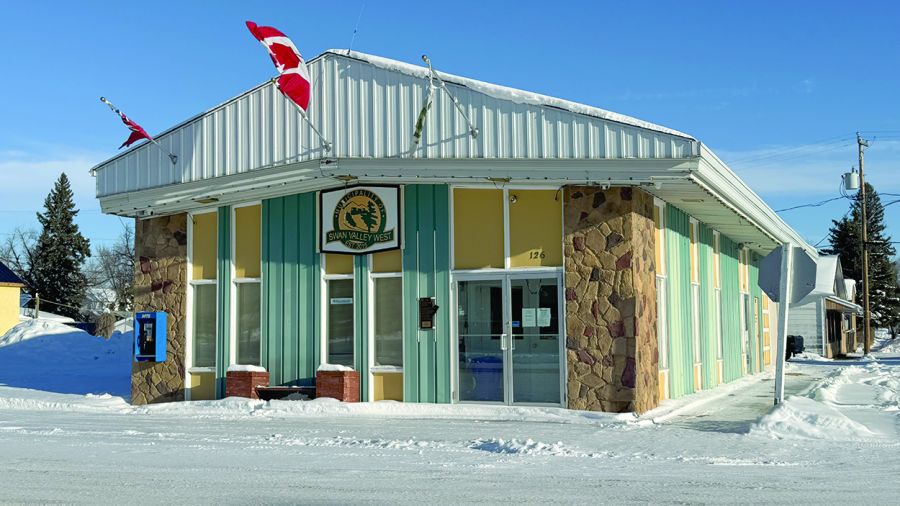
Earlier this month, the Municipality of Swan Valley West (MSVW) announced it would be reopening the municipal office in Benito. This would allow ratepayers in Benito to pay their water and tax bills, as well as have an in-town point of contact for anything municipal-related.
“This has been on our radar for three years now,” said MSVW Reeve Bill Gade. “After the election, we talked about it and it was put on a list of things we wanted to see happen, but we weren’t sure how. We didn’t want to just open an office for the sake of opening one; we wanted it to be open for a reason. It’s easy enough to hire someone to sit there, but what do they do all day? There had to be more to it.
“We came up with some more work for that person to do, besides the municipal stuff. Water bill and tax payments, building permits and all the other municipal office-related stuff that were in place years ago will come back to Benito. The staff at the Benito office will also spend their time providing support to various committees in the Valley.
“The Swan Valley Planning District has no one to do the administrative work, so this person will be making the minutes and agendas for meetings, doing the bank deposits, checking the mail and paying the bills,” said Gade. “This kind of work will get farmed out to the Benito office to do, as well as assisting residents.
“The time that the administrative staff spends on committee work will be paid by all four municipalities, instead of just Swan Valley West. This means that the whole Valley is supported and I think that is a great thing. It’s easy to spend tax dollars and get nothing, so we want to make sure this isn’t a waste.
“For some people, it doesn’t matter, but for a lot of people in Benito, especially the elderly, they want to pay their bills in person and speak to someone,” said Gade. “We are hearing that people are excited for the return of the municipal office in Benito. Many have expressed that it’s nice not to have to drive to pay a water bill or mail in a cheque.
“The Benito office will be open three days a week. We will start from there and see how it goes. I think this is a doable thing. The hours will be 8:30 a.m. to 4:30 p.m., and it will be closed over the lunch hour. The person hired is currently undergoing training and we are estimating that the municipal office in Benito will be opened by the end of the month.”
Like other municipalities, Swan Valley West has been battling with aging infrastructure and the rising cost of replacing and maintaining it. Every municipality in Manitoba struggles with utilities, whether is managing or replacing them. All municipalities have been dealing with reading water meters and finding economical ways to collect that data and bill it out to users. The majority of municipalities in the province use Neptune to provide automated meter readings, but the cost of that has also significantly increased, but Gade has found an alternative method.
In the past, Benito, like other municipalities, paid once for the setup of the Neptune Water Meters, and was able to read the meters with no extra cost
“The current system we use to read water meters is not a bad one; it can do a lot of things,” said Gade. “Going back in time, municipalities bought a handheld device that they would use to read water meters and there were no fees or subscriptions bought to use it. A few years ago, there was an upgrade offered and Swan Valley West was hesitant at first. We felt that what we had was working fine and didn’t see the need to spend $8,000 to upgrade.
“Over time, the company was more adamant that we needed to upgrade and that if we didn’t do the upgrade, they would not help us if something went wrong. It was a matter of doing the upgrade or else. We agreed to pay $8,000 for the upgrade, with the hopes that we would get 20 years use out of it.
“The money was paid and we received a paid invoice that stated an expiry date on the subscription,” said Gade. “When we called for clarification to ask why there was an expiry date for a year from now, we were told that it was a yearly fee. Swan Valley West was not told it was an $8,000 yearly fee for this upgrade, so every year we would be paying that amount. The municipality tried to cancel it and the company would not do that. We didn’t want a subscription, so we told the company the moment it expires that our municipality wanted out of it.
“We were told that we would be the only municipality in Canada to cancel this contract because there was no way to read the water meters without this subscription. We just felt there was a more cost-effective method for this. Now the subscription does some wonderful things, such as reporting the water meter reading every three minutes. This would allow one to look at how much water is being used. It would let people know if there was a small leak detected through the water usage, which is pretty cool, but not worth $8,000 a year.”
This led to Gade relying on his background of tinkering with radio frequencies and finding a more affordable and accurate solution.
“We did our own experimenting and found out that for $63, we made our own device that read the water meter readings,” said Gade. “I used an antenna from a software-defined radio and programmed it to read the Neptune meters and have the reading ready for import into Munisoft.
“The way it works is that the Neptune meters have a battery in them that is good for 20 to 30 years, and it transmits a reading, with a serial number, and indicates if there is a leak happening. It always sends that information out through radio frequency. So if you have the equipment to pick that up and are within 1,000 to 2,000 feet of the water meter, you can receive that information.
“We connected this all to a laptop, and the higher I put up that antenna when driving around, the further it will pick up a reading,” said Gade. “I drove around and every time it picked up a water meter reading, it would beep. We were able to come up with a list ahead of time of the places that had water meters, so it would also show me which ones were not read. I would then drive closer to that location and wait to pick up the reading.
“We are getting a 100 percent read rate on the device we built, whereas with the other one, we weren’t getting more than 90 percent read rate with Neptune. Also, with the Neptune system, it was suggested to put their device on and have someone walk every street in town to get a reading. That would take a couple of hours. With this new device we created, we put it in the vehicle and drove around, and it took almost 40 minutes to read the entire town.
“Also, with the Neptune system, you have to tell it everyone’s water meter serial number, otherwise it ignores it,” said Gade. “So if there is a mistake in a meter serial number, it won’t pick it up, but this new one will.
“There is a new radio tower up in Benito and this summer, we are hoping to find a way to use it to report any water leaks. That is phase two. Right now, we just wanted to find a cost-effective way to read the water meters and we have done that.”
This innovative discovery has also caught the attention of other municipalities struggling with the same issue.
“We have had other municipalities reach out to us to borrow our laptop to try it,” said Gade. “There are other companies out there making water meters and systems to read them that are more in the $200 to $300 range, so we will look into those options as well. For now, we will continue use Neptune meters until they die out.”
Benito also caught a media slurry of attention with its proposal to sell the old M & M Café building $1.
“It was a nice restaurant and the problem was the CRA got involved,” said Gade. “Once they put a lien on it, it was pretty hard for anyone to fix that, except for municipalities. Municipalities have the ability to get rid of those leans, which is what we did. This all took some time and over that time span, there was a bit of damage that happened to the building.
“We could have fixed up the damage and tried to lease it to someone, or we could tear it down. Council didn’t want to put money into the building and no one uses it, but the other option of tearing it down would cost around $50,000.
“I asked council if they would allow me to see if I could try something different,” said Gade. “I asked if we could try selling it for $1, rather than the other two options, which would cost us money. Personally, I felt this could be done and I didn’t want to tear down another building in Benito. Council agreed to try it.
“We had to market this concept of selling this building for a dollar and in order to do that, we had to get the Winnipeg media interested. We had almost every major media outlet in Winnipeg publish a story about Benito selling a building for $1. In the promotion of these stories, it was talked about how Benito had a new splash park and new businesses starting up and the potential development of new lots. In each story that was run, it talked about Benito being a nice place to live.
“When I look at the coverage we got from that, we got about $100,000 worth of free advertising from that for Benito,” said Gade. “Plus, we got applications from several places to purchase that old restaurant building for $1. Some were from Winnipeg and all over, and we even had a few come and look at it.
“We had Stuart Matheson from The Pas, come and check it out. He had this idea to do a cricket farm with a pet supply and food store. It would be one equivalent full-time job to run this place. In the end, we have a new business being established, created a full-time job in the community, sold the building for $1 and it will generate revenue and tax revenue for the municipality. This was a win-win-win situation.
“Now we have the media doing follow-up stories on this transaction and saying what a wonderful place Benito is,” said Gade. “I can’t imagine what the cost would have been to put that kind of advertising out there.”
Municipality to reopen Benito municipal office
Published in Swan Valley Star and Times Community
Published in
Swan Valley Star and Times Community
Tagged under
