

Mayor-elect eager to get to work
After a hard fought and heavily contested campaign the City of Dauphin has a new council in place to guide it over the next four years following polling in Manitoba’s General Municipal Election, Oct. 26.
Headed by David Bosiak as mayor, the new council features incumbents Christian Laughland, Kathy Bellemare and Devin Shtykalo, who will be joined by newcomers Steve Sobering, Randy Daley and Ted Rea.
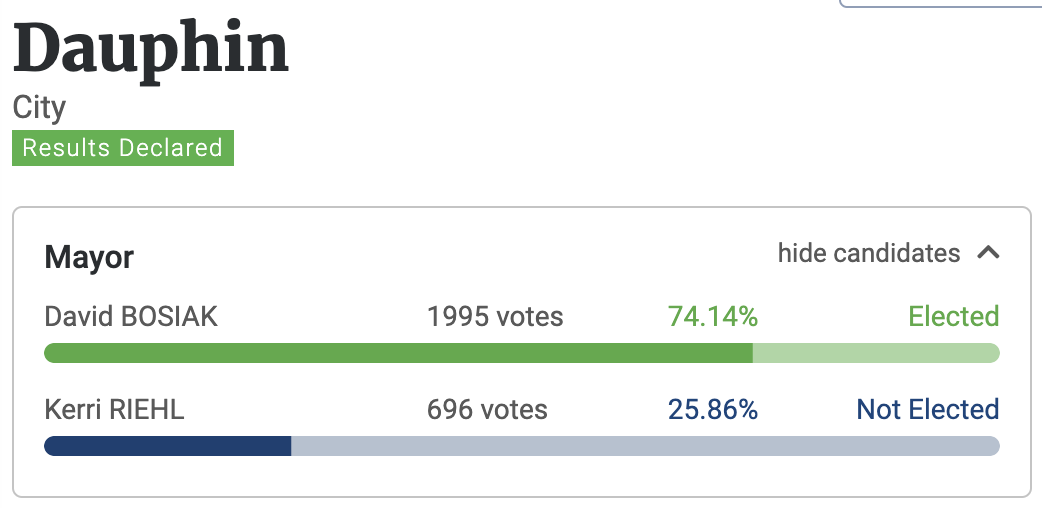
Bosiak earned the mayor’s chair by claiming 74.14 per cent of the popular vote, a total of 1,995 votes to defeat former councillor Kerri Riehl, who earned 696 votes.
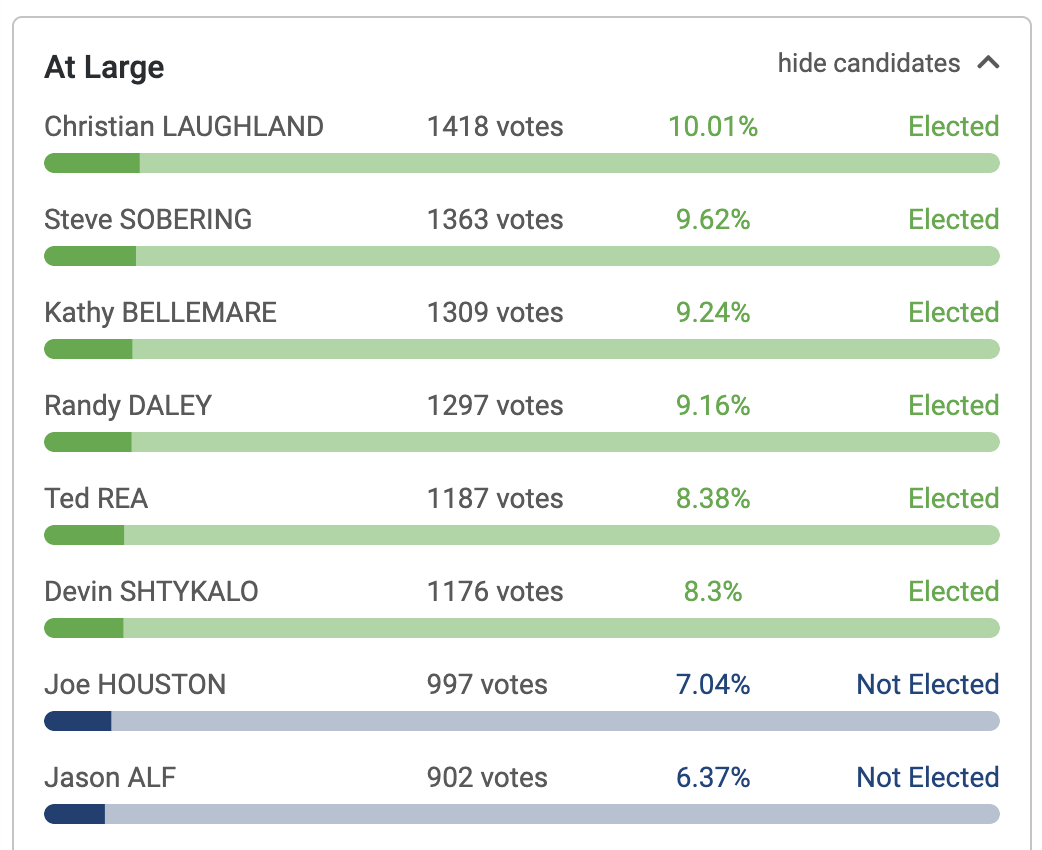
Laughland topped a field of 17 candidates vying for six council positions with 1,418 votes, followed by Sobering with 1,363 votes, Bellemare with 1,309 votes, Daley with 1,297 votes, Rea with 1,187 votes and Shtykalo with 1,176 votes.
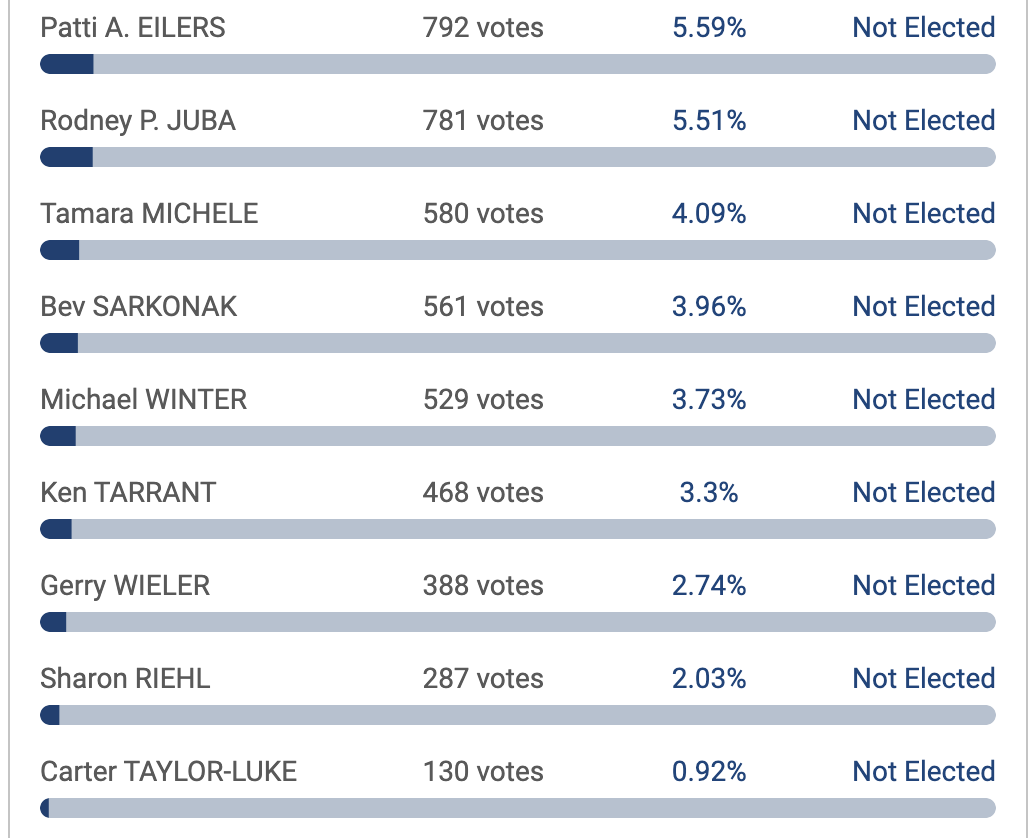
Unsuccessful in their bids were Joe Houston, who earned a total of 997 votes, Jason Alf with 902, Patti A. Eilers with 792, Rodney P. Juba with 781, Tamara Michele with 580, Bev Sarkonak with 561, Michael Winter with 529, Ken Tarrant with 468, Gerry Wieler with 388, Sharon Riehl with 287 and Carter Taylor-Luke with 130.
The results, Bosiak, said, fit perfectly into his philosophy about bringing good people together and getting out of their way to let them do their thing.
“When you look at who was elected and their strengths and backgrounds and interests, it so well represents what I think we need to do as a community going forward,” he said. “There were others who didn’t get elected who I thought could have done a great job, but the six who did are exceptionally talented and motivated and positive thinkers. And it bodes well for us going forward.”
Eager to get started, Bosiak has already met with senior administration at city hall and has been in contact with elected officials in other area municipalities.
“I talked to a few other elected people from a few other municipalities who congratulated me, and I them. And we talked about working together as a Parkland region on a couple of things, which again just bodes well, I think,” Bosiak said, adding he is sensing an air of optimism after two years of pandemic restrictions. “I think everybody just paused during COVID, especially us with the two former mayors and the untimeliness of their passings and how that impacted us as a community. But I think that everybody is ready to move on.”
We do have to keep in mind that COVID is still with us and could once again threaten public health, we just have to be ready to deal with it, Bosiak said.
“We can’t lose sight that we are still dealing with something big, but that we are moving on and we are learning how to live in our new reality,” he said. “And I think that is a key piece of this. The pause that we had during the beginning of the pandemic, I think, is done, but us now going forward it is something we have to consider. And again, I think that the mandate we have got reflects what the community thinks, let’s think about the community and what is important to us.”
Forty-four per cent of eligible voters came out to cast a ballot, which Bosiak believes signals an optimism in the community and the desire to see positive things happening.
“Some of my shtick about forward together and us together as a team manifested. It was destiny, karma, whatever you want to call it, it’s the truth,” he said. “The resounding turnout was nice to see. The notion that people paid attention. A lot of people were not vocal about it, but they voted with their feet. They showed up and I am humbled by the support and ready to work.”
Bosiak is aware that expectations are high, his included, and he is going to remain cognizant of that and try to temper that enthusiasm.
“And ensure we are focused and, like we have done in the past, we develop priorities and pick them off one at a time,” he said. “We work on more than one at once, but we can’t do it all at once, We will understand that process and move forward.”
His goal is to eliminate that attitude that “this is Dauphin, it will never happen here, it can’t happen here.”
“Oh, yes, it can. So in the realistic sense, and it is not like we are going to shoot for the moon, but we are going to chip away and with a positive outlook on things,” Bosiak said.
There is lots of issues for the city to deal with, Bosiak added, and not all of them are favourable and positive.
“But I think the approach we will take in dealing with them is all positive. What good can come out of this? What can we do with this challenge to turn it into an opportunity or a benefit for us? So I think if there is nothing else that I am so enthusiastic about, is the approach we will take to deal with the issues facing us,” he said. “So I am just really excited, enthusiastic and motivated. I have already talked to all of the council members who got elected and we are all happy to be working together.”
City & RM Elect New Councils

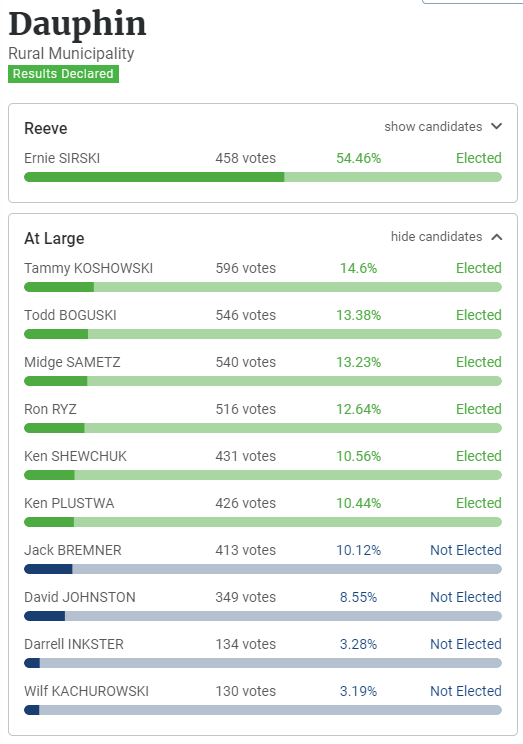
Both the City and RM of Dauphin have new leadership.
Below are the results. Be sure to check next week's Dauphin Herald for plenty more!
OTHER PARKLAND MUNICIPALITIES


Infrastructure at the top of the list for municipal representatives

For the final instalment of our mayoralty candidate series the focus shifted to infrastructure, which is perhaps the most important responsibility for a municipal government.
We asked, “From buildings and facilities to sidewalks, roads and the systems buried beneath them, infrastructure is arguably the most important responsibility of a municipal government. Where does infrastructure sit in your list of priorities and what plans do you have to drive maintenance and renewal of existing infrastructure along with additions to the City’s list of assets?”
Below are their answers. Remember to get out and vote on Oct. 26.
David Bosiak
Infrastructure affects people’s lives every day. It is the literal foundation we build our community on. We drive and walk on it. We turn on our taps, we flush our toilets, we play in our recreation facilities and our parks. We expect our infrastructure to meet our most basic needs. As such, it is the most important responsibility of a municipal government.
The City is well positioned to deal with the ongoing challenges of managing and operating our different types of infrastructure. This is primarily due to our current financial position of little debt, healthy capital and utility reserve funds, and the relatively good condition of much of our visible infrastructure. We don’t want to “get behind the eight ball” and constantly be trying to catch up, though. We need to make smart investments in our infrastructure and ensure it is keeping pace with our ever-changing needs.
One specific action that I will encourage new council and staff to address is our capital asset management plan. An asset management plan is used by municipalities to determine the life cycle management of its major infrastructure and provides an outline for infrastructure and equipment upgrades and/or replacement. It generally allows a municipality to ensure it has the resources and timeline to replace infrastructure when necessary and to keep the city operating in the most effective and cost-efficient manner possible.
An effective asset management plan helps save the city money. Major breakdowns usually have a ripple effect causing costly disruptions to city services and operations. A well executed plan avoids these situations by making sure the city’s infrastructure is in good working condition.
I will ensure that new council puts review of the plan at the top of our priority list. We need to keep it a relevant, current template that guides our city in making the appropriate repairs, upgrades and replacements at the most cost-effective time with the least disruption in service.
Adhering to a well-developed plan will allow us to regularly review our priorities, and measure them against grant opportunities from other levels of government. We must further ensure efficiencies found in sustainable development initiatives be maximized. Inputs from council as they meet with community members must be communicated effectively to administrative staff and vice versa. We have to continually revise and update this plan – and use it to guide our annual capital budgeting process.
Much of our city infrastructure is visible, and most of this is in reasonable to very good condition. The recent announcement of funding for upgrades to our lagoon suggests our sewage treatment system will have the capacity to serve the growing needs of our community for many years to come. We have a relatively new City Hall and our recreation facilities are in their “mid-life”, meaning they are in good condition but will require certain mechanical and system upgrades as they continue to age. Our public works shop is in relatively decent condition considering its age, but will require significant improvements soon. These issues must be identified in our plan and be addressed appropriately by council.
The city also has a considerable invisible network of infrastructure, most of it buried beneath our community. Some of this system consists of old and leaden pipes that need to be replaced or re-lined. Upgrades must be considered, which may ultimately save us money in the long run, as water main break repairs are a costly item in the city budget.
Can we do this all at once? Not likely. We have to be logical and plan, budget, execute, learn and focus on best practices. We will start this process by ensuring our asset management plan is current, and being used appropriately. We need to invest wisely.
If elected mayor on Oct. 26, I will ensure council and staff work together to provide citizens the best possible value for the infrastructure we all need, rely on and have come to expect from our great little city.
Kerri Riehl
We cannot move forward unless we have a solid foundation. There have been many changes within the last two years thrusting the city into an environment of great upheaval. Inflation is the highest it’s been since 1983. That changes every aspect of community and daily life for us all. Great change requires strategic planning. Once a strategic plan has been completed the next step is an organizational review. The City of Dauphin’s strategic plan was released in 2021 outlining goals and priorities to lead decision making between 2021 and 2024. The first goal of the strategic plan is a sustainable community. That encompasses everything mentioned in the question from buildings, facilities, sidewalks and roads.
The question is do we have the infrastructure planning, internal processes, analyses, and the blueprints for change in place? Have our priorities shifted since the strategic plan was developed? We can’t keep doing what we were doing two years ago. There have been drastic changes.
I was asked numerous times what I wanted to accomplish in my first 100 days as mayor, and this was my response. An organizational review. The city does a financial plan and a financial yearly audit. I don’t see that an organizational review has been completed. The two go hand in hand. The organizational review helps understand how work needs to be structured to achieve desired goals.
An organizational review is an assessment of jobs, tasks, and how positions are related and inter-related. It is a targeted effort to understand how work gets done now, what work is most important to accomplish, and how it may need to flow differently. It seeks to identify the levels and nature of the knowledge, skills, and abilities that the city has or requires if it is to match resources with priorities.
There are free resources to assist municipalities with an organizational review. The timing is right to view things with a fresh lens with the best and honest intentions. Any bias, positive or negative, must be parked. It is not an assessment of people or of their level of performance. It’s conducting a position analyses. This is not about targeting staff or reducing positions. It is about focusing the organization on excellence and the work and processes that support it.
For example, our roads and back alleys. They require maintenance and repair. We have excellent staff who can address this infrastructure. Is it finances? Do we have enough staff? Are there too many other critical priorities? Can we obtain services of other trades? Is it a lack of equipment? We have roads in town that are the province’s responsibility. These include River Avenue, Main Street, 2nd Avenue NW, and 1st Ave NE. The city is responsible for the parking lane and gutter. Imagine how that works for snow removal and the predicament this causes for our snow clearing staff. The snow piled in the middle of the road down Main Street is the province’s responsibility to remove. Is there not an opportunity to work with the province to address this which would facilitate a better solution for our city staff regarding snow removal? A win/win for both?
Some roads in town have a six-inch drop in pavement from the road to the gutter. Sidewalks need repair with large drops in some cracks. We need to consider mobility of our citizens. During a parade this summer a long-term citizen fell crossing the street from one side of the road to the other on Main Street. This individual tore their meniscus, hurt their shoulder and back. They still are receiving treatment 2-1/2 months later from infrastructure.
The city draft plan recently released has many great ideas and demonstrates a snapshot of where we are currently, and where they would like to go in the next 25 years. It doesn’t align with the cities’ first strategic plan’s goals that was completed a year ago. Does the strategic plan need to be redone even though it was implemented in 2021, or is this the new strategic plan?
Therefore, the organizational review is critical. It removes people and positions from the equation and identifies how to achieve goals. There has been a high level of staff turnover in key critical positions within city staff over the last four years. Mayor Irwin died in November of 2017. There will be four different mayors for the city in the last five years. We need consistency over time. At 54 years old, I am dedicated to seeing the long-term vision for Dauphin to become a reality. Change requires time.
We cannot blaze a path forward until we know where we are headed, how were going to get there, and determine if our current infrastructure can provide us with the solid foundation, we require to achieve our goals. How can we do better if we don’t know better?
I would appreciate your vote on Oct. 26. Thank you.
Sustainability is a key factor in decision making
With polling day just two weeks away, mayoralty candidates take a look at sustainability.
We asked the question, “Over the last number of years the City has undertaken development with eye towards environmental sustainability. Is this a focus you would like to see continue and what initiatives have you included in your platform to proceed down that path?”
Here are their responses.
Kerri Riehl
The current options and opportunities are limitless when it comes to environmental sustainability. We are fortunate to live in a time where sustainable development and environmental stewardship are being fostered by every level of government. Elaborate plans, and research is not required.
Endless grants and funding opportunities are laid out for us. We need to capitalize on these opportunities. There are many grants and incentives available through Efficiency Manitoba, (provincial), the Green Municipal Fund under the Federation of Canadian Municipalities (federal), the federal government and Manitoba Hydro.
The key is changing mindsets and getting “buy in” from the community including council. To me, public engagement means sharing a vision, sharing what the city of Dauphin is currently doing and engaging knowledge. Communication, and sharing of information is key. We have incredibly knowledgeable people in our community on numerous subjects, but we must be willing to invite them to participate.
I am fortunate to have the ear of a power engineer, a niece who is an environmental engineer currently working for the City of Regina, and her husband who is a petroleum engineer working for the Province of Saskatchewan. They are incredible information resources. Visionaries, with endless possibilities who just recently revamped my compositing system.
Competency in the role and job is key. The city draft plan states that in March of 2020 they finalized a community and energy emissions plan. Plans are a great starting point and a snapshot of existing infrastructure, but they require competent action with measurable goals and sufficient competent resources for implementation.
While working for two international diamond mines, technology from Israel, South Africa and Australia was incredible. Virtual meetings were held daily.
In 2018 when I was elected to council, paper agendas were still being utilized and there was no IT position. I suggested an online upload version of agendas. In 2020 Justin Tokarchuk was hired as Information and Communications Technology manager. With his knowledge and competency, he has made incredible strides in bringing the City of Dauphin into the technology era within two years.
The visions are there. They need to be accessed, actioned, and completed. FCM Green Municipal Fund currently has an energy grant for transitioning ice rinks and swimming pools to net zero. Our systems currently are at end of life and require replacing. We could significantly lower our operating costs. The federal government has a $27 billion grant available for electric vehicle transit buses until 2025. We could have a transit bus at no cost. Biomass energy opportunities in this area are available for our agricultural partners. Not only would it be environmentally sustainable, but it would also provide incredible economic development opportunities.
I currently have an off-grid property utilizing biomass heating, solar, compositing, and has net zero impact. At home, food security is key for me growing my own vegetables, microgreens, composting, and I am now experimenting with hydroponic vegetable growth throughout the winter months. I am committed to environmental sustainability.
Stewardship is a key role of council. Council is “responsible for the supervision and care of the municipality’s resources. This means making sure that infrastructure, money, and staff are used properly and effectively. This also means planning strategically for the challenges and opportunities of the future. Only council as a whole can make decisions for the municipality.”
People must understand that the mayor has no additional perceived authority or power over any other member of council. The mayor has one vote. Every council member has one vote. Everyone is to have an equal voice. There are to be no meetings held outside the council chambers excluding other members. There is to be public debate. It is not what “I” can achieve, it’s what we can achieve together through research, knowledge, discussion, and the willingness for progressive change. Seeking individual solutions is not effective. You won’t hear me say “I will,” “I can”, or “as mayor I will,” because it’s not one individual who makes the difference, it’s the entire council.
The possibilities for environmental sustainability are endless and very exciting. We simply need to make it a priority.
David Bosiak
I would like to broaden the definition of sustainability in my response to include more than the environment – and start by saying yes. The City of Dauphin must forge ahead and embrace all forms of sustainability, as it is a key component to building a safe, healthy community.
I wrote a book in 2014 titled If You Don’t Look After Your Body, Where are You Going to Live that focussed on caring for yourself so you would be better able to care for others. In a broader context, we must do the same with our community, we must care for it so it remains a healthy and vibrant place for ourselves and our children and grandchildren.
The Federation of Canadian Municipalities recently produced a report that outlines the role of municipalities in building a greener economy. The report states, “Green economy initiatives can improve a community’s quality of life, foster economic development and drive competitiveness, while creating jobs and enhancing the skills of the local workforce. . . Making municipal operations more energy efficient can produce substantial cost savings, freeing resources for other municipal objectives.”
Former Mayor Eric Irwin strongly believed in sustainability and was instrumental in establishing a pilot project in Dauphin that created a Community Energy Advocate position, the first of its kind in Manitoba. Mayor Al Dowhan also supported the program, and many innovative environmental initiatives occurred under the direction of Steve Sobering, our Community Energy Advocate.
You might recall the various LED lighting projects in Dauphin that brightened our streets, most commercial and all municipal buildings - including the CUP, solar panels at the City shop and #1 Lift Station, our active transportation plan, lagoon upgrades, a recycling and diversion centre at the waste management site, green bins . . . these are all helping us be more sustainable. But we must continue to innovate, to do more.
Selkirk recently hired an Energy Advocate and now leads Manitoba in sustainable energy initiatives. Their city has received considerable funding from the provincial and federal governments because of their actions related to environmental sustainability.
If elected I would immediately urge council to re-establish an energy advocate position, fund it appropriately and initiate innovative projects sitting on the shelves at City Hall and in the minds of our citizens.
That will lead to cost savings and a more sustainable future for all of us.
If elected I will also advocate for a greenhouse gas emission monitoring program that will help us become more efficient in our energy use and help us plan for the future. I will investigate the options of replacing our diesel garbage truck with an electric model, that will reduce both emissions and operating costs, and do the same for the pick-up trucks used by the public works and recreation departments.
However, sustainability is more than environmental. The availability of recreational and cultural facilities is paramount to community sustainability, and if elected I will ensure adequate funding is provided to Dauphin Recreation Services, the Dauphin Public Library, the Watson Arts Centre, Northgate Trail System and museums in our community. I will encourage council to continue its support of the Maamawi Park development at the former DMCC grounds and ensure Vermillion Park and its trails and pathways are always accessible and available for citizens.
I will encourage council to support health and education services and programs offered through the Dauphin Friendship Centre, Parkland Crossing, Regional Connections, Neighbourhood Renewal Corporation and other not-for-profit agencies. These partners are doing tremendous work in helping make Dauphin a great place to live, work and play.
The purposes of a municipality are to foster economic, social and environmental well-being and Dauphin can continue to do that by embracing and encouraging partnerships and productive supportive relationships.
I have a track record of working with others and getting people to get along. Working together to enhance our community sustainability will be a top priority at City Hall if I’m elected on Oct. 26. Forward. Together.
Check the Dauphin Herald's Election Section this week for more on the upcoming Municipal Election ---> VIEW HERE!
Dauphin Herald's 2022 Municipal Election Section


Speaking to voters
A full slate of candidates turned out to address a large crowd of voters at the Parkland Chamber of Commerce candidates’ forum for the City of Dauphin at the Watson Arts Centre, Sept. 28.
The evening began with councillor hopefuls introducing themselves and answering questions gathered from the public on issues such as crime, small business, infrastructure, homelessness, growth, post-secondary education and more.
The second half of the evening featured mayoralty candidates David Bosiak and Kerri Riehl facing questions from the public and each other.
The forum was live streamed on the chamber’s Facebook page and is available for viewing by those who were unable to attend.
The chamber is also hosting a forum for Rural Municipality of Dauphin candidates tonight (Oct. 4) at the Aspen Lodge in the Parkland Recreation Complex.
Mayoralty candidates focus their attention on crime
This week’s question for Dauphin mayoralty candidates focuses on crime which has emerged as a leading issue in the campaign.
We asked, “Crime has emerged as a major issue in the upcoming municipal election. Considering the municipal government has no power to legislate criminal laws, has no influence over the courts and no real control over RCMP operations, what role do you see for the City in the fight against crime?”
Here are their answers:
David Bosiak
We all follow the news. We read the paper, listen to the radio. Every incident of violence or property loss gives us pause.
What kind of community do we live in? What kind of community do we want to be? Crime isn’t just about policing and security investments. It’s a multi-faceted problem that requires efforts from a large number of people and organizations. This includes:
• The RCMP – The local RCMP is unable to keep the full budgeted complement due to high vacancy rates and low recruitment in the force nationally. As Mayor, I would meet with the local staff sergeant to discuss staffing levels and scheduling and explore how they can best meet our needs within their reduced complement. I will advocate to D Division and to the federal government, if necessary, to ensure staffing shortages are addressed.
• The Association of Manitoba Municipalities – As mayor, I would engage with other communities that are facing similar increases in crime to ensure a collective campaign to senior levels of government to address the unmet policing needs of rural communities.
• Social service organizations – Criminal activity is often a result of poverty, drug addiction, mental health issues and inadequate social support networks including lack of appropriate or any housing. Dauphin is fortunate to have several agencies dedicated to addressing these needs. As mayor, I would ensure the City took a more active role in leading discussions between these groups, primarily by helping them identify service overlaps and gaps and, when necessary, providing additional funding and other supports to ensure services are fully available and being efficiently delivered. The City must do more than participate in discussions with these groups – it must lead.
• Other communities – Dauphin is not unique in struggling with issues of crime, poverty and homelessness. We must look elsewhere for best practices and consider whether other programs might benefit us. As mayor, I would investigate whether a Saskatchewan Community Service Officer (CSO) program – where CSOs handle less serious matters, leaving the RCMP free to focus on serious crime – would benefit us here.
• Collective action – Reducing crime is a collective activity that should involve everyone. As mayor I would facilitate this collective action by supporting the newly-formed Citizens on Patrol program and working to implement a Neighbourhood Watch program. I would reach out to the Bear Clan and explore the possibility of partnership with them, as well.
• Individual Action – As mayor I would follow the lead of other Manitoba communities which send out daily email and telephone notices reminding citizens to “lock things up” before heading off to bed. I would encourage council to promote neighbourhood and block party events which would allow neighbours an opportunity to get to know each other and lead to a greater sense of personal and neighbourhood security.
• Investment in infrastructure – As mayor I would encourage the City to actively facilitate the development of affordable housing projects in Dauphin and would continue support to existing projects at Parkland Crossing, The Dauphin Friendship Centre and Under One Roof.
There are many opportunities that are within the power of city council and each and every citizen to contribute to making Dauphin a healthy, functioning community that do not require criminal law legislation or police officers or judges. The criminal law is only part of the solution - the rest is up to us. Living in a community means dealing with some level of crime. We can focus on crime and crisis solely or we can put effort into building a community that is healthy and functional for all. We should be moving forward finding solutions, not stoking fears. Vote for me on Oct. 26 and I will make sure the City is doing everything within its power to move toward a brighter future for everyone.
Kerri Riehl
The city is the key player in the fight against crime within Dauphin. City council decides on the number of police officers for the area.
According to the city of Dauphin website we currently have one staff sergeant, three corporals and 18 constables. The area covers 8,000 square kilometres, and borders RMNP, Dauphin Lake to the East, Duck Mountain Provincial Park to the NW and all the towns within that area.
In 2019 council decided to pay for an additional RCMP member to work with four other members in the region as a member of the Crime Reduction Enforcement Support Team who focus on intelligence-based investigations such as drugs and property crime. $3.2 million is spent on protective services. Council’s number one responsibility to the citizens of Dauphin is financial accountability and therefore it is essential this money is utilized properly.
Council has a Protective Services Committee who meets quarterly with the RCMP. They work with them to determine policing priorities. As the deputy mayor I participated in an audit with the RCMP to evaluate the services they supplied to our community.
In 2019 I attended the AGM for the Canadian Municipal Network on Crime Prevention. Afterward, I asked the city to become a member of the organization which we did. They provide national practices, mentorship and support from community safety specialists and peer practitioners, as well as monthly workshops and training.
Membership benefits give us access to a large network of professionals, programs, prevention initiatives, community safety plans, resources, and the tools to tackle the issues of crime within our own community.
Our issues are the same issues other communities are facing across Canada, we are not unique to the challenges of today. The positive side of this, is that the solutions are also readily available to us from across Canada, we do not need to “reinvent the wheel.”
In 2019 I put forth an initiative to establish a community wellness advisory committee. This committee was recently established in 2022 and Dauphin received $1.2 million in funding from the provincial government to assist with the implementation of this safety plan over two years. This is a critical component. This group will be tasked with the compilation of data and the development of a safety plan which will then enable council to apply for funding and advocate to other levels of government. This funding can create crime prevention and harm reduction initiatives. Such initiatives could include a sobering center, a restorative justice center, community safety officers, etc.
The citizens on patrol group met on Sept. 22 There was a guest speaker in attendance. Richard Ives from the Dauphin Co-op is spearheading this initiative. He advises that he has 12 volunteers for the program so far.
I love Dauphin. We live in a wonderful community, and I am grateful to be home. I also see concerns that need to be addressed, ignoring, or denying them won’t make them disappear.
There is a lot of passion and willingness within our community to address crime and the risk factors associated with it such as addiction, mental health, poverty, and homelessness. I am a realist. I accept a situation as it is and deal with it accordingly by tackling the issues head on. Difficult conversations are required, and action plans are necessary to address the issues. With 35 years of experience in the police and security industry I have the vision for a safer Dauphin.
City council, your elected officials are the key component to addressing crime in Dauphin and it is possible.
Your vote matters.
Dauphin mayoralty candidates discuss leadership
Dauphin mayoralty candidates continue their campaigning this week with their thoughts on the concept of leadership and their specific qualities which will enable them to effictively lead Dauphin city council for the next four years.
The following are responses to the question, “The effectiveness of any policy developing body - elected, appointed or volunteer - can eventually be traced back to manner in which it is steered by leadership.
What is your vision of being a leader and if elected as mayor of the City of Dauphin what style will you employ to ensure citizens get the most from their local government over the next four years?”
Kerri Riehl
Councils’ role is to be the decision-making authority. They steer the ship. City administration is responsible for implementing the decisions made by council. In other words, they row the boat. Elected officials are to serve you, the people who have chosen Dauphin as their home. The goal is to achieve office creating an environment which improves the lives of people in our community. People before politics. My vision and goals of leadership.
Residents want to be seen, heard, and feel that they are a valued member of the Dauphin community. I believe when the communities’ voice is ignored, our opportunities as a community are diminished.
I joined council in 2018 after I asked for a meeting to address my concerns about the rising crime within the community. The existing council did not respond for six months. Council asked me to attend a meeting only after I held two public town meetings which I organized myself.
Once elected, each councillor was to submit goals for the four years. I attended a meeting where my defined goals were discussed. That was my introduction to being a councillor in Dauphin in 2018. I left the meeting feeling defeated. I was not privy to the goals of other councillors. At the following council meeting I received the list of “our” goals for the next four years.
I went on a quest identifying councillors’ role and responsibilities. My intention was to understand the process thoroughly. I am now competent in the process.
Change takes courage, the courage to break away from the old ways of doing things that are not achieving the needed results. We require leaders who are respectful even when the status quo is challenged. This can be achieved by speaking about the issues and not about personalities. This is the foundation of politics as I believe it.
My vision of being a leader is “creating an environment where all people feel valued and heard as contributing members of our community.”
My leadership style can be described by one of my staff. I share it with her permission as follows:
“I just wanted to say thank you for everything you have done for me since we met in September. You gave me a chance. You helped me fill out forms and always check to make sure I am ok. You have no idea how much I appreciate it. The way you treat your employees with respect and caring nature makes this job so much more stress free and makes me love it here. I never had a boss give me a birthday present before. For everything you have done, I’ll be forever grateful and in debt. You will always have me perform at my best any time you need me. You’re an amazing individual, an amazing employer and I hope to be half of the person you are one day. I hope you feel just as appreciated as you make me and others feel. You deserve it. Thank you. You have my full support as you walk your journey of life. I am only a call away. You would make a great Mayor.”
There are 17 candidates running to fill sixcouncillor positions. I have spent three years on council, including one term as deputy-mayor. The mayor must understand the process to be effective.
Our current mayor speaking as deputy-mayor during his media interview on Oct. 4, 2021, stated “the first year was a throw away because you have to absorb so much information. I feel like I was useless for that first year because I had to learn so much.”
Our previous mayors had experience as councillors prior to fulfilling the role as mayor.
Leaders steer decision makers, it is essential they understand how the process works. Councillors must have the knowledge and experience to understand when they are being steered in the wrong direction. Knowledge comes from experience working within the process, and I have both.
I relocated 11 times in the RCMP yet chose to make Dauphin the place I call home.
I have three promises.
1. The governing process will be followed with integrity and transparency.
2. I will see you, hear you, and treat every individual respectfully.
3. I will never forget that I serve and work for you.
David Bosiak
A leader’s greatest responsibility is to the people around them.
People are complex and managing relationships is a key attribute of effective leaders. Sometimes this requires them to be a peacemaker, sometimes a morale booster, sometimes a champion.
I strongly believe the true test of a leader is how they treat the complex and varied people around them. Are they getting the best out of these people? Are they creating and maintaining positive relationships between all the members of their team, especially during challenging times?
My leadership style has been forged over a professional and volunteer career spanning more than 40 years. I’ve worked with dozens of organizations and communities, big and small, and been involved with several provincial and national organizations.
These experiences range from multi-year, multi-million dollar projects to small, struggling not-for-profit organizations. In many of these situations I gained group trust to hold leadership positions. Each of these situations taught me something. Being willing to listen, to engage in meaningful dialogue, to disagree without becoming confrontational, to strive to achieve consensus and to keep going when things get tough are all traits of effective leadership.
An experience comes to mind that highlights my leadership capabilities. It was the early 1990s. I had just been hired as the new general manager of the Dauphin Joint Recreation Commission, and was representing the DJRC at a provincial meeting of the Manitoba Parks and Recreation Association (MPRA).
At the meeting, MPRA was informed that the City of Winnipeg had changed their department structure. No longer were city recreation staff able to participate on the board of MPRA, which quickly led to its demise. In one fell swoop Manitoba became the only province in Canada that did not have a provincial recreation organization. As a result, Manitoba lost its seat around the Canadian Parks and Recreation Association (CPRA) national table.
Being concerned about the plight of recreation in Manitoba, I quickly engaged with a group of recreation contacts. We agreed that something had to be done. We reached out to our networks, advocated for support, and after a short time of energetic planning, formed a new provincial recreation organization - Recreation Connections MB. I soon became the organization’s president, and helped lead Manitoba back to becoming an active and participating member of the CPRA.
My own leadership style evolved over time through this experience and others like it. I have developed and continue to base my style of leadership on a few key values that I believe embody effective leadership.
If elected mayor I commit to bring these values to city hall:
• Empathy – Leaders must care for and respect others and their opinions as much as they care about their own. I cannot recall an effective leader who did not rely on the efforts of others to achieve success. Leaders rarely succeed alone.
• Passion – Leaders must believe fully in their mission and pursue it with vigor. They must be able to bring people along and share their passion. True leaders don’t impose their opinion - they light a path that others want to walk down.
• Integrity – Leaders should be aware of what the rules are and set an expectation that they be followed. This creates a secure and transparent environment where the team has confidence in procedures. Leaders should never expect others to do what they themselves would not and should create an environment of trust, where people feel free to share opinions and ideas openly and without fear.\
Effective leaders think and talk about solutions, not problems. They surround themselves with smart people and aren’t afraid of them or their opinions. They create an environment where great ideas turn into reality. Leaders don’t complain – they get the job done.
Elect me on Oct. 26, and this is the kind of leadership you can expect.
Dauphin election picture is coming into focus
With the registration period now closed the Oct. 26 municipal and school board election is coming into focus.
And when it comes to the City of Dauphin council race that means a crowded ballot.
Last week, prior to the end of the nomination period, 16 candidates had registered their intention to seek a council seat, senior election official Kirk Dawson said, adding candidates still have a limited amount of time to drop out of the race.
Currently the six council seats are being contested by Jason Alf, Randy Daley, Steve Sobering, Sharon Riehl, Carter Taylor-Luke, Ted Rea, Michael Winter, Joseph Houston, Kathy Bellemare, Rodney Juba, Patti Eilers, Devin Shtykalo, Christian Laughland, Bev Sarkonak, Ken Tarrant and Tamara Michelle.
The mayor’s race will officially feature two candidates in David Bosiak and Kerri Riehl,
Over in the Rural Municipality of Dauphin the reeve’s chair is being sought by two candidates in Ernie Sirski and Tom Gibbs.
RM voters will have some choices to make when it comes to filling the council table with Todd Boguski, David Johnson, John Bremner, Ken Shewchuk, Midge Sametz, Ken Plustwa, Ron Ryz, Jarri Thompson and Wilf Katchurowski all seeking a seat.
In terms of the race for school board trustees, only one candidate had returned their nomination papers as of last week, Floyd Martens in Ward 1 Roblin.
Mayoralty candidates offer positions on small business
This week’s focus on the race for the City of Dauphin mayor’s chair looks at supports for small business.
The question for candidates David Bosiak and Kerri Riehl was:
Small business is one of the pillars of the community and locally, many small businesses are struggling to rebuild from the devastating effects of the pandemic. What role do you see for the City in facilitating that recovery and do you have any specific programming in mind that would you like to see implemented?
David Bosiak
The global pandemic stopped ordinary life in its tracks. We were all there. From family gatherings for weddings and funerals to rites of passage for our young people the usual just didn’t happen. Local businesses were dealt a devastating blow. Things are improving but to start anything from a dead stop takes energy, time and money. Small businesses particularly are dealing with inter-related challenges – from the pandemic, staff shortages, rising input costs, supply chain issues and inflation. As a small business owner of 30 years in Dauphin I have been concerned by the issues facing current businesses. Who will weather this storm? Who won’t? What role can the City play in their recovery?
Firstly, the City should not make life more difficult. The City supports small business (defined by Industry Canada as a firm that has fewer than 100 employees) by making Dauphin an attractive and affordable place to operate. Although the City does not partner directly with businesses, they create the climate where businesses thrive or struggle so should assume responsibility for keeping them in Dauphin. As Mayor I would work with Council to:
• Freeze municipal taxes during recovery period;
• Lower existing service fees and charges to small businesses;
• Not impose new business taxes; and
• Propose an interest free property tax deferral program to assist businesses during pandemic recovery
There is a growing issue with lack of available workers in our region. In order for businesses to have access to the right people at the right time, skill building has to be occurring constantly. Do we need plumbers, electricians, nurses’ aides, practical nurses and child care workers? Those people can be trained right here. Keeping that capacity in place is one plank of recovery. Institutions such as Assiniboine Community College, Dauphin Friendship Centre and Regional Connections (the immigrant support service) have a wealth of courses and support to help people get job-ready. As Mayor I would work closely with these organizations and advocate to them and their various funders for the continuation of education options, settlement services, English-as-a-Second Language classes and literacy classes to provide job seekers the tools to join the labour force and support local business.
There are also structural changes that can be made to support bold and innovative ideas. Dauphin implemented a new accommodation tax this year. I would work with Council and propose the proceeds of this tax be earmarked for economic development initiatives for local businesses. The newly unveiled Dauphin Tourism branding “Adventure From Here On Out” positions Dauphin nicely to attract major events. Such opportunities attract people who spend money at local businesses. I would propose a new “Dauphin Adventure Fund” that would allow local organizations to apply for assistance and seed money to attract more major events to our city. The economic spin-off impact of major events is real, and many Dauphin businesses would benefit from more visitors traveling here to see all we have to offer. I would recommend the current Economic Development Committee expand their work to ensure there is community input into the use of accommodation tax revenues.
There are even smaller businesses that have a few employees or are run by entrepreneurs out of their basements, garages and workshops. These micro-businesses are adding more and more to Dauphin’s economy. I would ensure the City worked in partnership with local organizations the Hub and Community Futures so that entrepreneurs can access loans, training opportunities and assistance with business planning and related needs. I will propose ongoing financial support for the Hub to City Council and be a strong advocate for its approval.
Behind the scenes there are interactions with the City that are not always visible to the general public. Administration must continue to ask themselves - are we making it easy to be in business here or are we making it hard? I would ensure the Economic Development Office continues to work with businesses to smooth out the permitting and development plan process, and to work with new developers to find cost efficiencies and create incentives to stimulate commercial, light industrial and residential housing developments.
Dauphin is a great little City. I know from personal experience it is also a great place to operate a business. Elect me Mayor on October 26th and we will keep moving forward.
Kerri Riehl
Experience is knowledge. I experienced the covid era as the sole owner of a small local business in our community, Riehl Security Solutions. Business owners endured alongside many other professions and people. We certainly were not in a covid pause, we all were in survival mode pivoting and scrambling daily.
As we emerge from the covid 19 crisis, other challenges continue to deeply affect Dauphin’s small businesses including struggles to return to normal revenues, the weight of the covid-related debt businesses were forced to take on to pivot and survive, rising costs on virtually every business expense and a gripping shortage of labor.
Along with the devastation to our local small businesses, our community members are also dealing with a great deal of trauma, loss, high cost of living, and food security. Strong leadership is vital to our community’s recovery.
What role do I see the city in facilitating with regards to recovery?
Principled leadership. For example, several people advised while their businesses were shut down for many months, they never had any contact with our leaders or economic development. However, they received a ticket for a snow-covered sidewalk and suggested a phone call would have been preferred under the circumstances.
As a business owner myself, I have experienced the same lack of regard. My only contact has been letters seeking donation to the city’s Christmas hamper or welcoming programming within the last seven years.
Personally, I served on council for three years. I resigned as my 84-year-old mother was diagnosed and quickly at end of life in B.C. requiring immediate terminal care. City staff are provided with time off and the option to care for their dying parents while small business owners are not. They cannot simply “close shop” and expect to reopen in the future. Councillor Eilers was the only individual who reached out to me upon my resignation and upon the passing of my mother. There was no press release thanking me for my contribution or notifying the citizens of Dauphin of my resignation. As a result, I’ve continued to endure bullying and have had to spend numerous hours dissipating the ripe Dauphin “rumour mill” while it could have been prevented by city administration.
It matters how leaders treat their citizens. Respective investors and existing businesses should be equally welcomed at city hall. Establishing standardized policies to ensure impartiality must be available. Systemic discrimination creates dysfunction. Every citizen must be treated with respect despite differences of opinion, religion, ethnicity, views, socioeconomic status, or associations. That is the role of municipal governance without exception and is law under discrimination legislation.
What programming would I like to see implemented?
Hire a project manager to source different funding grants at all levels of government and manage projects to completion while collaborating with all stakeholders.
Offer flexible business tax payment timelines and business fees without penalties for those businesses greatly impacted by covid. Businesses don’t want a handout; they want a hand up at this difficult time.
City undertake an advertising campaign spotlighting small business in conjunction with the chamber of commerce, economic development, The HUB, Community Futures Parkland, Regional Connections, educational institutions, and other key community partners.
Continue the Parkland committee of reeves and mayors seeking opportunities for economic regional growth in areas such as tourism.