


Shawn Bailey
A celebration of music

Students at Ecole Macneill celebrated the conclusion on Music Month with an outdoor concert for family and friends, May 31.
Those attending were treated to a variety of songs celebrating music before enjoying a picnic in the school yard for those wishing to attend.
While music is an important part of the Manitoba school curriculum throughout the year, its role in education is highlighted during Music Month.
Dauphin Adventure Fund in place to support local events, organizations

Building upon its brand, Adventure From Here on Out, the City of Dauphin has launched the Dauphin Adventure Fund, an initiative they hope strengthens the community’s position as a destination for events.
Funded through the accommodation tax, the Adventure Fund will provide financial assistance to organizations involved in the planning, execution, and hosting of regional, provincial, national, or international events within the City of Dauphin and the Rural Municipality of Dauphin.
The fund will focus on fostering overnight stays in the community, Dauphin Economic Development manager Martijn van Luijn said.
“If you are a local organization and you want to put on an event that, at least, has some sort of overnight stay attached to it, because that is really what feeds our economy, then you can apply for some funds and we will help you get this project going,” he said.
van Luijn said as a vibrant community that values the power of events to stimulate economic prosperity, Dauphin recognizes the importance of attracting and nurturing diverse events that draw visitors.
Financial assistance will be available for a wide range of events, including, but not limited to sports tournaments, cultural festivals, art exhibitions, conferences, and more.
“We firmly believe that investing in events is investing in our community’s future. By supporting event organizers through the Dauphin Adventure Fund, we are empowering them to create unique experiences that attract visitors, stimulate our local economy, and showcase all that Dauphin has to offer,” mayor David Bosiak said.
“We invite event organizers to seize this opportunity and partner with us in driving Dauphin’s success as a thriving event tourism destination.”
The fund started with a balance of $40,000. The allocation of funding will be administered by the Sports-Tourism subcommittee of the Dauphin Economic Development Committee, working in close collaboration with the Economic Development Manager.
Through a thorough evaluation process, funding amounts will be determined based on the potential impact of the event, its ability to attract overnight visitors, and its alignment with the city’s strategic goals, van Luijn said.
Funding requests exceeding $5,000 will require approval from city council.
“We’ve already received three applications. There is a need,” van Luijn said.
For more information on the Dauphin Adventure Fund and the application process, visit tourismdauphin.ca/meetings-special-events or contact van Luijn or Ember Kutcher by email at This email address is being protected from spambots. You need JavaScript enabled to view it. or by phone at 204-622-3216.
Pounding the pavement
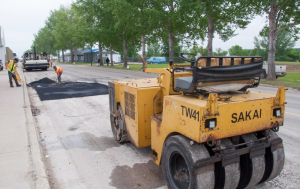
Crews from Stirling Enterprises have been in the community getting going on the City’s 2023 road improvement program.
Watch for barricades through the community as they complete some pavement patching and milling and overlay projects in the city core.
Here’s the play at the plate
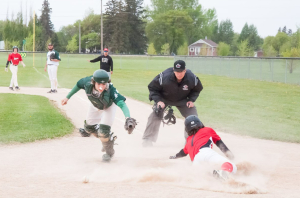
Dauphin Clippers catcher Cash McCallum can’t come up with the throw home as a Goose Lake Raider scores on a play at the plate during the Zone 8 playoffs, last Wednesday.
Dauphin beat Goose Lake, 14-10, and advanced to the zone final where they faced the Swan Valley Tigers, who earned their berth into the final with a 13-11 win over Ste. Rose.
The Tigers clawed their way to a spot at provincials with a 14-1 win over Dauphin.
Bike Week activities promote cycling culture
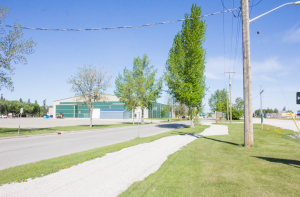
Dauphin residents are being asked to hop out of their cars and onto their bikes next week.
June 5 to 11 is Bike Week and Dauphin Recreation Services and the Dauphin Derailleurs Cycle Club (DDCC) have organized a number of activities to celebrate.
Monday is Bike to Work and School Day, while Tuesday is Bike to a Park or Playground highlighted by a gathering at Fusion Credit Union for coffee and cookies from 9 a.m. to 11 a.m. The gathering is an opportunity to find out everything that is going on to celebrate Bike Week and join DDCC and mayor David Bosiak for a “slow roll through Vermillion Park,” said spokesperson J.L Guillas.
“The Derailleurs will have some of our fat bikes there if people want to try that,” he said, adding the exact itinerary for the ride has not been set. “It’s depending on who shows up. If it’s families, if it’s kids, we’ll take them over to Vermillion and have a gentle ride. It’s not a time trial.”
Wednesday will feature a bicycle based scavenger hunt, while an open house will be at Northgate Trails on Thursday at 7 p.m., providing an opportunity to tour one of the micro cabins at the site, try out a fat bike, get information about programming, learn about the trails and volunteer opportunities, and chat with a board member.
Guillas encourages everyone to bring a bike and a friend.
“I believe the Kids of Mud will have their race that night, as well. So there’s going to be lots of activity,” Guillas said. “People shouldn’t be shy if the parking lot is full. Come on in.”
Finally, Friday has been designated as Bike to Get Your Favourite Treat day, Guillas said, adding more activities and contests are being added all the time.
For example, he said, the Parkland Chamber of Commerce is asking employers to encourage their staff to ride their bikes and track the kilometers they cover for the week. The business with the most accumulated kilometres will win $50 per employee to a maximum of $500.
All of the activities add up to an opportunity to promote Dauphin as a bicycle-friendly city, Guillas said.
“Dauphin, it’s very accessible by bicycle and if people get in the habit of it, it just becomes more of a culture change for individuals and families and it’s just a positive thing,” he said. “Bike Week itself is to just remind people how much fun it can be to be on a bike, how accessible the city is on a bicycle and then also the great facility we have over at Northgate.”
The city is regularily adding to its active transportation routes making cycling even more of an option, Guillas added.
“There’s another piece that’s coming, that’s going to be constructed this year linking up right to (Assiniboine) college from the Kingsway Trail,” he said. “It’s about the culture of biking and also the infrastructure. Vermillion Park is a great place to take young kids to learn biking in a safe place to get them off the roads. We’ve got lots of great opportunities in town and also the big facility south of town.”
Whether you are an experienced cyclist or just starting to seek two-wheeled adventures, Guillas encourages everyone to take in all that Bike Week has to offer.
“It’s a good workout and it’s good lifestyle choice. It can be fun, you do it with your friends and you see things in town that you don’t see when you’re speeding by in your car,” he said.
“Whether you’re on a $100 used bicycle, a hand-me-down bicycle or a top-end bike, it doesn’t matter, it’s all fun and it’s for everybody.”
Squeaky clean
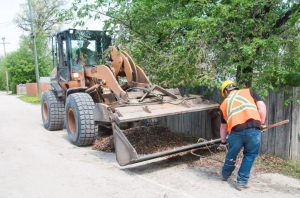
City crews conducting a spring cleaning of the community have moved on to Day 2 on the garbage and recycling schedule.
During one pass through the city, crews will collect accumulated garden waste, grass clippings and leaves, as well as shrubs and tree branches less than six inches in diameter at a maximum length of eight feet, last week.
These items will only be collected if they are free of household waste, hazardous waste and recyclable materials and are in a clearly identifiable pile.
The spring clean up campaign will occur in the back lanes, so place the items near your back lane for pick-up.
Those residences that do not have a back lane, place your items on the boulevard near the curb.
Large equipment will be used, so it is important to place the items close to the lane or curb to avoid property damage.
Brewing up some magic . . .
Even before it opens its taproom doors to the public, Obsolete Brewing Company is receiving industry accolades.
At the recent Prairie Beer Awards in Regina, Obsolete Brewing Company earned a gold medal for its Hourglass Coffee Kolsch, as well as a silver medal for its Cavalry Soldier Imperial Maple Stout.
The competition drew microbreweries from across Manitoba and Saskatchewan and saw judges make their selections from among 270 different brews.
Company co-owner Steve Sobering said while the awards are an affirmation of all the hard work everyone has put in to get the venture to this point, the bulk of the credit has to go head brewer Marcos Bardelli.
“I feel like we have one of the best brewers in the country. And even though he was brewing on a small batch system and all the headaches that goes with that, I still had this assumption that he would come home with something. And he totally delivered. I’m very confident in him just because of the years of experience he has and he has such a deep knowledge,” Sobering said.
“When it comes to the brew zone it’s all Marcos. We would never be as confident in this venture without having him at the helm of our brewing team. “He’s a great brewer, we’ve got a couple great awards and we’re super excited because that just means we are a credible microbrewery. We can compete with anybody and still bring home some hardware.”
Sobering is hoping the public will have an opportunity to sample the award winning brews as work is progressing on getting all of the proper permits in place to open the company’s tap room, located in the former Acklands building on Second Avenue Northwest.
“We’re dealing with government regulatory requirements, and when you’re brewing beer there’s a lot of them,” Sobering said. “We have a manufacturing license, we’re looking for a retail license and we’re also registering our product with MBLL (Manitoba Liquor and Lotteries).”
He hopes all that can happen in the next few weeks.
“We’re in good shape. We want to be open, obviously. We want to get to the next phase, which is the fun part, serving good, tasty beer and building that community, working on our outdoor space and trying to start driving some activity in the up-and-coming craft district,” Sobering said.
City, area rakes in Building Sustainable Communities grants
Maamawi Park Phase 2 got a huge boost when the list of projects approved under the Building Sustainable Communities (BSC) program was released, last week.
The toboggan hill/recreational park development planned for the local Dauphin Recreation Services grounds received $300,000 as part of the $25 million set aside to to support 428 community development projects throughout the province.
“Locally developed projects are, by design, tailored to address their community’s specific, unique needs and opportunities,” said Municipal Relations Minister Andrew Smith. “Our government is pleased to continue supporting community-based projects that foster thriving, sustainable neighbourhoods and improve residents’ quality of life.”
The province’s 2023 budget maintained funding support to the Building Sustainable Communities Program for a total commitment of up to $25 million. This investment was doubled last year to increase support for community projects.
This investment included over $12 million for 368 local and regional initiatives and nearly $13 million for 60 larger-scale capital projects.
“The Building Sustainable Communities Grant has been integral to our process as they committed $300,000 to phase one of the project, which is the hill itself and now has just recently again committed $300,000 to phase two of the project, which will involve pathways, proper lighting and we’re looking at extending a beautiful grand entranceway,” said Stacey Penner, one of the driving forces behind the Maamawi Park project.
“So we’re very lucky that the Manitoba government has put forward this opportunity and we wouldn’t be as near as where we are without this granting opportunity.”
Penner said the funding has increased the options for the planning committee as what exactly is included as part of phase 2 will depend on available funds.
“Phase two right now is a little bit negotiable, like what we want to include. There will be a phase three and potentially a phase four. We have some other big granting opportunities out right now that we have our fingers crossed on, so there is no firm end of phase two and beginning of phase three,” Penner said. “Funds will continue to roll in and we will continue to plan accordingly.”
Other Dauphin projects receiving grants include:
• City of Dauphin - $25,000 for Watson Arts Centre repairs.
• Dauphin and District Snowmobile Club Inc. - $67,987 for construction of a storage facility.
• Dauphin and District Handivan Inc. - $71,394 for the purchase of a new handivan.
• Dauphin Neighbourhood Renewal Corporation - $75,000 for Community Resource Center upgrades.
• Dauphin Recreation Services - $74,750 for iceplant upgrades.
• Dauphin’s Countryfest Inc. - $9,476 for upgrades at the Selo Ukraina festival site.
The BSC program was launched in 2019 to offer municipalities and non-profit organizations a new program that streamlined administrative processes and reduced red tape, the minister noted, adding that the program replaced seven programs that were restrictive, operated in silos and were administratively burdensome. Since 2019, the BSC program has committed over $82 million to support 1,745 community projects throughout Manitoba and leveraged $185 million in other funding sources.
The grant program supports planning activities, organizational capacity building projects, equipment costs, capital infrastructure and other local or regional initiatives that enhance the sustainability of communities.
Other area projects included in the announcement include:
• Gilbert Plains Country Club Inc. - $75,000 for golf course upgrades.
• Gilbert Plains Municipality - $176,200 for Gilbert Plains Recreation Complex upgrades.
• Grandview Kinsmen Club Inc. - $58,921 for Wilson Park upgrades.
• The Grandview Senior Drop In Centre - $25,756 for facility upgrades.
• Mallard Community Council - $5,593 for community hall upgrades.
• McCreary Golf and Country Club - $10,584 for clubhouse upgrades.
• Municipality of Lakeshore - $71,325 for Ochre River Hall upgrade.
• Municipality of McCreary - $15,143 for facilities renovations.
• Municipality of Mossey River - $43,754 for Winnipegosis Beach area renewal.
• Municipality of Mossey River - $44,814 for Winnipegosis Arena and Curling Rink upgrades.
• Ste. Rose Recreation Commission - $83,250 for phase two of the Turtle River Trail.
BSC projects can receive up to 50 per cent toward eligible costs. The maximum grant for projects in the regular stream is $75,000, while larger-scale capital projects can receive up to $300,000. Approved projects, with the exception of planning activities, are required to have a minimum of 10 per cent of funding from non-government sources.
“The Association of Manitoba Municipalities (AMM) greatly appreciates the collaborative partnership between our organization and the Manitoba government in assessing municipal project applications under the Building Sustainable Communities program,” said Kam Blight, AMM president. “Municipalities have identified numerous projects and initiatives that benefit local communities and contribute towards building a stronger Manitoba. Thus, this funding announcement is certainly timely and will help grow our province.”
The minister noted the BSC program intake includes valued feedback from AMM to ensure local and district priorities are addressed.
“The BSC program is making a remarkable difference in communities provincewide,” said Smith.
“From installing play structures to creating outdoor recreation spaces to renovating community centres, these projects make communities healthier, stronger and more competitive.”
The 2023-24 BSC program intake period closed on Jan. 23 with 655 applications received. The list of the 428 approved projects is posted at gov.mb.ca/mr/bldgcomm/index.html.
City’s 2023 construction plan leans on reserve funds
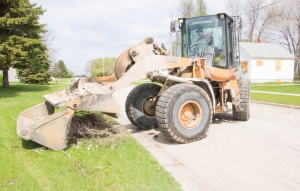
The City of Dauphin’s capital plan is set for 2023 and Public Works crews will be busy throughout the community.
“It’s going to be a busy year again, so we’re hoping to hit the ground running in the next week or two,” director of Public Works and Operations Mike VanAlstyne said. “We’ll start with some of our sidewalk work, get going on that and everything should fall into place.”
More than $13.8 million in capital expenditures is included in the plan for 2023, ranging in scope from the design and construction of a south end drainage system to the purchase of a carpet cleaner.
“It’s about the same as we’ve done the past few years. We have a little bit more paving and road reconstruction this year than normal, but that just meant we were doing less than the previous year, but it’s because we had more utility work last year,” VanAlstyne said.
Coming in at a cost of $8,196,415, the south end drainage system accounts for the majority of the capital budget. While $46,415 of the costs will be borne by reserves, the remaining $8.15 million will be debentured.
Road work is also planned at a cost of $643,330. That involves road reconstruction projects on Aster Bay at a cost of $168,000, as well as Fourth Avenue Northeast from First Street to Second Street at a cost of $215,500 and 10th Avenue Southeast from Main Street to First Street at a cost of $158,000.
Milling and overlaying work is also planned for Second Street Northeast from Fourth Avenue to Mountain Road at a cost of $101,830.
Sidewalk work will take place along with roadwork projects, but there is additional sidewalk work planned outside the capital budget, VanAlstyne said, specifically on Main Street.
The east side of Main Street South will see the paving stones replaced with poured concrete from Sixth Avenue to Eighth Avenue at a cost of $51,000; Eighth Avenue to 10th Avenue at a cost of $46,000 and a half block from Fourth Avenue to Fifth Avenue at a cost of $19,600.
A pedestrian crossing with flashers will be installed on Buchanon Avenue at Johnson Street at a cost of $15,000, which will be borne by reserves.
The project was originally slated to be completed last year at the intersection of Buchanon and Jackson Street.
“After talking with the province, they didn’t like it at the (original location) just with how busy the rail crossing is there,” VanAlstyne said.
“So we’re moving that a little bit to the west.”
Construction of a new back lane will take place in the west end between West Street and King Street at a cost of $23,000 which will be borne by reserves.
A design and refurbishment of the Buckwold Bridge over the Vermillion River on Fourth Avenue Southwest is also slated at a cost of $969,036, which will also be paid for out of reserves.
Several civic buildings will also see work done this year.
The Watson Arts Centre windows have already been replaced at a cost of $111,782, with the General Fund budget covering $60,891 and the remainder coming from reserves.
The building will also undergo some brick repointing work with the General Fund and reserves equally covering the $88,000 cost.
Finally, the Public Works Shop will see the addition of a lunchroom at a cost of $50,000 and exterior lighting will be installed at City Hall at a cost of $35,000. Both projects will be paid for out of reserves.
The Fire Department has a couple of capital purchases set for the year. The most substantial is a new pumper truck at a cost of $750,000 with $262,500 of the cost borne by the General Fund budget and $487,500 coming from reserves. The department will also receive a new hydraulic rescue tool valued at $6,000, paid for by the general fund.
A $10,000 upgrade is planned for the Diversion Centre at the waste disposal ground with the costs borne by reserves, while reserves will also pay the $12,000 required for a new computer server at City Hall. The cost of a new digital information kiosk will be split with the budget covering $7,500 and reserves the remaining $8,000.
An addition to the city’s statue inventory celebrating our Indigenous heritage will be erected at a cost of $107,000 with $100,000 coming from the General Fund and the remainder being drawn from reserves.
Several recreation-related capital expenditures are planned, such as additions to the Active Transportation system at a cost of $215,000 with $70,016 coming from the budget and the rest being borne by reserves.
As well, a new Parks lead hand truck will be purchased for $35,000, along with a new riding mower for $20,000, both of which will be covered by reserves.
Reserves will also cover completion of the toddler playground at Meadowlark Park for $20,000 a boiler and compressor replacement costing $103,558, the purchase of a carpet cleaner for $4,860 and lighting upgrades at Vermillion Park costing $23,000.
Machinery purchases planned for the year include a new garbage truck with a price tag of $405,521, a new Public Works truck for $60,000, refurbishment of the waste disposal site compactor for $153,399 and a new loader valued at $279,000. All will be paid for from reserves as will a new plasma cutter valued at $7,500.
Utility capital
On the Utility side of the budget water main renewal projects are planned for 10th Avenue Southwest from First Street to Second Street at a cost of $127,700 and Seventh Avenue Southwest from Main Street to First Street at a cost of $104,300.
Water main relining projects are set for Dunfield Avenue from Dorothy Street to Elmay Street at a cost of $100,000 and Main Street South from Ninth Avenue to Fourth Avenue at a cost of $305,000.
Sewer main relining is set for 10th Avenue Southeast from Main Street to First Street at a cost of $45,000 and Fourth Avenue Northeast from First Street to Second Street at a cost of $45,000.
Other utility capital projects include Manitoba Water Services Board supported upgrades in the amount of $177,452, the majority of which will be split evenly between the Utility Fund budget and reserves.
Lagoon dredging and design work is planned valued at $525,000 with $220,000 in the current budget and $305,000 being borne by reserves.
The purchase of a new flow metre at the booster station valued at $30,000, a new water metre reading device valued at $12,000, SCADA modem upgrades worth $15,000 and the purchase of a new trench cage worth $20,000 will all be paid for out of reserves.
City council sets its 2023 financial plan
After years of mill rate reductions and freezes, Dauphin residents will see an increase in their property tax bills for 2023.
Dauphin city council passed the 2023 financial plan at a special meeting, May 11, which will see the mill rate rise from 18.332, which raised $6,382,457 in 2022, to 18.937 this year, which will raise $6,827,186, representing a 6.3 per cent increase.
“It became apparent very early in the 2023 deliberation process that we could no longer provide the same level of service without needing to raise some taxes,” Mayor David Bosiak said. “So therefore for 2023 there will be a 6.3 per cent Municipal tax increase or a 3.3 per cent increase in the mill rate in order to continue to provide a consistent, if not better level of service to our residents. So those were some decisions and discussions that we’ve had to get to this particular point and I think that we’ve balanced both a need for generating revenues to support our operations and also to hold the line as best we can on, I’ll call it frivolous or any spending that is not absolutely necessary for us as a community.”
The plan also includes increased income from grants in lieu of taxes and “other” revenue for a total revenue/expenditure balance of $13,295,966.
On the expenditure side of the ledger, General Government Services will see an increase in its budget to $1,433,111 from the $1.389 million budgetted in 2022. That represents a 4.19 per cent increase driven mainly by regular staff wage increases and in-person conferences and training, community grants and appropriations of $58,000 and a Dauphin Regional Airport Authority subsidy of $98,000.
The Protective Services budget will see a six per cent overall increase to $3,754,132 in 2023, mainly due to increased RCMP costs resulting from retroactive unionization costs and wage increases. Other areas covered under the budget category include fire, emergency measures, building inspection, animal control, insect control and bylaw enforcement.
Transportation Services expenditures will increase by 7.58 per cent for 2023 to $1,945,576. The budget category includes administration and operating costs for Public Works and engineering, such as maintenance of curbs and gutters, lanes and roads, as well as general pavement repairs, crack sealing, sidewalk repairs, drainage maintenance, mowing, street cleaning, snow and ice removal, bridge maintenance, street lighting and signage.
Environmental Health will also see a slight increase of 1.64 per cent to a total of $1,030,239 to cover operations such as collection of garbage, yard waste and recycling, as well as maintenance and operation of the waste disposal grounds. Plans are to purchase more garbage and yard waste bins.
Public Health and Welfare Services again remains unchanged at $33,749 as the category consists entirely of a one-tier social assistance payment to the Province.
Environmental Development Services sees a decrease of 24.35 per cent to $222,407 as the Development Plan review nears completion. Other areas covered under the budget category include Dutch Elm Disease tree removal, Communities in Bloom, weed control and city events, such as parades and Remembrance Day services.
The Economic Development Services budget, which fluctuates depending on development, will see a sizeable increase of 30.39 per cent to $525,733 for 2023. Areas covered by the increase include economic development incentives programs for residential and commercial developments, tipping fees, spec homes and operation of the Dauphin Business Park. The category also includes Tourism related costs such as the Adventure Guide and place branding program, as well as merchandise costs, displays, the City’s website and photography and ideography expenses. Other areas include Tourism
Accommodation Tax Project and the Veterinary Services Board appropriation.
Recreation and Cultural Services will also see an increase, 7.93 per cent overall, to a total of $2,164,866. While over 86 per cent of that budget consists of operating funds for Dauphin Recreation Services, the money also includes appropriations for other facilities, such as the Watson Arts Centre, Fort Dauphin Museum, the Dauphin Rail Museum and the library. Also included is money for the Community Band and the Community Jazz Band.
Fiscal Services, which outlines capital expenditures and reserve transfers totals $13,994,146 in 2023 about $650,000 more in capital spending and transfers. Also included is the City’s portion of the Main Street South twinning project, which involves $8.15 million in borrowing.
Utility Fund
Income in the utility ledger will decrease in 2023 due mainly to less in the way of Provincial grants to $3,660,006.
The bulk of that income will come through residential water sales budgeted at just over $2.3 million and sewer service charges totalling $663,273.
On the expenditure side, operation and maintenance of the water supply system accounts for the majority of expenses at just over $2 million while sewage collection and disposal accounts for another $415,145. There is also $863,026 in capital work planned, transfers to reserves in the amount of $250,000 and $83,517 in debenture debt charges.