

Shawn Bailey
Walk with Pride

The Northwest Metis Council, in partnership with the Dauphin Friendship Centre, Mountain View Teachers Association and Boho Tattoo, presented the first-ever Walk With Pride parade, June 28.
Starting at Dauphin Regional Comprehensive Secondary School, hundreds of parade participants showed their pride walking a route to Vermillion Park, where they enjoyed a hotdog barbecue, a bubble station, face painting, the splash park and live entertainment.
As part of the celebration, flash pride tattoos were offered by Boho Tattoo for $100 with 100 per cent of the proceeds earmarked for the DRCSS Pride Club.
Home sweet home

Fighting back tears of joy, Chantel and her three children aged 16, 12 and 10, accepted the keys to their new home built through the efforts of Habitat For Humanity Dauphin Chapter and countless volunteers and sponsors.
“It’s an overwhelming unrealistic experience. It is still unreal today to me. It is about building, grounding, new routes for me and my family here in Dauphin. We’ve been here for a long time, but this is just the next step in our journey,” Chantel said, adding her children seem relaxed about the whole process.
“They’re excited, but I think once the day comes and we are moving in, it’s going to kick in more for them. I’m the one that’s been pretty busy getting everything done. Habitat for Humanity helped us out so much to get a home like this. This is a big opportunity for me and my kids. I’m going make the most of it, of course.”
Chantel accepts the keys to the home from Habitat for Humanity chair Rodney Juba.
Fair draws large crowds

With record setting gates, packed grandstands and long lines at attractions, success is the only word which can be used to describe the Dauphin Agricultural Society’s 130th Fair and Exhibition, June 29 to July 2.
“It’s been a great turnout here so far. We’ve had some pretty record days at the gates and it’s great to see the grounds packed with lots of people,” ag society president Teren Stykalo said. “You know we have the national stock dog show here and that brings lots of people in from all over western Canada. So it’s been great to see all the action here this weekend.”
Other attractions included numerous 4-H events, workshops, competitions and sales, along with multiple heavy and light horse classes, the small animal display, Kids Play Zone, Home Living Section, All About Science Show, Kids Pedal Tractor Pull, Extreme Dog Stunt Show, numerous vendors and, of course, the Select Shows midway.
“It’s just a good old-fashioned Fair people want to come out they want to do stuff around the community,” Stykalo said, adding it is about more than just the attractions which keep people coming back year after year. “They want the camaraderie. They want to see some stuff, some new stuff here and, of course, the midway is always a big draw. But we have lots of support from around the community, whether it’s businesses or people. Putting on big volunteer events and people want to be a part of that and they like to support it. So it makes a big difference when you have a big crew of volunteers. Everybody knows somebody who wants to come and support them and all of a sudden it’s a big draw to our fair.”
Despite the success of the fair year after year, Stykalo said ag society directors are always looking for way to improve.
“I think there’s always a forward Vision at some point. Of course it’s kind of hard to see in the blur of these three days, but we’re always looking at what’s going to be the next thing that people want to come back and see,” he said, adding he can’t thank the public, sponsors and the volunteers enough for their support.
“Because ultimately, at the end of the day, we want people to come back to the fair. We want them to have fun. We want them to look forward to next year even though it’s a whole year away. We want people to be excited to come back for next year.”
And so there will always be a next year, Stykalo encourages anyone with ideas or suggestions to get involved.
“We’re always looking for people to just come and show support and even if you’re willing and you want to volunteer, we’re always looking for volunteers,” Stykalo said. “And that’s probably the best way. If you have a good idea, come on the board and let’s talk about it and we’ll put some sort of plan to action.”
Winters acquittal met with anger
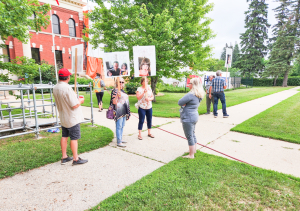
A local court room erupted in a display of shock, anger and anguish as Justice Sandra Zinchuk handed down a not guilty verdict for a Dauphin man facing 15 charges in connection with a 2019 drunk driving collision which killed two young sisters.
At the heart of the trial of Jack Winters, 28, was the identity of the person behind the wheel of a Ford F-150 registered to Winters, which ran a stop sign at the intersection Road 457 North and PTH 362 north of the city causing the collision, killing six-year-old Oksana Dutchyshen and her four-year-old sister Quinn.
Winters was travelling with his friend Jeffrey Thompson and court was told both men had been drinking heavily, with both men having high blood alcohol levels.
Winters’ DNA was found on the drivers’ side airbag and he was found on the ground near the driver’s door by first responders. However, in delivering her verdict Justice Zinchuk indicated the defense offered multiple alternate scenarios which could account for the DNA transfer.
The question of who was driving was further clouded by contradictory statements made by Thompson, who immediately after the accident told a first responder he was driving. Later that night in hospital, Thompson told police he “might” have been driving and in a final statement to police some months later indicated he was not driving.
Thompson died in an unrelated incident in 2020 making further clarification of his statements impossible, Zinchuk said.
Winters maintained throughout that he had no memory of the accident.
It all added up to reasonable doubt about who had care and control of the vehicle, Justice Zinchuk said.
“A reasonable doubt is not an imaginary or frivolous doubt. It is not based on sympathy for, or prejudice against, anybody involved in the proceedings,” she said. “Even if I believe that Winters is probably guilty, or likely guilty, that is not sufficient. Accordingly, I must find the defendant not guilty on all counts.”
Following the decision, the victims’ mother Claire McBride crumpled to floor in tears, while other supporters and family members hurled obscenities at the judge, the accused and his family and levelled charges of incompetence at police.
Outside the courtroom following the proceedings the girls’ grandmother, Gaylene Dutchyshen, expressed her “profound disappointment” in the verdict.
“We don’t have a reasonable doubt. We know our grandchildren are dead. This is not about me, it is about those two little girls. This is not an accident, this is wilful drinking and driving. They chose to get in that vehicle,” she said. “Total injustice and that’s all I can say. And we have to live with it, we have to live in the aftermath of being without those two little girls the rest of our lives.”
Traditional dance

The Government of Treaty 2 Territory took the opportunity on National Indigenous People’s Day to share a little bit of their culture with a powwow demonstration at the 8th Avenue Hall in Dauphin, June 21.
The day also included a hotdog lunch and entertainment in the hall.
Seniors fund set up by DDCF

A new fund in support of seniors has been established by the Dauphin and District Community Foundation (DDCF) to handle donations coming in the wake of the June 15 crash which killed 16 members of the area community.
The Support Our Seniors fund will provide funding to programming, equipment and activities that support seniors, through the traditional community foundation model.
The fund was established on the advice of officials of Humboldt, Sask., who indicated their community was ill prepaid to handle donations following the 2018 accident which killed 16 members of the Humboldt Broncos Jr. A hockey team.
The new fund is not meant to compete with the wishes of the victims and their families when it comes to directing donations, but rather it is an option for those wanting to do something for the community, said DDCF board member Martijn van Luijn.
“If somebody wants to donate to a particular family member, absolutely just donate to that family member,” he said.
van Luijn said there have already been corporate inquiries about where to direct donations to community at large with Wawanesa Insurance being the first, pledging $50,000.
“We said that’s awesome, but hang on, let’s get organized first,” he said, adding the foundation’s endowment is made up of a general fund which can be used to support virtually any cause, and restricted funds which support a specific area.
“We don’t have a restricted fund for seniors. So that’s why the idea came up to do a Support Our Seniors fund.
“So the donation from Wawanesa will go into that.”
Those interested in contributing to the Support Our Seniors Fund can make this tax-deductible donation at www.DDCF.ca, calling the DDCF at 204-638-4598 or toll free 1-877-974-3631, or stopping in at the office located at 100 Main Street South in Dauphin.

Stylish and secure
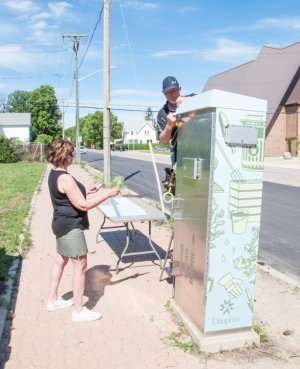
Wayne and Gail Himpe of Repromap Ltd. apply an anti graffiti wrap on a traffic light control box at the corner of First Street Northwest and Second Avenue Northwest, last week.
The initiative was inspired by city councillor Kathy Bellemare after she encountered a similar initiative on a trip to British Columbia.
The wraps have graphics centred on Dauphin themes such as Indigenous heritage, agriculture, the environment and arts and culture, created by local graphic artist Jeanne Brenner.
Six switch boxes have been wrapped in the downtown core of the community with the blessing of Manitoba Highways, which owns the equipment, as phase one at a cost of around $8,000.
Turtle River Trails phase two to proceed thanks to grants, donations

The community of Ste. Rose is celebrating a windfall which will allow for the completion of phase two of the Turtle River Trails project.
Through its Community Spaces program, Co-op has pledged $85,000 towards the project as part of a $1 million investment in 15 community projects across Western Canada.
“We are so very thankful to be the recipient of the Co-op Community Spaces Grant, to have Co-op partner with us to create such an amazing space for the people of Ste. Rose and surrounding communities to enjoy,” said Shari Shankaruk, chair of the Turtle River Trails Committee. “Valuable projects like ours, and communities across the country are becoming a reality because of this program. Co-op is a community-minded business and is undoubtedly known for their generosity and support in communities such as ours. On behalf of the Turtle River Trails project committee, I would like to extend a huge heartfelt thank you to Co-op for believing in our project and partnering with us to make it a reality.”
Intended to enhance, beautify and promote healthy living in the community, the Turtle River Trail system built during phase one, through phase 2 will be augmented with the construction of a toboggan hill, nature trail and nature play park, as well as a nine-hole disc golf course.
Dauphin Ste Rose Co-op general manager Lorne Eiffert said the local business is pleased to be involved with the development as it “reflects our vision to enrich the life of our communities.”
“Each project can be different in a community where it’s located and that’s the beautiful thing about local residents building their communities, they understand the community needs,” he said.
“I want to thank the Turtle River Trails committee for your commitment and extraordinary work you do on a daily basis. That makes such a big difference in the community of Ste. Rose. Co-op is proud to be part of bringing this project into reality and together we are improving the places where we meet, play, learn and share.”
Since 2015, the Co-op Community Spaces program has provided $12.5 million to 175 projects in three categories: recreation, environmental conservation and urban agriculture.
The program was developed as part of Co-op’s commitment to invest in the communities it serves.
Funding has also been secured through the provincial Building Sustainable Communities Fund in the amount of $83,250, as well as a $10,000 grant from the Thomas Sill Foundation which, when combined with the money from Co-op Community Spaces means phase two will be able to proceed without any further fund-raising being necessary.
Investigation, recovery continues in the aftermath of tragic accident

Ten of the 25 Dauphin area residents involved in the horrific crash at the intersection of Hwy. 5 and the Trans-Canada Highway remain in hospital, while the medical examiner’s office continues working to identify the remains of the 15 killed in the accident.
At a press conference, Friday, provincial health officials said the injured - six women and four men are being treated at hospitals in Winnipeg and Brandon for serious injuries. Six are in a critical care unit at the Health Sciences Centre, while the other four are being treated for serious injuries in a surgical care unit
“A number have received operations and more operations are planned, but these injuries are quite significant,” Dr. Shawn Young, chief operating officer of Health Sciences Centre, said.
While the families of those deceased have been notified by police, Manitoba’s chief medical examiner, Dr. John K. Younes, said fingerprints, dental records, surgical history and, if necessary, DNA will be used to confirm the identities.
“The worst possible outcome for us is to mistakenly identify someone and give wrong information to families, so we have to undertake a scientific means of identification of each of the deceased,” he said, adding the process should be complete later this week.
The accident occurred shortly before noon, June 15.
RCMP initially said the bus carrying 19 women and six men ranging in age from 58 to 88 years old was travelling south on Hwy. 5 en route to the Sandhills Casino in Carberry and was crossing the eastbound lanes of the Trans-Canada Highway when it was hit by a semi-trailer.
In an update Friday afternoon, police said they have obtained footage of the crash from a camera installed in the semi which shows the bus entering the lanes on Hwy. 1 without having the right of way.
“We are not assigning culpability or laying any blame at this time. We’re merely stating the facts as we know them,” Supt. Rob Lasson of the major crimes division said, adding witness accounts align with what RCMP saw in the video.
Lasson said the semi driver has been released from hospital and police have been able to interview him as they further their investigation. They have not yet spoken with the driver of the bus as he is still being treated in hospital.
“Our primary concern at this time is his medical care and recovery,” Lasson said.
He added police are doing what they can to support families of the victims through support centres in Dauphin and Winnipeg
“Each family will be presented with a direct RCMP contact that they can reach out to for support. We know this is of utmost importance,” Lasson said. “It is imperative that we all respect what the families are going through at this time. This is not easy.”
MVSD welcomes partners to updated Violence Theat Risk Assessment protocol
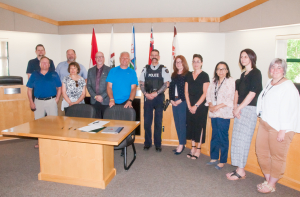
Mountain View School Division is celebrating the updating of its Violence Threat Risk Assessment (VTRA) and Intervention protocol.
“It’s a long title, but in short, it is looking at having the school division partner with community agencies to help make our community a safe place. So that when we have incidents of violence that occur anywhere in our community, we can activate this protocol. We can follow what is written within it and we can share information expeditiously,” MVSD superintendent and CEO Stephen Jaddock said at a signing ceremony last week.
“Oftentimes the faster that we can share information and not have to worry about cutting through some red tape, it’s going to be helpful and that’s what essentially this is all about.”
Originally developed in 2013, Jaddock said it was time to update the protocol to reflect the current environment and to welcome new signatories to the document.
Signatories of the original document included Child and Family Services, General Authority, Community and Youth Corrections, Cree Nation Child and Family Caring Agency, Dauphin at Risk Teens (DART), Michif Child and Family Services, Prairie Mountain Health, RCMP West District D Division and West Region Child and Family Services.
The City of Dauphin has been welcomed as a new signatory to the revised protocol and Jaddock said more partners will be welcomed as they present themselves.
“Our goal is to invite new community groups to level one violence threat risk assessment training with MVSD trainers to build a better understanding of the VTRA process and the necessity of a multi-disciplinary approach. As new community organizations train to a level one VTRA, they will be invited to sign the community protocol, because then they’ve been made aware of what it’s all about and then they can sign on knowing what they’re getting into,” he said.
“In terms of Mountain View School Division, we need to remember that we have seven communities, so we’re looking at partner agencies in each of those seven communities that we can bring on, as well as all those municipalities themselves signed on to this. The City of Dauphin is really the only municipality at this point, but we will continue to work to bring others.”
Jaddock said through the updated document, MVSD is recommitting its efforts to collaborate with community partners to make schools and communities safe.
The protocol supports collaborative planning among youth, families, schools and community agencies to reduce violence and to reflect safe, caring and restorative approaches. It fosters timely sharing of information about individuals who pose a risk for violence towards themselves or others while respecting an individual’s right to privacy to the fullest extent possible.
“In Mountain View School Division, where we would have youth at risk, (a threat) might originate in the schools and where a threat has occurred, then we need to proceed accordingly. And we have a protocol that says that every threat will be investigated and followed up on it, so there’s no fooling around, there’s no playing or (saying) it’s just a joke. We do need to investigate,” Jaddock said. “And if we do investigate and our preliminary steps do indicate that it is just a joke, then we don’t need to take it further, we don’t need to activate the full protocol. But when we find that, yes, there is a reasonable threat and it is not the normal activity of particular students, then we would raise it to a violence threat risk assessment and that our protocols would jump into place.”
Jaddock added there was recently a situation where the VTRA protocol was activated.
“We were able to share with our community partners in a very quick fashion. So there’s benefits to it and we are seeing that already,” he said.