

Jeremy Bergen
Main Street Parade
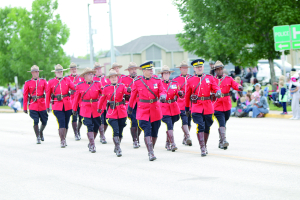
Seemingly thousands of people gathered along the streets of Swan River on Friday morning (July 28) to watch approximately 80 float entries amble down Main Street in the Swan Valley Chamber of Commerce Parade, with this year’s theme celebrating Diversity in the Valley.
Around the Barrels

Four afternoons of chariot racing kept the grandstand packed and audience excited during the NorthWest Round-up and Exhibition this past weekend.
From Farm to You
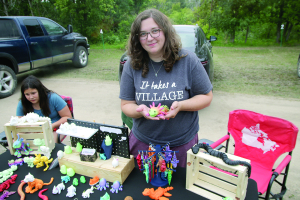
The Swan Valley Farmers’ Market is now underway, with the first one of the year taking place on Thursday afternoon (July 13). Markets will continue to take place weekly from 4-6 p.m. at the Swan Valley Historical Museum, until the end of September, with vendors selling items such as fresh garden produce, baking, handmade items and more...
Ladies Open

The Swan River Golf and Country Club hosted the Ladies Open on Wednesday (July 12) with 36 golfers participating. Patti Pearson came out on top of the Championship Flight at the end of the day, finishing the 18-hole round in 92 strokes after countback. Martha Messinbird came in second also with 92 strokes, and Judi Dickey came in third with 93 strokes. In the first flight, Kathy Sanderson, Nicole Bobick and Rachel Miller all finished with 102 strokes. In the second flight, Connie McKay finished the day with 118 strokes, Colleen Immerkar with 119 and Lyana Compton with 120. Here, Julie Kooistra takes her last stroke on Hole No. 4.
Schoolyard Carnival
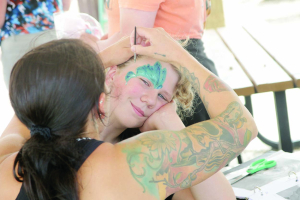
The Kindergarten to Grade 6 classes at ESRSS headed outside on Monday afternoon for their Carnival, with students playing games around the yard in order to win tickets they can use to purchase prizes or experiences, such as dropping Mrs. Allan-Fuchs in the dunk tank, or getting decorated with a nifty design.
Outdoor Showcase

The Swan Valley Cheetahs Gymnastics Club held their spring showcase on Tuesday (June 20), with student gymnasts displaying the skills they learned.
Celebrating 125 Years
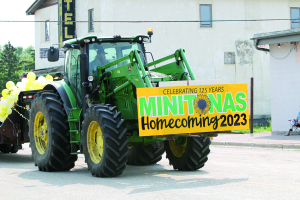
Not only did the Swan Valley celebrate the anniversary of Canada last weekend (July 1), but also the anniversary of Minitonas and the early settlement of the Swan Valley with events recognizing the Minitonas Homecoming taking place from Friday to Sunday (June 30 to July 2).
New life in the membership at the Swan River Senior Citizens’ Centre

There’s a good time to be had by all at the Swan River Senior Citizens’ Centre (SRSCC), which has seen an influx of members join in the last year.
The SRSCC has been operating their facility nearly continuously since 1978 when they were incorporated, save for a couple of years when the COVID-19 pandemic was at its peak.
In recent years, the SRSCC had been struggling for members and participation, but it is now headed in a positive direction, always with room for more the join.
“In the past, a lot of the time the membership has been 80+ years of age,” said SRSCC President Marvin Vestby, who himself is 86 years old and took on the role of president soon after joining the membership for the first time in late summer of last year. “But, we’ve had quite an influx of younger seniors in the 65-75 age range, which bodes well for activity.”
Vestby noted that when he joined last year, there were maybe four people playing pool once a week. Now, a weekday afternoon might have all pool tables and shuffleboard courts going with some card games in the main area.
“On Mondays and Fridays, we have pool and shuffleboard, and on Wednesdays, they play cribbage here,” said Vestby. “People are also learning how to play bridge. We also have a full slate of bingo here on Tuesday afternoons and a potluck dinner once a month.
“Also, once every month, we have a Friday afternoon birthday party for all the birthdays that happened that month. I think at the last birthday party, we had 65 people here. It’s really turning into a big event, with entertainment, dancing, cake and ice cream. I feel it’s really bringing the community together.”
Vestby added that the increased activity has even brought down a few people from Bowsman, which he is pleased with.
“When I joined, there were maybe 60 members, 30 of which were active,” said Vestby. “We have upwards of 90 members now, and on any given day, we have 35-50 people here, which I would say has been a real success.”
While folks in their 60s might be considered on the younger end of the participating spectrum, membership is open to people as young as 50. If a member has a spouse that is younger than that, they are welcome too.
The membership fee is at a very affordable $15 a year, with a $1 daily charge for coffee and a $1 charge for whatever game you want to play that day. The revenue helps them keep up with operations and keep the lights on, but they have also gotten grants from places in the past like from Louisiana Pacific or the Fenske Foundation to assist with upgrades, repairs or maintenance to the building. Vestby admits that the fees have been that way for a long time and may have to be raised slightly to keep up with increasing expenses.
“There are some people who have retired that have said they don’t know what they would do (without the SRSCC),” said Vestby. “They are excellent supporters.
“So many of these people didn’t really know one another either. They might know one another to see each other, but now they are here talking to each other. It’s bringing everybody together, young and old. Anybody can join in fellowship.”
The doors of the SRSCC are open Monday and Friday morning from 9:30 a.m. to 12 p.m., as well as Monday to Friday afternoons from 1-5 p.m.. To sign up, just walk in while it’s open and ask for Treasurer Connie McKay, who will gladly welcome you in.
Raising money for cancer research with crocheted cloths

Never forget that sometimes individual effort can inspire a community and make a difference in the world.
Such is the case with local crafter Linda Daviduik, who crocheted a total of 205 prayer cloths and cards to benefit breast cancer research in Manitoba and those suffering from it.
Each package that Daviduik assembled comes with a crocheted prayer cloth, a laminated prayer card and a pink ribbon pin to wear.
“The prayer cloth idea came from a gift I received from a neighbour who made prayer cloths for sale,” said Daviduik. “I immediately thought, ‘why can’t I make prayer cloths that are pink for breast cancer research?’”
When she presented the idea to where she wanted to donate them in Winnipeg, Daviduik noted they were thrilled with the idea, took what she already had made and gave her two large rolls of pink ribbon to make more.
“I said I wouldn’t mind making them but I couldn’t sell that many in Swan River as our community is small,” she said.
This happened prior to the COVID-19 pandemic, and once the pandemic affected everyone’s lives, Daviduik had lots of time to make her 205 prayer cloth packages.
Daviduik was sure to mention her friends that helped out with providing some of the supplies or donate to the cause, such as Adam Maksuta, manager of Ace Hardware at the time, who donated two balls of pink yarn. Rachael Stober, owner of Bee Gee’s Stationery also donated paper, printing and laminating services for the prayer cards, and other friends donated money to buy the rest. Friends who donated $10 each include: Annie Zaretzky, Elizabeth Yablonski, Helen Klimuk, Tammy Zaretzky-Denischuk, Mary Jenner, Helen Proskie, Helen Martinussen and Dorothy Dixon.
“I am so grateful for caring friends who reached out to help me with this project,” said Daviduik.
She estimates that if the prayer cloth packages are able to be sold at $4 each, that could raise $800 for breast cancer research.
Daviduik is an avid crafter who has had projects taken all over Canada.
She also spends lots of time volunteering and giving back. She has volunteered as a Heart and Stroke coordinator as well as involved in coordinating fall suppers, rodeo luncheons and the Loving Hearts event.
Exploring the World of Lights and Sirens

Emergency and enforcement services around the Swan Valley came together with their vehicles and equipment for EMS Day at the Swan River Centennial Arena, allowing Swan Valley students to explore the world of front-line services. Represented services included RCMP, municipal and provincial fire departments, emergency medical services, Manitoba Hydro and Manitoba Conservation.