

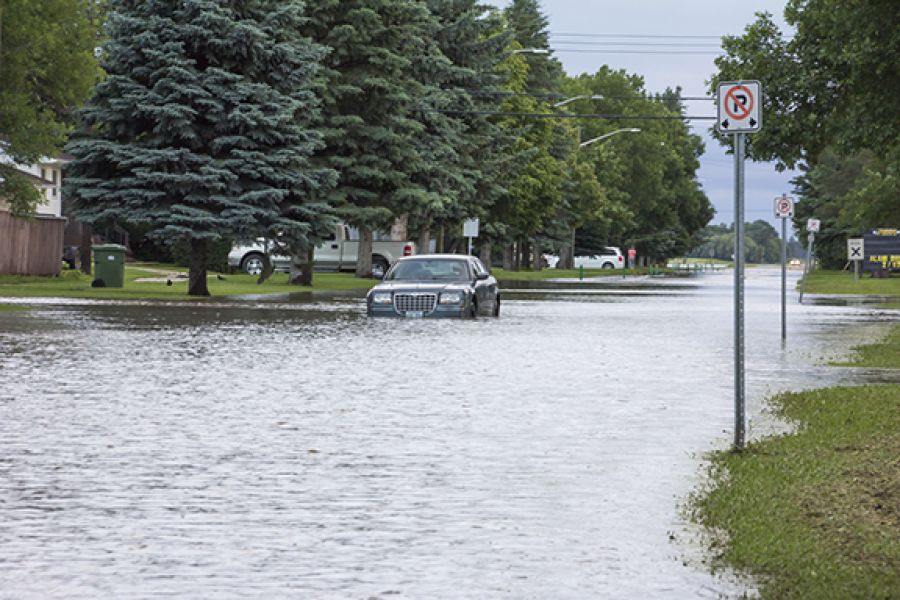
The City of Dauphin is looking for ways to mitigate the damage if the flooding experienced in the community at the beginning of July should ever happen again.
At their regular meeting July 13, Dauphin councillors discussed ways to lessen the effects of the Vermillion River on the community in the future and passed resolutions calling on the province to aid them in those efforts.
Among the discussions was the need for better monitoring of the river upstream of Dauphin, and within city limits, and improved riverbank elevation data, along with the possibility of developing a river diversion project.
When it comes to river monitoring, there currently is just one station upstream of Dauphin at the Vermillion dam, and one downstream where the river crosses Hwy. 20 north of the city.
Additional monitoring, when combined with accurate and comprehensive riverbank elevation data can go a long way to forecasting potential flooding, identifying vulnerable areas, and implementing timely mitigation measures, city manager Sharla Griffiths told council.
In this latest incident, when city administrators were looking for information about river levels, the capacity of the Vermillion River within city limits and how close the river was to spilling its banks, that information was not readily available.
“We didn’t know where to look for that. We assumed it was there and it was on us that we hadn’t found it,” Griffiths said.
“Unfortunately, it’s not there. There is no Vermillion River monitoring upstream of Dauphin except at the Vermillion Dam, there’s nothing in Dauphin and it’s at Highway 20 on the other side.”
Realtime information on river flows and water levels is used to great effect when it comes to flood preparations in other communities, she added.
“We see people in other communities, sandbagging certain areas to different levels and stuff like that,” Griffiths said, citing Brandon as an example of a community
“It's the province who monitors the river levels. They have a whole hydrologic department that runs scenarios based on those levels and it alerts them what when things are happening. So we want to be part of that monitoring system.”
While some communities might get two to three weeks of notice about potential flooding, that would not be the case in Dauphin, given the topography of the area.
“Just doing some really quick and dirty analysis with EMO, we would get 24 to 48 hours notice of something happening,” Griffiths said, adding advance warning would help improve flood forecasting, emergency preparedness, and long-term flood resilience..
“We do have to get that information, be proactive, learn what those levels are so that we can mitigate, and there might be have to be some more permanent mitigation measures put in because we wouldn’t get that (lengthy) heads up.”
One of those more permanent mitigation measures being considered is some sort of river diversion infrastructure designed to reduce flood risks, protect homes, businesses, and essential public infrastructure and improve long-term community resilience.
On the recommendation of Griffiths, councillors passed a resolution calling on the province to undertake the necessary hydrological studies, engineering assessments, planning, design and construction of a potential Vermillion River floodway in collaboration with the city and neighbouring municipalities to reduce future flood risks while avoiding adverse impacts on surrounding municipalities.
“I really only knew of like the Winnipeg floodway or the Portage diversion. It seemed like it had to be something massive that was protecting a lot of things. However, in talking to EMO, there’s communities that have 78 residents that the river is diverted if it goes up above certain levels,” Griffiths said.
“When we look at Dauphin being a city, and it’s the largest urban concentration in the Parkland, I think it’s valid for us to ask the Province to entertain a discussion about this.”
It is important that any such project would not cause problems further downstream, she added.
“The last thing we want to do is cause more flooding downstream at the cost of saving the city. However, there has to be a trade-off and it would be in consultation with our neighbours.”
Future flood fights: City council explores mitigation options
Published in Dauphin Herald News
Published in
Dauphin Herald News
Tagged under
