


Submitted
Tourists encouraged to “ride the rails to see the whales”
By Ed Stozek
For the Herald
A recent full-page advertisement in The Winnipeg Free Press announced two VIA tour dates departing Winnipeg in early July, “to ride the rails, to see the arrival of the Belugas of Churchill” and also to experience the wildlife, natural wonders and man-made attractions of the region.
Limited to 18 spaces per tour, a choice of two packages were offered at $3,395 or $3895 per person based on double occupancy for the seven-day, six-night excursion.
The price included rail travel, transfers, hotel stays, heritage attractions, all meals on the train, and breakfasts and dinners in Churchill.
During the stay at Churchill, off-train accommodations for three days and two nights were provided at a centrally-located hotel.
An arctic char welcome dinner and a possible stop at Thompson on the way back were also scheduled.
From 1936-1975 tourists utilized the Canadian National Railway for an excursion in early July to Churchill. Typically, 200 to 240 excursionists boarded the 17-car train consisting of 10 sleepers, two entertainment coaches, two dining cars, one lounging car, and quarters for the crew. The excursion was very popular, especially with American tourists, and starting in 1954 a second tour was added in August.
As advertised in the 1969 CN brochure, “It’s a vacation to pique your pioneer spirit and still pamper you in CN ‘traveling’ comfort. A new and different land passes by your private train between Winnipeg and Hudson Bay. You pioneer in comfort, the recreation car is the meeting place for movies, singsongs and parties with your fellow adventurers.”
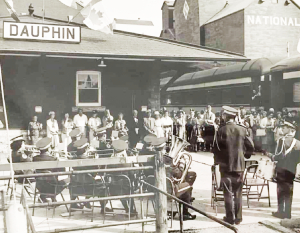
In 1969 a package price of $229 per person landed a lower berth on the 33rd annual six-day tour. The passengers boarded the train at Winnipeg, left the city at 10:05 a.m. on Friday morning and arrived at Dauphin at 2:30 p.m.
“A brass band and practically the whole town turns out to welcome the CN Hudson Bay Explorers with a civic reception. After the party there’s a motor trip using cars donated by local citizens around the rich farmlands and lakes that surround Dauphin.”
Dauphin’s hospitality was always in full force during the three-and-a-half hour stop. On one trip, three Mounties in full dress met the train as the Dauphin Boys Band played “The Star-Spangled Banner.”
Welcoming speeches and presentation of honourary citizen certificates were included in the formal part of the programme. The tourists then enjoyed cake, cupcakes, ice cream and refreshments served by the ladies of the I.O.D.E. at the Tourist Park. In case of inclement weather, provisions were made to use the Town Hall. As the train pulled away from the station at 6 p.m., the brass band played, “Au Revoir.”
The next stop occurred at Flin Flon when the train arrived at 9:30 a.m. the next morning. Festivities included an afternoon picnic at Phantom Lake with some tourists paying to go fishing, as this event was not included in the package price. An evening planned activity included an hour-and-a-half slide show at the Flin Flon Community Hall depicting life in the far north. The train left Flin Flon at 11:00 p.m.
The train arrived at Thompson on Sunday morning at 10:30 a.m. The tourists visited the church of their choice and then explored the town. After the train left Thompson at 7 p.m. it passed through Gillam, the Kettle Rapids and arrived at Churchill, the “historic, romantic gateway to the North,” at 2:30 p.m. Tours included a visit to a large grain elevator and other landmarks. If the tourists wanted to visit the ruins of Fort Prince of Wales, arrangements were made to pay for the boat ride as this was not part of the package price. On Monday night the itinerary included a dance party.
The train left Churchill on Tuesday at 8:30 p.m. and arrived at The Pas at 4:30 p.m. the next afternoon where the tourists spent several hours sightseeing at their last official planned stop. The train left for Winnipeg at 7 p.m. and arrived at its destination at 9:30 a.m. the next day.
The popularity, cost and the itinerary for the current 2023 excursion has dramatically changed since the previous ones offered from 1936-1975.
“All aboard!”
Graduation Day

The Swan Valley Regional Secondary School Class of 2023 posed for a group photo prior to graduation exercises on Friday (June 23).
“A Trip of Inspection” offered glimpse into the lives of settlers
By Ed Stozek
For the Herald
In May 1899 over 400 Eastern European settlers arrived at Halifax and boarded a train for the long trip to Strathclair, Man.
Some carried a virulent illness in which over 40 children eventually succumbed to death. Several weeks later, a reporter accompanied Dr. Cameron to visit several camps located north of Shoal Lake and wrote an article, “A Trip of Inspection Through Galicia - Observations by the Way” in the Shoal Lake Star.
“Our first call was at a house two miles north of Alex Menzies in the Rossburn municipality. Here were gathered about fifteen Galicians with a family who have been in Manitoba for about a year.” The correspondent noted that the younger members of the family could speak English.
After they left the house and were driving along the road, “two boys approached the doctor in a childish way and volunteered the information that a woman was sick on Section 10; that the road was good and that there was no big water to cross.”
At the home they encountered an elderly woman and a younger woman suffering from rheumatism. “The doctor prescribed for both and we proceeded to Reid’s store at the entrance of the colony. Here we put up for dinner and Smith and Harold looked after our wants.”
After dinner, the two men continued their journey to Brunditt’s Lake where the first camp had been set up one month previously and where scarlet fever had raged.
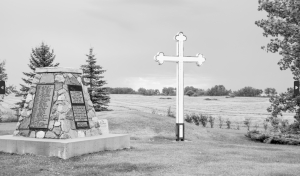
“Here was a small plot of ground fenced in and fifteen crudely constructed crosses told the sad death amongst the Galician children. Tired out from a long journey, exposed to the hardships of camp life and deprived of suitable nourishment, they were unable to combat against the ravages of what at any other time in favourable circumstances would not have been considered dangerous. At this camp we saw, like St. Paul, things which cannot be uttered.”
While at the camp a mother brought her baby to the doctor for treatment. The baby had burned his hand and foot and blisters had raised on them. The doctor readied his knife to let the water out of the blisters but the mother shrank back in horror exclaiming “No, No!”
Later, upon returning, they noticed that she had pricked open the blisters and wrapped the sore hand and foot. A sick boy was also having issues with his lungs, however, the parents would not let him go to the hospital to receive proper treatment.
The reporter noticed there was a pronounced tendency to hide any sickness. “None sick is a warning and intimation that under cover of a shawl or in some other hiding place there is a sick enfant.” He also noted the families were in daily expectation of being moved to their homesteads.
Dr. Cameron and the reporter then drove eight miles to a second camp located “in a most picturesque part of the mountain. Hills and lakes and meadows and avenues of trees form natural bounties second to none on the continent.” He saw that the settlers took great care of their cattle.
“Unlike the Canadian who allows the cattle to use their tails to brush off the mosquitoes while he protects himself, the Galician neglects his own comfort and walks by the side of his cattle, brushing off the mosquitoes from their backs with a twig while they feed in contentment.”
It was observed at this camp that it was free from disease of any kind. One man had complained of a headache. His wife had poured spirits of vinegar over his head. This eventually had the effect of closing one eye, swelling the ears to twice their size and scaling the skin off his face, however, the headache was cured. The group then proceeded to another camp four miles further. Everyone was in good health at that camp.
In the ensuing years many more settlers from Eastern Europe immigrated to the Parkland. In 1904 my maternal grandparents settled in the Horod district.
I am very grateful that they had the vision to come to Canada in search of a better life.
Flood Waters
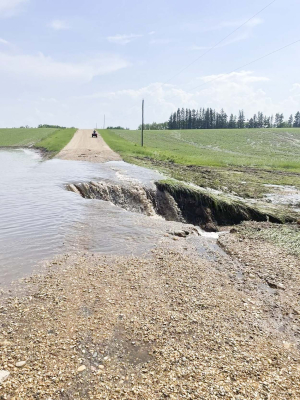
After experiencing pockets of thundershowers all week long the skies really opened up Saturday afternoon, dumping a large amount of rain across the Valley with the south east being one of the hardest hit areas.
“Tin soldiers and Nixon’s coming”
By Ed Stozek
For the Herald
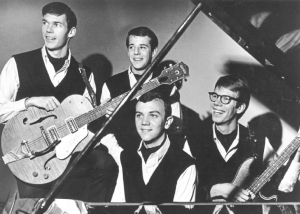
The Dec. 11, 1963 edition of the Dauphin Herald publicized an upcoming Christmas dance taking place at the collegiate auditorium on Friday, Dec. 13, with music supplied by the Squires from Winnipeg.
Formed in 1963 the group featured 17-year old lead guitarist Neil Young. The Squires signed with V Records and on July 23, 1963, recorded two original Neil Young guitar instrumentals at CKRC’s radio station studio. A total of 300 records of “The Sultan” and “Aurora” were pressed and were distributed locally by the band. Today there are only a handful of copies of “The Sultan” that are known to exist.
The Hub and Rebound is a not for profit store located at Almonte, Ont.. Recently a patron was searching through the used record section and found a 45 rpm copy of “The Sultan.” He paid 50 cents for it and then posted the rare record for sale on the Internet. After selling it for $1,000 he donated half of the proceeds to the store.
In 1966 Neil Young relocated to Los Angeles and helped form the band Buffalo Springfield. In 1969 Young teamed up with Crosby, Stills and Nash (CSNY) and performed at Woodstock before striking out as a solo artist. Throughout his musical journey, Neil Young has recorded over 1,100 songs.
On July 14, 2006, CSNY performed their Freedom of Speech Tour at the MTS Centre in Winnipeg. Earlier that year Neil Young released his “Living with War” album featuring scathing songs regarding the Iraq and Afghanistan wars and George W. Bush.
To promote his album Young planned a reunion with David Crosby, Stephen Stills and Graham Nash. After two sets of 27 songs and eight more for the encore, I left the MTS Centre reflecting upon my favourite protest songs, “For What It's Worth” and “Ohio.”
In November and December 1966, local residents and businesses were not happy with the crowds of young people going to clubs and music venues and causing late night traffic problems along the Sunset Strip in Los Angeles.
Ordinances were passed to stop loitering and included a 10 p.m. curfew. The music fans felt the new laws infringed upon their civil rights. Some 1,000 demonstrators gathered to protest resulting in many arrests. In response to the protests Neil Young's bandmate, Stephen Stills composed “For What
It's Worth.” With its opening line, “There’s something happening here” and Neil Young's melodic harmonics on guitar, the song peaked at No. 7 on the Billboard Hot 100 chart and gave the Buffalo Springfield instant national exposure.
On May 4, 1970, the U.S. National Guard shot and killed four unarmed students peacefully protesting against the bombing of Cambodia.
The May 15 issue of Life magazine covered the story that occurred at the Kent State University in Ohio. The headline “Tragedy at Kent” and a cover photo of a wounded student inspired Neil Young to pick up his guitar and starting with the line, “Tin soldiers and Nixon's coming,” composed the song “Ohio” in 20 minutes. He summoned Crosby, Stills and Nash and later that night they recorded the song. The master copy was flown to New York and “Ohio” was released on June 4, just a month after the shooting incident.
Many years later, watching CSNY perform “For What It’s Worth” and “Ohio” at the MTS Centre was indeed a highlight and made me reminisce of my university days in the early 1970s when my friend Frank and I spent a great deal of time playing music.
Frank played keyboards and I accompanied him on guitar. One day Frank and I were visiting some friends who played in a rock band and had a basement full of musical equipment. We jammed and ended up playing “For What It’s Worth” and “Ohio.”
One can also imagine the “buzz” among the students at the Dauphin Collegiate when an up and coming Winnipeg band, the Squires, played songs from the hit parade as well as some original music.
I wonder if the Squires sold any copies of “The Sultan” and “Aurora” that night.
Someone attending the dance might have a rare and most sought-after copy of Neil Young’s first attempt at recording an original song.
Local Bike Week activities planned

Bike Week is coming up June 5 to 11. The Dauphin Derailleurs Cycle Club is partnering with Dauphin Recreation Services and Northgate Trails to host several events in the city and at the Northgate Trails throughout the week to promote cycling in our community.
In order to enjoy your bike ride CAA Manitoba has some great information about safe cycling available on its website at caamanitoba.com.
Below is a summary of some of the key points to keep in mind to safely share the road and have a trouble-free trail ride:
• It is the law that individuals under the age of 18 are required to wear a helmet while cycling. (Everyone should wear a helmet – not just kids.)
• Wear bright colours and reflective clothing while cycling on roadways, and if you are cycling at night make sure you have a working headlight and a red taillight. It’s a great idea to have a flashing red taillight on at all times when you cycle on roadways.
• Cyclists share the road with motorists so be sure to use proper hand signals to indicate your direction.
• On trails, if you are coming up behind a pedestrian be sure to use verbal cues indicating which side you are passing them on and attach a bike bell or use a whistle to give a warning ring when approaching.
• On roadways, travel with traffic, near the edge of the curb and do not weave in and out of traffic.
• Obey traffic signals and lights.
• Ride single file when cycling with others.
Cycling is a great activity for the entire family.
The City of Dauphin is adding to its active transport system every year, so get out and ride.
Clear Lake Golf Course grows into one of the best
By Ed Stozek
For the Herald
The Minister of the Interior, the Hon. Charles Stewart, addressed a large gathering at Clear Lake on Aug. 16, 1928.
He promised considerable improvements to Clear Lake and Riding Mountain Park, but was non-committal on setting aside an area for a national park. He noted that initially $20,000 had been set aside for the improvement of roads, the increasing of bush facilities and the establishment of a golf course.
By 1930 the near completion of the golf course was well under way.
“According to an official, three golf architects have designed the course and it is being seeded down this year. There is no possibility of it being opened this year but when completed it will be one of the finest courses in the west.” (May 22, 1930, Brandon Daily Sun)
An article in the July 30, 1931, edition of the Dauphin Herald showed that the course was used daily by a large number of players who were challenged by several tricky holes in which a stream of clear running water contributed to a variety of hazards.
The course with its rolling ground also tested the individual player’s skills. Local players found the course to be in great shape and predicted that it would soon become a popular tournament centre.
Situated on a high hill just north of the 9th green, a new clubhouse was also completed by May in 1932. Due to the growing number of golf enthusiasts the clubhouse was expanded in 1935 with further alterations carried out in 1945, 1956 and 1976.
Expansion was also planned for the golf course.
“West of the present fairways a new nine-hole course is being cut out of the bush and while it is not likely that play will be permitted this year, the work will be rushed along provided the appropriation for such a plan is available.” (January 5, 1932, Brandon Daily Sun) It was also stated that the second half of the course promised to give even the best players a great deal of challenges.
In June 1928 the Country Club and the Community Golf Club at Dauphin hired a young man with an excellent record in amateur competitions, Winnipeg’s Johnnie Lawrence, to act in a professional capacity. As mentioned in Emma Ringstrom’s book, Riding Mountain, Yesterday and Today, while occupying the position at Dauphin, Lawrence also assisted in the construction of the Clear Lake golf course.
Lawrence left Dauphin in 1934 to become the professional at the Clear Lake course. In July 1935, Lawrence played a round of golf with the Hon. James Bowman, Conservative MP and Speaker of the House and Dauphin’s Dr. Harrington. Lawrence set a new record for the eighteen-hole course carding a 71, one stroke better than his former mark. Along with being the golf pro, Lawrence also designed courses at Shoal Lake, Sandy Lake, Neepawa and Minnedosa.
In 1976 at the age of 68, Lawrence retired after being a professional at the Clear Lake golf course for over 40 years. A special testimonial night was held at Danceland on Aug. 9, where Lawrence was “roasted” and “toasted.” Lawrence was elected a Life Member of the Canadian Professional Golfers’ Association, the Manitoba Professional Golfers’ Association, and the Clear Lake Golf Course.
During Lawrence’s tenure as golf pro, the first annual Grey Owl Golf Tournament started on June 3, 1961, with 100 golfers paying the $6 entry fee to participate in the hunt for prizes and 10 trophies. The entry fee included $4 for green fees and $2 for the prize pot.
After playing 36 holes in the two-day tournament Winnipeg’s Ron Fiddler captured first place. He had the honour to wear the green blazer and was the recipient of the Brandon Hotel Trophy.
The other major trophy winner, CBW-TV’s sportscaster Don Wittman, claimed the Ted Heming Trophy for sportswriters and sportscasters.
The following year 167 golfers participated in the tournament. Currently the Grey Owl Golf Tournament is one of the longest running tournaments of its kind in North America.
Located on 1 Johnnie Lawrence Drive, the Clear Lake Golf Course ranks as one of the most unique and beautiful golf courses in Manitoba.
In the Field
With the recent stretch of warm weather, farmers across the Valley were able to get into their fields and get the 2023 farming season underway.
Country roads are still leading me home
By Ed Stozek
For the Herald
John Denver’s song, “Take Me Home Country Roads” always sparks memories of the many trips down the gravel roads that once led to my parent’s farm.
Today, a typical road-trip from my home at Dauphin to the farm in the Oakburn district includes a lunch at a scenic outdoor location plus visits to several one-room country school sites, farm yards, churches and cemeteries, as well as conversing with the locals whom we happen to stop and visit with.
The first stop usually occurs at the Horod School site. It serves as a reminder of the days when Grades 1 to 8 classes learned the three Rs in a one-room country school setting.
Sitting on the front steps and eating a sandwich reminds a person of the lunches that were consumed over a 12-year period of attending school. My mother packed lunches in my Davy Crockett metal lunch kit. The lunch kit had a scene of Davy fighting a grizzly and came complete with a matching thermos. The lunch kit was eventually replaced with a plain black lunch box and in my high school years a brown paper bag sufficed.
As one drives from Horod, every hill and curve in the gravel road makes one reminisce of past experiences.
One year my parents and I moved part of our herd of cows and calves almost nine miles by walking them from our farm to my grandparent’s place near Horod. Kicking stones and checking for gophers in the ditches occupied most of the walk. Once the journey was over we were rewarded with a drink of cold water from the spring well and a well-deserved lunch.
Several of the farmyards that we walked past that day are now vacant.
At one of our former neighbour’s yard, the house had recently succumbed to the elements and the yard is now overgrown with grass and weeds. When the family occupied the premises, the yard and the buildings were well looked after. My mother always admired the garden and the flowers. While my parents visited with Peter and Joan, I got the opportunity to socialize with their sons. I recall one visit when two of the older boys brought out their instruments and showed their talent by playing some tunes. It spurred my interest in learning to play the guitar.
In 1971, soon after writing my exams at university, my first summer job was “brushing” some of those ditches that the cows and calves followed.
Armed with axes and saws our crew cut down the brush so that the ditches were clear from obstructions, especially at blind spots located at uncontrolled intersections. When driving, one learned to look both ways and slow down and watch for oncoming traffic at those corners.
Initially, while attending Brandon University I often hitched a ride home for the weekend with one of my school friends. In 1973, I became the proud owner of a Toyota Corolla and coming home became much easier. That spring, when university classes ended, my fiancé and I dropped my classmate Frank off at his home near Rossburn. We borrowed Frank’s recording equipment and Janice and I had a great deal of fun in my parent’s livingroom recording songs on the four-track reel to reel tape recorder. One of the songs that we practiced that afternoon included “Take Me Home Country Roads.”
When my parents had their auction sale in 1975, the frequent trips to the farm came to an end. Almost 50 years later, driving down those familiar gravel roads for a visit to the “homeland’ brings back many memories.
Sadly, on the last trip this past summer, my sisters and I stopped in to visit an old friend and former farm neighbour. Her husband had recently passed away and we stopped in to say hello and give Olia our condolences. My sisters and Olia were former classmates at the St. John School one-room country school. It was great to talk about the “good old days’ and of all the changes in the neighbourhood that had occurred since my sisters and I moved away from my parent’s farm.
“Country roads, take me home, to the place I belong.”
Challenge is on
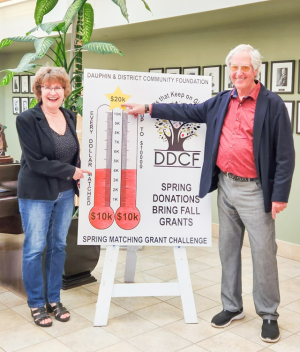
Bob Williams, developer of the Dauphin Market Place Mall, has issued a challenge where he will match donations made during the Dauphin and District Community Foundation’s Spring Donations Campaign up to $10,000.
Williams, pictured here with DDCF executive director Kit Daley, made the challenge in memory of Ernie Hutsal, affectionately known as “The Hutsal Man”, the longest serving employee at the mall.
The spring donation campaign is currently underway.