
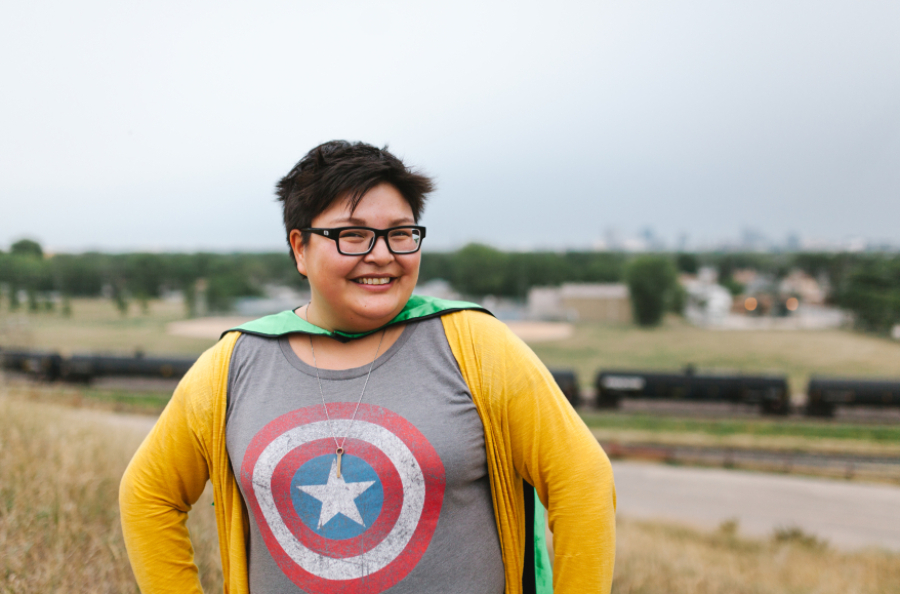
Growing up with a love of reading and making up stories is a sure path to a career in writing of some sort. That is exactly what fueled the fire for Sonya Ballantyne to become a writer, director and filmmaker.
“When I was a little girl, I loved making up stories,” said Creative Native Writer, Director and Public Speaker Sonya Ballantyne. “When I was in nursery school, I saw this huge book on my teacher's desk and she told me that people got paid to write books, and I knew it was what I wanted to do when I grew up. I became a film director, because in film school there were people who wanted to change my work, so it wasn't about Indigenous people or about the reserve as so to maintain my writing that I decided to pursue directing. I prefer writing though. “I always wanted to leave the reserve. I grew up mostly on the Misipawistik Cree Nation, but spent a lot of time in Opaskwayak Cree Nation and Chemawawin growing up. I always wanted to travel. The best route to get me away from home was to attend university, so I went to the University of Manitoba when I was 17. It was a hard few months, because I hadn't ever been away from home. I was on my own mostly, because my family still lived back home. “I really wanted to at tend this history of film class I signed up for, so I kept making excuses to stay in Winnipeg,” said Ballantyne. “By the time Christmas rolled around, I loved Winnipeg and the university, and decided to stay.” Ballantyne’s first experience with film making happened to be on her own first film. She had a story to tell and audiences were listening, which led her to do more. “The first real project I worked on was my first film,” said Ballantyne. “It was a short film called Crash Site and it was about two Cree sisters who reconcile after the death of their parents with the help of a superhero. “The highlights of making it were how everyone responded to it. It is still shown in university classes and festivals to this day, even though it is almost 10 years old. The challenges were mostly related to how many things had to change. I ran out of time when we were making it so some scenes were changed or left out entirely.” Ballantyne’s list of films and writing projects has been extensive over the last nine years. Every year she has worked on some kind of project. Crash Site was her first short film she did as a director and writer in 2015, and it was the winner of the Gimli Film Festival pitch competition. Nosisim is a short documentary that Ballantyne both wrote and directed 2017, which recently placed in the Indigenous Art Centre of Indigenous and Northern Affairs Canada. Then in 2018, Ballantyne was co-director for My Boy, a short documentary. Eagle Girl was another short film that Ballantyne both wrote and directed in 2019, and it was the winner of the ImagineNative pitch com petition. Ballantyne was also named a Barbie Role Model in 2019, and worked as a sensitivity consultant on the video game God of War Ragnarok. Then Ballantyne wrote The Walking Dead: LAST MILE: video game in 2022. For television, Ballantyne was a writer and story editor for the series Acting Mel and her Kookum. “I love showing the world as I see it,” said Ballantyne. “With my newest film, Death Tour, I wanted to portray northern Manitoba as I saw it. Good, in 2022 to 2023, and was nominated for the Writer's Guild of Canada Award. Another television series that Ballantyne wrote for was Builder Brothers Dream Factory last year. Ballantyne’s more recent film project is The Death Tour, which she was a co-director and wrestling consultant. The film has been screened at Cannes Film Festival 2022 and Slamdance Film Festival 2023. “I enjoyed working on Builder Brothers Dream Factory the most, because it was my first real writing job out of working full time at a government job,” said Ballantyne. “I was so prepared to come in and fight for everything that I wanted to say, and I ended up being embraced by the writer's room. I didn't have to put up a fight for anything or justify why I wanted to tell the story I wanted to tell. “I wrote a story about this little girl Mel finding out her Kookum was a residential school survivor. I remember being asked how we were going to portray residential school in an age appropriate way for a pre school audience, and I think we succeeded. I never thought I would write for a Cree girl that wasn't my own creation and not only did I get to that with Dream Fac tory, but I also had two Cree actresses play Yeah, it can be harsh but it is one of the most beautiful places on earth. Our people are dealing with terrible things, but there is so much joy despite the hardship. “I also like that I am contributing to more representation for Cree women and girls. I never had a TV show or movie that showed Cree women or Indigenous women in general, in film genres I enjoyed while I was growing up. When I became an adult and still didn't see the content I wanted, I decided I would have to create it. “I promised myself I would never write some thing about residential school, but my creative juices had other plans,” said Ballantyne. “A lot of my work has autobiographical elements, so sometimes it can be hard to watch or create to the north. Each night, even if we didn't announce a show, word got out quickly that there was one and every kid on the rez would be there. They were so excited for the show and for this one wrestler, The Matriarch, that when she won a match, the kids almost broke the ring in their happiness. things that are about harder aspects of my life. It took me a long time to be able to sit in on screenings of Nosisim, because it felt like relieving the death of my grandma every time, but I find the more open I am about sharing the hard things about my upbringing, the more audiences connect with it.” With the film The Death Tour, it allowed Ballantyne to dive into her love of wrestling and what wrestling matches in northern communities can bring to the people as well as the wrestlers. At one point in Ballantyne’s life, she wanted to become a wrestler. “My family were huge fans of wrestling so WWF was always on,” said Ballantyne. “I really loved how accessible it was. Anyone could be a wrestler. “I seriously looked at becoming a professional wrestler when I was 13, but I came up during the time of WWF's Attitude Era, where the most popular match for women was a bra and panties match. The winner was the woman who could strip the other down to her underwear. “I wanted to be Bret Hart or Shawn Michaels, my favourite wrestlers, but I saw the glass ceiling for myself before I even started,” said Ballantyne. “I was disheartened and gave up on that dream. “Wrestling events brings a lot of joy “I think a lot of people would see something like a wrestling match as not too important in the grand scheme of things, but I saw for myself how happy it made the audience whenever we had a show,” said Ballantyne. “I think anything that makes a person happy is important. “Many of the wrestlers had never been to a reserve, including my fellow director, Stephan. It really opened their eyes to what Indigenous people endure in their own back yards. There were a rash of deaths while we were on the trips and so many shows were cancelled while the community mourned. Despite their grief, one community made sure our group was ok by bringing moose meat stew and pizzas to us. The wrestlers were overwhelmed by how they were welcomed to and embraced by the communities we visited.” Ballantyne is already working on her next film project and for 70s rock music lovers, it’s sure to be one to watch. “I'm working on a film called Six, which follows the friendship of two young girls and how they survive residential school through the music of Creedence Clearwater Revival."
From paper to the big screen
Published in Opasquia Times Community
Published in
Opasquia Times Community
Tagged under
