

Submitted
New life members
The Kilty Kurling Klub welcomed three new life members to its fold, recently.
Debra Watson of the life membership committee, presented Carolyn Baker with her certificate, top, while committee member Dona-Leigh Davis presented certificates to Norma Johnson, middle, and Brenda Desroches.

The three new members were recognized for their contributions to ladies curling in Dauphin.

D Division commander retiring
Manitoba’s top cop is retiring.
Assistant Commissioner Jane MacLatchy announced her planned retirement from the RCMP last week, after more than 34 years of dedicated service to Canadians.
A/Commr. MacLatchy has been the commanding officer of the Manitoba RCMP for three years, having taken command in February 2019.
Her last day as commanding officer will be in June.
“My career with the RCMP has brought me across Canada, and three years ago, it brought me to Manitoba,” MacLatchy said. “It has truly been an honour to be the commanding officer for the Manitoba RCMP. Over the last three years, I’ve seen countless examples where the nearly 1,500 employees of this incredible organization have made positive differences in the lives of Manitobans. Time and again, they have gone above and beyond to ensure the safety of the communities we so proudly serve in this province. It has been a privilege to work alongside them and see first hand, their commitment and professionalism.”
The process to select a new commanding officer will begin shortly.
Further details will be available at a later date.
Furry friend funds
On Mar. 21, the Gilbert Plains branch of Western Financial Group was able to donate $5,000 to the Parkland Humane Society.
Pictured, from left, is Kristen Rubeniuk, Peanut, Dawn Fillion, Nancy Beattie and PHS volunteer Denise Penrose.
The donation was made available through the Western Financial Group’s charitable arm, The Western Communities Foundation - Infrastructure Grant.
The funds will go towards kennel renovations and other upkeep needs at the shelter. In 2021 the branch was also able to donate $3,144 to the Gilbert Plains Caboose Restoration project, $459.50 to the Gilbert Plains Resource Council activity fund and its annual $750 graduation bursary to Melanie Patenaude.
A helping hand

The women of the Fork River Women’s Institute recently made a donation of cash and hygiene items to the Parkland Crisis Center and Women’s Shelter.
Pictured are Amanda of the Crisis Center, and Marilyn Kippen, Lorna DeVos and Emily Pylypchuk of the Fork River WI.
The ladies of the WI live by the motto “For Home and Country.” They are a dozen women who focus on sharing helpful information and improving the lives of women and families locally, nationally and internationally.
Despite the difficulties of fund-raising during COVID-19, the group wanted to help other women facing difficult times in their lives.
The number of wards, trustees in question MVSD wants to hear from its communities
By Floyd Martens
MVSD Board Chair
Who represents your voice?
The easy answer is the people we choose to speak on our behalf.
But it can be more complicated than that. Not everyone who gets elected has the same perspective that I may have on an issue. It is the nature of democracy.
We choose people to represent us – the majority of us. They will not always share our perspective on each and every issue that arises. They may make decisions we agree with or they may make ones we do not support.
Regardless, they were elected to represent everyone.
For those elected, the responsibility is to willingly hear concerns and viewpoints from all citizens. After doing so, they make the best decisions possible. It may not be the decision I might make or like, but they are elected to represent all voices and make decisions accordingly.
Elections matter.
This fall, elections will be held for municipal governments and school boards. We as citizens have the opportunity to choose our representatives - those who will make the best decisions they can with the information and constraints they have.
Mountain View School Division is looking for your input on this upcoming election. Not only are people encouraged to run as a trustee, but the make-up of the board requires your input.
Currently, the board of trustees has nine trustees elected in four wards. These wards follow municipal boundaries and are used for election purposes. Once trustees are elected, they represent the entire school division and not just the area they are elected from. It is the nature of trusteeship.
Each trustee represents approximately the same number of people. It is a requirement to be within 25 per cent below or above the average number of electors.
When that gets out of alignment, wards need to be adjusted. At the present moment, we are nearing the 25 per cent threshold in a couple of our wards.
In looking at potentially adjusting wards, two options exist.
We can leave the structure and number of trustees the same and see where the average sits after this election. It may require changes for the election four years from now.
Or, we could adjust the number of wards and trustees for this year’s election.
Instead of four wards and nine trustees, we could move to three wards and seven trustees.
It is not an easy decision.
The board has been operating for over a year with seven trustees due to two resignations in the midst of the pandemic. Holding byelections, given the restrictions, was not advisable.
While this required more time commitment for current trustees, the board managed to represent our communities with the reduced numbers.
But, do our communities feel represented?
The reduction of two trustees is not really a financial consideration. Although the trustee budget will be reduced slightly, saving $10,000 to $15,000 from a $45 million budget does not make a significant difference.
The issue is more about representation.
To that end, the board is seeking feedback from our communities prior to making a decision.
A short survey is available for you to provide your input. It is available on our website at www.mvsd.ca until Apr. 8 at 4 p.m.
You can also receive hard copies by contacting the division office at 204-638-3001.\
Representation is important. The board does not want our communities to feel a loss of local voice if a reduction to the number of trustees were to occur.
We need to hear from you.
U15 female Rangers capture bronze at provincials
The U15 Parkland AAA Female Rangers have had a season of ups and downs this year, but ended on a high note.
The weekend of Mar. 11 to 13, the team traveled to Carman to compete in the Rural AAA Provincials, which included seven regional teams - Eastman Selects, Pembina Valley Hawks, Westman Wildcats, Brandon Wheat Kings, Norman Wild, Yellowhead Chiefs and Parkland.
The first day of the tournament was a long one, as some of the players hit closed roads on the way to Carman on the Thursday night and slept in their vehicle in a gas station on the No. 1 highway. Other players had early mornings on the road that were just opened to make it to the first game at 1 p.m. in Carman, but all the girls came to play.
The first game we met the host team, Pembina Valley Hawks.
The Rangers came up short and lost a hard fought battle 5-3. The Rangers then faced off against Westman Wild and ended in a 1-1 tie.
Once all the other teams finished the round-robin play, the Rangers placed fourth, which meant on Sunday morning they were playing for a chance to go into the gold/silver medal game.
The Rangers lost against the Brandon Wheat Kings for that chance. The Rangers then moved on to the bronze medal game where they were to meet the host Pembina Valley Hawks again. The Rangers put everything they had into the game and came up with the W, a 4-3 OT win, with the winning goal scored by Avery Frattinger and assisted by Montana Jubenvill. The coaching staff are head coach Phil Fafard from Dauphin, Dave Kirk from Swan River, Jodi Kaskiw from Gilbert Plains, Ann Ransom from Dauphin, and Jill Wiebe from Grandview. The team includes Adel Wiebe of Grandview, Avery Frattinger of Elkhorn, Brooke Shewchuk of Dauphin, Carli Durston of Dauphin, Dara Robak of Gilbert Plains, Ffion Devonlad of McCreary, Grace Kirk of Swan River, Katie Falkevitch of Russell, Layne Minshull of Grandview, Montana Jubenvill of Gilbert Plains, Olivia Brown of Dauphin, Peyton Lehmann of Bowsman, Ruth Dandeneau of Dauphin, Sara Hopfner of Ste. Rose, Sophie Oversby of Ste Rose and Tayah Zimmer of Russell.
Extracurricular activities are of great importance
By Gabe Mercier
MVSD Trustee
As parents and adults, we have come to realize how important, rich and rewarding participation in our community activities has been for our quality of life.
The research is showing that students who participate in extracurricular activities benefit from the many opportunities provided by the events. Gains from participating in extracurricular activities include higher self-concept, better school attendance, higher standardized test scores and higher educational attainment.
Extracurricular activities in Mountain View School Division (MVSD) provide an avenue for reinforcing the lessons learned in the classroom. They provide students the opportunity to apply academic skills in a practical context of real-world situations, and are therefore considered part of a well-rounded school education.
Those extracurricular activities in MVSD can help students build professional skills, as well as skills that cannot be learned in the academic environment of the classroom alone. The activities can help expand students’ social circles and also allow them to pursue their interests. Having to contend with school and extracurricular activities encourages students to build good time management skills.
Almost every school, and particularly the high schools in MVSD, offers some type of extracurricular activity, such as student council, music, volunteer opportunities, educational travels, student voice, sports, etc.
These activities offer opportunities for students to learn athletics, the values of teamwork and team spirit, individual and group responsibility, competition, social diversity and the need for community.
Student Voice activities, for example, aim to promote student engagement and achievement in MVSD by listening to and learning from students. This gives students an opportunity to share their experiences, expertise, opinions and ideas with their school and the division to improve student learning.
Participating in student councils gives students valuable insight in governance within a greater society.
At many schools in MVSD, student council is a group of mainly elected student volunteers who work together with a staff advisor within the basis of preset procedures, to provide a means for students to assist in school activities. This gives opportunities for student experience in leadership and communication skills, and encourages student, school staff and community relations.
School sports encourage the students to participate in activities that will assist in learning about healthy living and in promoting physical, social and emotional values. Below are the Sport Principles of the Manitoba High Schools Athletics Association:
• Go for It – Rise to the challenge – always strive for excellence. Discover how good you can be.
• Play Fair – Play honestly – obey both the letter and spirit of the rules. Winning is only meaningful when competition is fair.
• Respect Others – Show respect for everyone involved in creating your sporting experience, both on and off the field. Win with dignity and lose with grace.
• Keep it Fun – Find the joy of sport. Keep a positive attitude both on and off the field.
• Stay Healthy – Place physical and mental health above all other considerations – avoid unsafe activities. Respect your body and keep in shape.
• Include Everyone – Share sport with others. Ensure everyone has a place to play.
• Give Back – Find ways to show your appreciation for the community that supports your sport and helps make it possible.
Participating in extracurricular activities reduces the possibility that a young person would participate in illicit activities or indulge in drug and alcohol use.
The evidence is clear: it is important for schools, communities and parents to provide more extracurricular opportunities for our students.
While it is a fact that some extracurricular activities are expensive - and for many families, those activities may be cost prohibitive and out of reach for their children - there are a myriad of activities provided by schools and community organizations that provide opportunities for the development of positive self-worth, teamwork, leadership skills and community connections.
Finally, without a doubt, the advent of the COVID-19 pandemic over the past two years has been devastating for family connections, extracurricular sports, and face-to-face group activities.
This situation has challenged many of our families and educational communities when it comes to our relationships, well-being and mental health.
We are all relieved with the conditions that have precipitated changes in the health and safety precautions, and the lifting of restrictions that were placed on group activities.
Many of our team sports have resumed their activities, and MVSD will continue to support those activities that will provide enhanced extracurricular opportunities for students.
We wish those participants in extracurricular activities success in the remainder of the school year.
Everyone enjoyed listening to The Hotel Band
By Ed Stozek
For the Herald
Elmer Zalischuk started his musical journey by learning to play the guitar when he was 18 years old. He later took fiddle lessons from Edward Lytwyn and Francis “Fiddling Red” Sabiston. Elmer noted that Fiddling Red taught him some of the tricks of the trade including playing “The Orange Blossom Special.”
In 1957 Elmer boarded the train and with 14 other locals left Winnipegosis to seek employment at Churchill. He initially worked as a carpenter renovating the theatre and then he helped to build a bowling alley. In 1959 he gained employment with the National Harbours Board. His interest in the electrical department led him to become an electrician, a job that he worked at until 1972. Since Elmer was a seasonal employee he came back home every year from November to April and helped his brother operate a garage business. During his years of working with the Harbours Board, Elmer only had to twice stay for the whole year at Churchill.
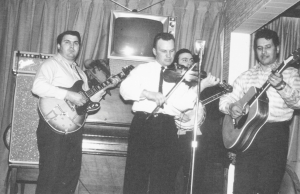
Playing music has always been an important part of Elmer’s life. Shortly after arriving at Churchill he began “jamming” with Edward and Josey Lytwyn. They formed a band and played together at various social functions. Elmer ordered a new fiddle from the Eaton’s mail order catalogue and in 1961 teamed up with Bobby Demeulles, Danny Demeulles and Josey Lytwyn.
In 1962 the owner of the Churchill Hotel hired the band to play from 9 p.m. to 11 p.m. on Friday and Saturday nights. They were the first band to provide live music at the establishment. The hotel was divided into two beverage rooms and had a small stage area. One side of the room was designated for men only and the other side accommodated both women and men. Men couldn’t sit on the women’s side unless they had a female escort.
When provincial hotel liquor laws changed the room dividers were taken down to make one big beverage room. The hotel was always packed on the nights when there was live entertainment. Patrons lined up and waited for a table to open up and a chance to sit down, have a drink and dance to the music of the “hotel band.”
The CHGH-TV station affiliated with CBC at Churchill went on the air in 1964. The hotel band accepted the invitation to do live performances every Saturday at 7:30 p.m. for a new half-hour show, Country Caravan.
Up to this time the band never had a formal name. Five minutes before air time someone suggested the name, the Rhythmakers. The name stuck. After playing at the television studio they had to pack up their equipment and rush over to the Churchill Hotel and set up to entertain at 9 p.m.
The Rhythmakers also played at the Hudson Hotel and at various other social functions.
Located six miles from Churchill, the Strategic Air Command Training Base for American servicemen was also home to three night clubs, the Aurora, the Borealis and the Navy Club. Elmer remarked that at the formal dances the ladies wore long evening gowns and the servicemen were attired in dress uniforms.
“It was a very classy place to play at.”
When Elmer came home for the winter months he played with the Serenadors and filled in with other local bands including the Sedors, the Meadowlanders and Smiling Johnny. In 1982 the Original Polka Kings needed a guitar player for a wedding at Pine River. Elmer practiced a few tunes with the band right before the function started and ended up becoming a permanent member with the Original Polka Kings until 1987.
Currently, Elmer enjoys playing with the Prairie Dust band. Prior to COVID-19 they entertained at a variety of social functions including weekly performances at the local senior’s care homes.
Elmer also competed and did very well at various fiddling contests.
The love for music runs in Elmer’s family and started with his father playing the fiddle. Recently, most Thursday nights find Elmer and his son Michael spending quality time practicing a variety of fiddle tunes. Elmer’s grandsons are also learning to play the guitar and the fiddle.
The musical journey continues. “It’s that Orange Blossom Special rollin’ down the seaboard line.”
Gilbert Plains students get hands-on taste of ag. research
By Riley Turetsky
GPCI Student
On Dec. 7, 2021, Grades 11 and 12 students at Gilbert Plains Collegiate Institute (GPCI) were given the opportunity to sit in on former GPCI student, Chris Manchur’s “Agriculture through a Microscope” presentation.
The presentation aimed to give rural high school students a chance to experience science in a way that would otherwise be out of reach for them because of their rural location. Manchur managed to make the presentation relatable by centering it on agriculture, the main economic stimulus in the area.
Manchur is currently attending the University of Manitoba as a master’s student in the Department of Biological Sciences. He first got into agriculture from his experience on his family farm, along with a project he did in a high school course called “Topics in Science.” This is where he learned about GMO’s, and specifically, the golden rice situation.
After graduating in 2015, Manchur went to the U of M to obtain a bachelor’s degree in Agriculture from 2015 to 2020, where he studied plant biotechnology and crop protection.
Afterwards, he moved to pursue a master’s degree in Agricultural Sciences. His work focuses on researching new biotechnologies, more specifically, replacements for current fungicides with the more environmentally friendly RNAi technology.
Farmers need to know if their crops can withstand the disease, and that’s where Manchur and science comes in. He uses his degree to help farmers control their crop diseases by introducing an innovative technology called RNAi (RNA interference). It seems to be the next generation of fungicides because it can remain environmentally friendly unlike our modern chemicals that carry the risk of being toxic and environmentally hazardous.
Manchur centered his presentation on the problems that farmers and others in the agriculture industry, face. Those things consist of droughts, flooding, costs of fertilizer and seeds, prices of crops, etc.
However, the biggest threat that farmers must endure is diseases. Manchur explained that diseases can lower yields, which impacts farmer’s profits and the amount of food available around the world. Manchur taught us about four diseases in the presentation, as well as speaking about how a single disease can reproduce into numerous variants called strains.
During his presentation, Manchur conducted two experiments with the assistance of the GPCI students. In the first experiment, he presented a method called Gel Electrophoresis, which is a laboratory method used to separate DNA, RNA and protein fragments according to their molecular size. This technique allowed the students to see which strain of a disease they were working with.
In the second experiment, he used a method called Disc Diffusion Assays, which is a method to test the effectiveness of different concentrations of fungicide. In the experiment five petri dishes were contaminated with a certain pathogen and then five separate concentrations of fungicide, ranging from as high as 1,000 ppm to 0.01 ppm, were placed in each petri dish respectively. The idea was to pinpoint the lowest concentration that supplied enough protection from the pathogen, without the concentration of fungicide being too high. This can help farmers lower cost and the environmental impact of their sprays.
Towards the end of his presentation, Manchur spoke to the future high-school graduates in the school about post-secondary education opportunities in agriculture.
He provided the necessary information about the University of Manitoba, the agriculture programs they offer, and scholarships offered for those programs.
Along with quizzing the students about everything they have learned and offering prizes such as sweaters, water bottles and more to those who participated in answering his questions.
The presentation was eye-opening and provided an excellent opportunity to see the real-world applications of science beyond our general high-school courses.
Partnerships between local leadership and MVSD are important
By Charlene Gulak
MVSD Trustee
Education leaders and local government have a closely linked relationship.
The health and viability of a community is often very dependent upon access to a school and vice versa. Changes to school programming have the potential of ripple impacts in the community. Rural population trends often have a direct impact on school enrolment. In the same way, the location and proximity to a school can be a vital asset or even a determining factor when individuals or families consider relocating to a community.
According to Ron Kostyshyn, Reeve for the Mossey River Municipality and Parkland representative for the Association of Manitoba Municipalities, our planning priorities between the education sector and municipal government work in tandem.
Reeve Kostyshyn identified that any opportunities to enhance a municipal tax base are always at the focus of local promotion and decision making. Access to quality education in a small community, is a huge asset which contributes to the fabric of the community life. He stated that access to a school provides valuable amenities which assist in marketing a community’s assets and encouraging relocation. The spin off benefits when someone new moves into a community have a domino impact on housing and all other services within a community.
This symbiotic relationship is much more prominent from a rural lens and holds true for the communities located within Mountain View School Division (MVSD).
Recently, MVSD met with local leaders to reconnect, following the height of the pandemic. The conversation also focused on a review of current ward boundaries and potential changes. Equitable representation is a priority when considering the local population base and its distribution within MVSD’s catchment area.
The division contains a huge geographical area with both larger and more sparsely populated communities. Ensuring local voice is effectively represented, while determining efficiencies and size in board composition, is a balancing act. Further public consultation is necessary to ensure that any change reflects the forecasted needs of a community and local leadership is vital to this gauge.
Shared partnership opportunities between municipal and Indigenous leadership within MVSD’s footprint reflect many mutual priorities and the need to shift and fit changing circumstances as we enter a pandemic recovery phase.
Public health restrictions have prevented community use of schools for nearly two years. For our MVSD communities, we know that this has halted community-based recreation, sports and arts activities and hosting public events – ranging from dance recitals to public Remembrance Day events.
Access to MVSD public school infrastructure is weaved into the vitality of communities. The collective loss of access on gathering has impacted the collective life of our communities. The easing of restrictions and commitment to safe approaches to manage the pandemic and the virus will translate into renewed vigor for communities.
Community leaders in local government appreciate the need for shifting priorities as we build a collective understanding of the pandemic’s impacts on youth. Re-establishing routines around returning to school safely, is a concern shared by leaders. Jimmy Chartrand, councillor with Skownan First Nation, advised that it is important to work with partners in education to participate in conversation and build strategies which support the needs of youth.
He reflected that, “Two years of the pandemic has had a huge impact on youth who have not been in school regularly.”
The hour-long bus ride for a student having to travel to Winnipegosis Collegiate or Rorketon School from the community, particularly during the many cold winter days we have experienced this winter, makes the return to in-person learning a welcome but challenging transition.
I have experienced a similar experience with motivating my own daughters to attend school, due to their preference for remote learning. This wouldn’t even have been considered an option prior to the pandemic.
Remote learning delivery has been a unique rural challenge for Manitoba due to inequities in household internet connectivity access.
These mutual priorities are shared among leadership on both sides of communities and education.
Experiencing these challenges with your family, but also as a local leader, stresses the importance of working with stakeholders in education to help build upon partnerships which support youth and their education. Councillor Chartrand shared that we all have an important role to play in prioritizing education and recognizing that, “it is the key to the future and dreams.”
MVSD will continue to work with communities and foster relationships with all stakeholders, including municipalities and Indigenous leadership.
The dialogue is critical to the strength of rural communities and putting students first in success of their education.