
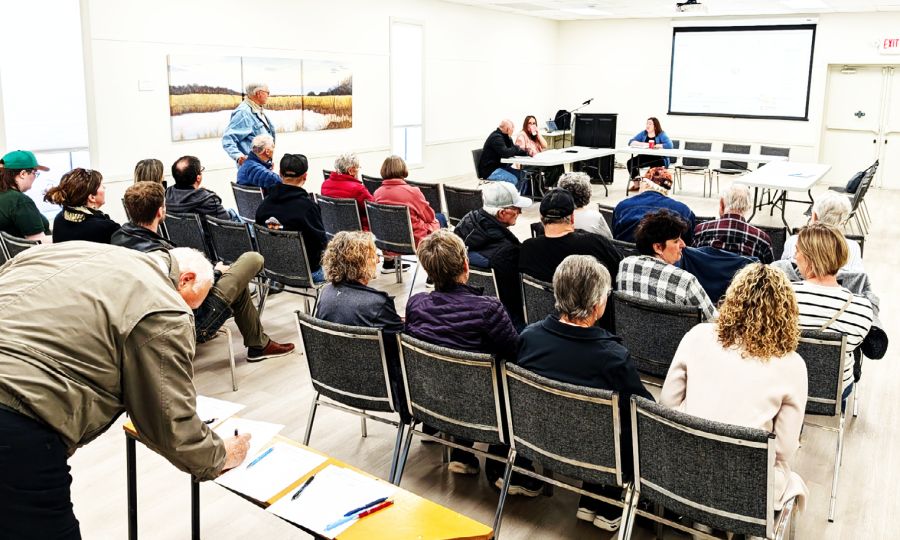
Approximately 50 people attended a public meeting discussing the urban reserve proposed by Gambler First Nation and the federal government encompassing the property at 447-459 Main St. N. - commonly known as the offices of Gambler First Nation, The Russell Banner and Canada Post. The following questions were presented to Gambler First Nation and the Municipality of Russell Binscarth:
What is the dispute-resolution process if the municipality and First Nation disagree on issues like bylaws or services later?
Article 13 of the proposed Municipal Services Agreement (MSA) outlines a clear, step-by-step dispute resolution process. First, both parties agree to attempt to resolve issues through good-faith negotiations between appointed representatives within 30 days. If unresolved, the matter goes to a jointly selected mediator. If mediation fails after 60 days, disputes specifically concerning financial provisions or service standards are referred to binding arbitration in accordance with The Arbitration Act of Manitoba, ensuring a final and legally binding decision for both parties.
• How often will the service agreement be reviewed and updated, and who initiates those reviews?
The current draft states that the agreement remains in effect as long as the lands retain their reserve status. Any changes or amendments to the agreement must be made in writing and signed by authorized representatives of both governments. Any party to the agreement may initiate changes to the agreement.
Economic Impacts
• How will the municipality be compensated for lost property tax revenue on the urban reserve land?
Under Article 9 of the MSA, Gambler First Nation commits to paying an annual "General Service Charge". This charge will be calculated as a negotiated percentage of the municipal tax levy that would have applied if the property were taxable, based on the property's assessed value determined by the provincial assessment authority. This ensures guaranteed, annual revenue for the municipality.
• What protections exist to prevent unfair competition for local businesses due to tax exemptions on the reserve?
By law, First Nation businesses located on an urban reserve are required to collect provincial and federal sales taxes. The only exception is for registered Status Indians, who are exempt from sales tax when purchasing goods and services on reserve land. For all other residents and visitors of Russell-Binscarth, the prices and taxes will be the exact same as at any other local store, ensuring a level playing field and fair competition. To further reassure local businesses, please note that we do not plan to open high-traffic retail operations such as convenience stores or gas stations on this site. The property will continue to be used exclusively for First Nation administrative offices and to accommodate our existing tenants. The property will be subject to Gambler First Nation's Land Laws, which currently prioritize administrative and professional tenant use for this specific location.
• Are there community benefits or joint initiatives planned, such as job training or infrastructure upgrades for Russell-Binscarth?
Our core vision is that a successful reserve builds a successful region. The integration of this property will bring new investment, customers, and economic activity to Main Street. Urban reserves historically create employment opportunities for both Indigenous and non-Indigenous people and contribute to the revitalization of host municipalities. Furthermore, First Nations periodically have access to additional external funding for joint community initiatives, infrastructure, and training programs. However, these specific funding opportunities and programs will only become accessible once the property officially achieves full reserve status.
Services and Infrastructure
• Who will cover the costs of municipal services like water, fire protection,
waste management, and roads for the reserve?
Gambler First Nation covers these costs fully. It is important to note that the First Nation, through its current corporate ownership of the property, is already paying for all utilities (including water, sewer, natural gas, and electricity) just like any other business on Main Street. Under the proposed agreement, this seamless payment will continue. Specific utilities, such as water supply and wastewater collection, will continue to be billed at 100% of the standard user rates. Furthermore, general services—such as fire protection, policing, solid waste collection, and adjacent road maintenance (including snow removal)—will be fully covered by the annual General Service Charge.
• How will bylaw differences (e.g., zoning, noise, building codes) be handled between the municipality and the First Nation?
Safety and compatibility are legally bound in the agreement. Under Article 7.1, Gambler First Nation legally commits to meeting or exceeding the National Building Code of Canada and the National Fire Code of A. Regarding zoning, Article 6.1 explicitly requires that any land use and future development by the First Nation be generally compatible with the existing adjacent land uses on Main Street.
Agreement Details
• What specific benefits does this create for the Municipality of Russell-Binscarth and its ratepayers?
The agreement guarantees long-term financial certainty without burdening other taxpayers. It provides clear rules for the coming decades, outlines a solid framework for service payments and dispute resolution, and paves the way for further investment on Main Street. Furthermore, GFN assumes full responsibility for the maintenance of all internal infrastructure on the property.
• What are the municipality’s main concerns, and how are they being addressed in the agreement?
Through public consultation, we have heard concerns about potential tax losses, which are addressed by the guaranteed General Service Charge and full utility payments. Concerns about downtown zoning and safety are addressed by our commitment to National Building Codes and land-use compatibility.
The entire document is currently a proposed framework. We are actively in the public consultation phase, which is a key step before approval. Specifically, the exact percentage for the General Service Charge is still being negotiated with the Municipality, and the Municipal Council is currently reviewing legal notes on the draft.
• What metrics or conditions would define this proposal as successful for both governments and residents long-term?
Success is defined by true partnership and integration. A successful urban reserve will act as an economic engine, creating jobs and expanded services for everyone in the Russell region. A continued, respectful government-to-government relationship that provides certainty and economic growth for decades to come is the ultimate measure of success.
• Who would be responsible for policing of the proposed urban reserve?
According to Schedule B of the proposed agreement, Policing Services are listed as a "General Service". This means policing will continue to be provided by the local policing authority currently serving the Municipality of Russell-Binscarth, and the costs for this service are covered under the annual General Service Charge paid by Gambler First Nation.
In the event that leadership changes happen for either parties, the municipal service agreement stands, and both parties would have to agree to an amendment.
Public meeting held re: proposed urban reserve involving three properties on Russell’s Main Street
Published in Russell Banner News
Published in
Russell Banner News
Tagged under