

Dedicating over four decades of service to the Terry Fox Run

Bengals kick off football season
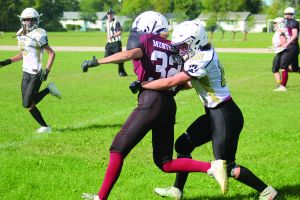
The Swan Valley Bengals girls’ football team kicked off their season at the SVRSS field this past Sunday (Sept. 13), hosting the Melville Vipers. While they came out on the wrong end of the score, it was an excellent football experience and, for many, their first ever game action. (TOP) Maddie Buchanan gets her grip on a Melville ball carrier in hopes of bringing her down. See more on B2
Let’s stop suicide
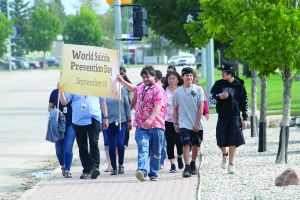
Members of CMHA Swan Valley and the greater community walked around downtown Swan River at noonhour on Thursday (Sept. 10) as part of World Suicide Prevention Day. World Suicide Prevention Day is organized by the International Association for Suicide Prevention, co-sponsored by the World Health Organization, with the purpose of raising awareness around the globe so suicide can be prevented. In Canada, approximately 12 people die from suicide every day and is the leading cause of death among youth and young adults between ages of 15 and 34. The demographic with the highest rate of death by suicide is those between 50-64 years of age, with men being three times more likely to experience death by suicide than women.
MPI helping Manitobans save money on dedicated winter tires

Drivers across the province can stay safe this winter by applying to Manitoba Public Insurance (MPI)’s Winter Tire Program.
Manitoba winters come with very cold temperatures and harsh road conditions, including packed snow, blowing snow, slush and ice. Winter tires are designed with rubber compounds that remain flexible in frigid temperatures, allowing the tread to conform to the road rather than becoming hard and losing grip.
“Wintertime in Manitoba means snowy and slippery roads, and as a result we consistently see the highest number of collisions between November and March,” said Maria Campos, MPI’s Vice President and Chief Customer and Product Officer. “Winter tires reduce collisions by 6.3 per cent, and vehicles equipped with winter tires may experience less severe damage in crashes.”
Winter tires should be installed when temperatures stay below +7°C. It’s a common misconception that all-season tires are sufficient for handling winter roads; tests show a full set of winter tires has better traction below -30°C than all-season tires and stop much faster on ice.
“MPI’s Winter Tire Program was created to keep Manitobans safe on the roads in winter,” said Campos. “For the past 12 years, MPI has been providing loans for tires that are engineered to handle these conditions through low-interest financing options that make them a more affordable investment.”
The Winter Tire Program, which provides financing of up to $2,000 for the purchase of eligible winter tires and related equipment, has provided over 287,000 loans to Manitobans worth over $387 million since it began in 2014.
To ensure program funding supports tires that deliver the greatest safety benefits in winter driving conditions, effective October 1, 2026, only manufacturer designated winter tires that display the Three Peak Mountain Snowflake (3PMSF) symbol will be eligible under the program.
Customers considering a tire purchase are encouraged to speak with any of the over 670 participating retailers across Manitoba to ensure the tires they select meet program eligibility requirements. Financing terms are between one and four years. The retailer will confirm eligibility and begin the loan authorization process. Manitobans can check their eligibility and learn more about the program at mpi.mb.ca/winter-tire-program.
First shipment of potash from Port of Churchill is PADCOM product

The Arctic Gateway Group celebrated their first ever export shipment of Manitoba potash for PADCOM to Belgium, alongside their third successful year of zinc shipments from Hudbay Minerals. As PADCOM continues to ramp up production, much potash will be shipped through the Port of Churchill. The PADCOM potash will be tested by farmers in Belgium.
The Hudson Bay Railway connection to Western Canada and the broader Canadian rail network make the Arctic Trade Corridor an ideal route to ship to the North and world markets. Arctic Gateway Group is owned by a partnership of 41 Indigenous and Bayside communities, including 29 First Nations. This local ownership model ensures that the economic growth of the Port of Churchill and Hudson Bay Railway directly benefits the communities that call the North home. Instead of profits leaving Canada, they are reinvested in Northern communities through reliable rail service, financial benefits, workforce training, and good-paying jobs – most of which are held by Indigenous workers. At the invitation of the Prime Minister, PADCOM attended the Canada Investment Summit in Toronto over the weekend. The objective of the summit is to attract a trillion dollars of international investment into Canada over the next five years.
Low Budget Rock Star releases new single

One of the tri-community’s talented groups of musicians, Low Budget Rock Star, have released a new single. Over the years, the band has changed some members, but the sound has always transitioned with the change. Low Budget Rock Star consists of frontman Kennie Henderson, Harley J.D. Whitehead, Terry Constant and Marshall Bignell.
“What I’ve come to understand is how it works sometimes in this business is that a song can take a life of its own and go a certain direction,” said Henderson. “It took a while and things have been a work in progress.
A new look in the works for The Pas Airport

If you happen to be travelling through The Pas Airport, you might notice it is in the process of getting a new look about it. Two new murals will have found a home inside the airport and are being done by artist Nereo Zorro, who has done a few murals throughout the tri-community already.
“I started the murals in The Pas Airport in early August,” said Zorro. “I’m doing two murals in the airport. One is closer to the counter wall and the other is located on the wall with an old-style clock on it.
Fire department sees small year-over-year increase in responses
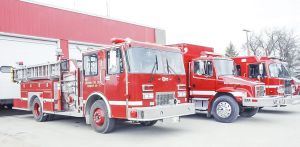
While an emergency call prevented him from walking councillors through it, Dauphin fire chief Cam Abrey submitted his report outlining the first seven months of fire department operations to City council at its Aug. 31 regular meeting.
From Jan.1 to July 31, DFD responded to 171 calls for service, about an eight per cent increase over the same time period in 2025.
The report indicated that false alarms remain the most frequent reason the department is dispatched with 51 incidents - 30 per cent of calls - during the first seven months of the year. Motor vehicle collisions continue to be the second largest volume of calls with 33 received so far in 2026, which amounts to 19 per cent of dispatches.
Structure fires accounted for 12 per cent of responses, while outdoor fires made up six per cent, kitchen fires four per cent, EMS lift assists five per cent and carbon monoxide alarms at three per cent.
The catchall category of “other”, at 17 per cent, saw an increase over previous years.
“This category typically includes incidents such as hazardous materials, elevator rescues, items that don’t necessarily require a category of their own as there are not very many in a typical year,” the report read.
“For this report, however, we included the calls related to the flooding of July 1, that DFD responded to.”
During that one day, DFD responded to 18 separate incidents, 13 of which were specifically for callers reporting flood related incidents. The remainder were for lift assists, downed hydro lines, mutual aid assistance and the evacuation of Dauphin Regional Health Centre.
When broken down by jurisdiction, 87 per cent of all calls -148 in total - were responses inside the city - including all vehicle collision responses regardless of where they occurred. The city has always paid for the motor vehicle collision response regardless of the location, the report said, as the fire chief looks after any eligible claims with Manitoba Public Insurance.
Twelve per cent of all dispatches were in the RM, while mutual aid calls accounted for one per cent of responses.
Broken down further, 2,511.5 firefighters hours were expended on city responses, about 74 per cent of all hours recorded. Again, those numbers include all hours spent on vehicle collision responses, regardless of where they occurred, the report said.
When it comes to staffing, Dauphin Fire Department currently boosts its highest membership in several years, Abrey indicated in his report, with 16 members participating in level I firefighter training this fall.
On the flip side, however, Abrey indicated the department lost one of its captains as Cameron Popiel resigned from the department as he is relocating to Brandon.
“Cam came to DFD in March 2018 and quickly rose through the ranks attaining his level I and II firefighter qualifications, as well as completing a number of other training seminars,” Abrey wrote in his report.
“He was promoted to lieutenant in 2022 and then captain in 2025 and will definitely be missed by all.”
Training
At the end of July, DFD celebrated Ryan Murray, Nicholas Shmon, Jesse Shuttleworth, Samuel Smith, and Oleksiy Vlasov after they successfully completed level I firefighter training. As a result, the department now has 24 members with level I and/or II certifications.
The department has also hosted some training seminars on behalf of the mutual aid district including school bus rescue training, May 29 to 31, involving local firefighters, as well as firefighters from Ethelbert, Roblin and Swan River.
On Aug. 28 and 29, 24 firefighters from across the mutual aid district took part in a heavy rescue seminar, learning skills required for incidents involving larger vehicles such as tractor trailers and other motor vehicles.
A number of other specialized programs are planned for the coming months including Critical Incident Stress Management, Fire Department Safety Officer, Fire Ground Management, and other seminars related to operating department equipment.
Utility terrain vehicle rollover claims a young life

A nine-year-old Dauphin girl is dead following a utility terrain vehicle accident in the Rural Municipality of Dauphin, last week.
On Aug. 31, at approximately 5:15 p.m., Dauphin RCMP, Dauphin Fire Department and paramedics were disatched to the scene of a rollover involving a UTV near a rural residence.
A 40-year-old man was driving the UTV with his nine-old-year daughter as the passenger. The side-by-side vehicle made a turn while driving on the property towards the residence when it rolled.
The girl suffered significant injuries as a result of the incident. Lifesaving measures were attempted by first responders, however, despite efforts, the child succumbed to her injuries at the scene.
Her father was transported to hospital in Winnipeg with non-life-threatening injuries.
The investigation is ongoing.
• • •
A Grandview woman found herself back in custody after providing a fake doctor’s note to avoid a court appearance.
On Aug. 31, Dauphin RCMP learned Amber Fisher, 42, who was scheduled for court sentencing, had submitted a doctor’s note indicating she was unable to attend after being seriously injured in a motor vehicle collision.
The note stated the collision occurred on July 22, and was given to her lawyer, who submitted the document to the court. The note was accepted by the courts and the Sept. 2 sentencing hearing on a theft charge was adjourned to a later date.
A court official followed up with RCMP, who began to investigate.
RCMP determined the doctor’s note was a forgery. A review of police files further confirmed no reports had been made involving the suspect being in a collision on that date in Manitoba or any other province.
On Sept. 1, the suspect was arrested without incident.
Fisher now faces charges of obstructing justice, forgery, and uttering a forged document.
She was remanded in custody.
Final chance for players to make their case with the Kings this week

Players hoping to crack the lineup of the Dauphin Kings have one final week to catch the eye of the coaching staff.
After winning one of three preseason games last week, the Kings are down to 24 players left in camp - 14 forwards, seven defencemen and three goaltenders.
Kings head coach and general manager Bryan Kromm said there may be more moves to be made after a home-and-home with the Neepawa Titans to end the preseason.
“There’s a lot of guys that still have to prove themselves this week. So it’s up in the air right now what we’re going to do,” he said.
After scoring a 5-2 win over the Northern Manitoba Blizzard, Aug. 31, in Dauphin, the Kings dropped a home-and-home with the Waywayseecappo Wolverines, 3-1 in Dauphin on Friday and 4-2, Saturday, in Waywayseecappo.
Kromm said the team experienced some growing pains as he incorporates some new strategies in terms of structure.
“It’s going to take a while for our guys to adjust to that. But we saw some good things out there, so we’ve just got to keep building and moving forward with stuff,” he said.
“We’re throwing a lot at the guys right now, so there’s a lot of growing pains and trying to figure out a lot of teaching stuff. Obviously, it’s a brand new team, so we’re trying to implement some things that might take a while for the guys to grasp.”
Local players Forrest Karlson and Noah Smigelsky returned to the team from the Western Hockey League.
The Kings will face the Titans, Wednesday, in Souris, with the rematch in Dauphin, Friday. Both games begin at 7 p.m.
Kromm said everybody is under the microscope right now and he will have some tough decisions to make after the final preseason game.
The Kings have only four 20-year-olds in camp - goaltender Bryson Yaschyshyn, defenceman Aiden Malone and forwards Kurtis Kinoshita and Dylan Miko.
Going with a more youthful team, Kromm said, was the plan going into camp.
“For me, I have to have the right 20-year-olds in my locker room in order to make it work. I just find that if you have a younger team, guys seem a little bit hungrier. It’s their first experience at junior hockey,” he said.
“Like I keep saying, there’s growing pains early on, but if we put our trust in our guys, by the back half of the season, we’ll be looking pretty good.”
When it comes to the final preseason contests, Kromm wants to see who can adapt to how the Kings are trying to play and who can’t.
“We’ve thrown a lot at them and we’re trying to see which guys grasp it and which guys can’t. That’s part of the evaluation process that we’re doing moving forward,” he said, adding he doesn’t know yet how many players he will carry into the season.
“We’ve just got to see how it goes this week,” he said.
Feeling the need for more of a veteran presence on the blueline, Kromm acquired 19-year-old defenceman Aidan Stewart from the Swan Valley Stampeders for a player development fee.
“So Aiden can hopefully help carry the mail for us,” he said.
Kings court: If Bryan Kromm’s surname sounds familiar, it’s for good reason. His grandfather Bobby Kromm coached the Winnipeg Jets to their first AVCO Cup championship in the World Hockey Association in 1976 and led the Jets to the league final the following year. He then left Winnipeg and joined the Detroit Red Wings, where he coached for three seasons. Bryan’s father, Richard Kromm, played parts of nine seasons in the NHL with the Calgary Flames and New York Islanders from 1983-84 to 1992-93.