

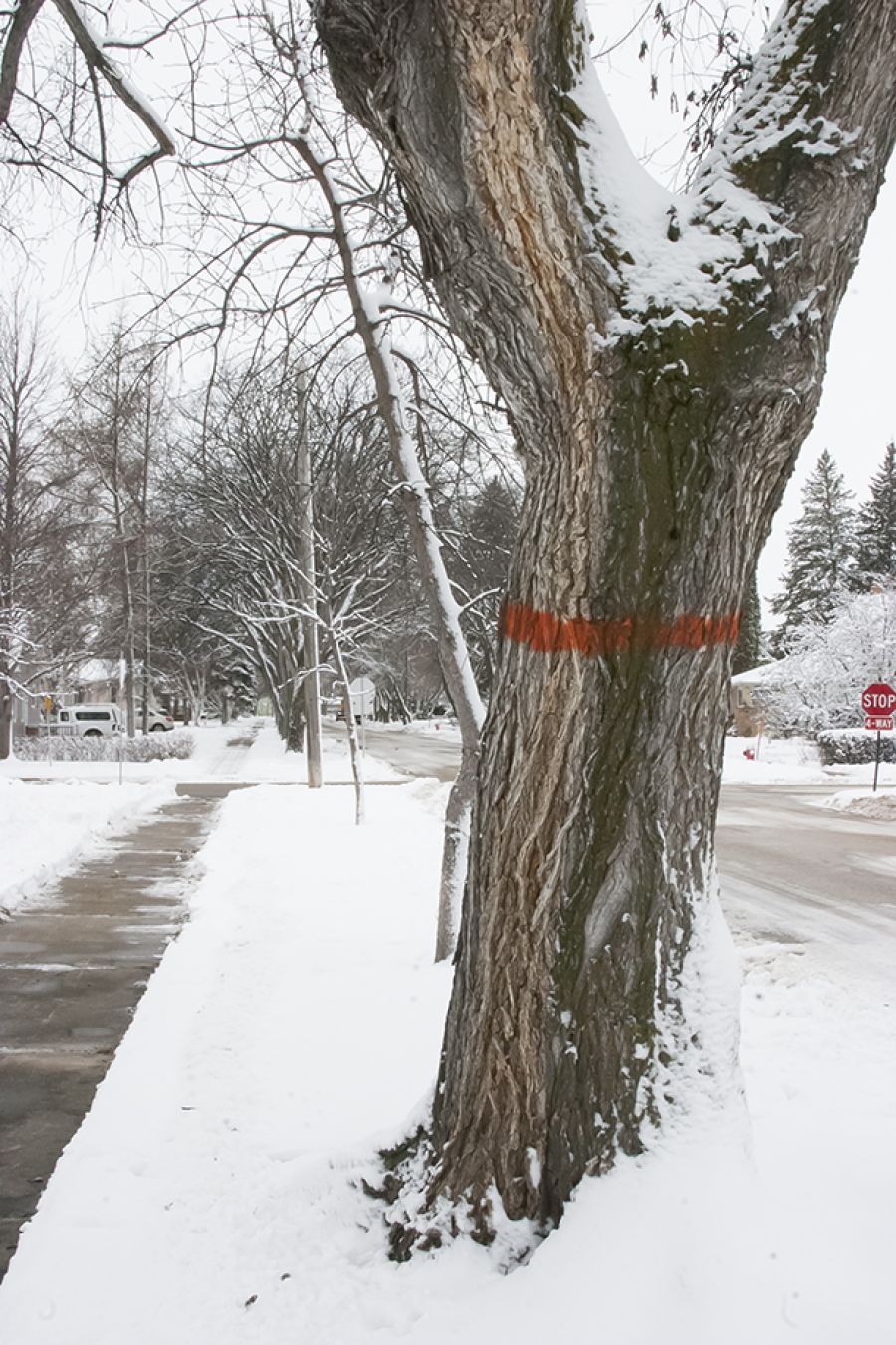
Tree removals are under way as part of the City of Dauphin’s Dutch Elm Disease program.
This year 195 trees have been identified for removal from the urban forest. The contract for removal was awarded to Tree Pro of Altona at a cost of $59,563.35. Two other bids were received as part of the tendering process, both well over $90,000.
Under the contract, removals must be completed by Feb. 28.
In recommending the Altona bid be approved by council, deputy city manager Lisa Gaudet said the licensed arborist has completed Dauphin’s removals in each of the last two years with no problems, doing “an exceptional job fulfilling the contract.”
The provincial Dutch Elm Disease Management Program has been running since DED was first detected in Manitoba in 1975.
While the province originally used its own forestry crews to remove trees identified as diseased, municipalities became responsible for the removal in 2015. At that time the province provided financial assistance at a flat rate of $181.32 per tree.
The program evolved again in 2018 and, while provincial inspectors continue to identify trees for removal, funding is now provided at a rate of $226 for a small tree measuring 10 cms to 30 cms; $452 for a medium tree measuring 31 cms to 79 cms; and $678 for a large elm measuring at least 80 cms.
Since the changes, Dauphin has received $34,010 for the removal of 111 trees in 2019, $63,840 for the removal of 210 trees in 2020, $50,160 for the removal of 196 trees in 2021, $49,400 for the removal of 192 trees in 2022 and $55,144 for the removal of 195 trees in 2023.
The current Dutch Elm Disease and Urban Forest Management Program is administered under The Forest Health Protection Act and Forest Health Protection Regulations.
Presently, the program is active in 38 communities that have significant elm populations.
Dauphin mayor David Bosiak said the community is lucky to be one of those 38 involved in the program.
“When I was a rec director back in the ‘90s, the city was involved in this program as were many other municipalities in the province. The province capped the funding, or reduced the funding back in the day and a lot of communities dropped off the program. But I would acknowledge that the City of Dauphin did not, and so we continue to get some support from the Province as one of the few rural urban municipalities that are continuing with the program,” he said.
“I think it’s done our elm tree population a great service.
One of the things to note is because of that decision made a long time ago, Dauphin is still in that program. There is no way to get into the program today. There are a lot of municipalities who have asked, several times, ‘how did you get into it?’ and I say it’s only because of history. We asked the province how would one get into it now and there is no opportunity for that.
“This has kept our elm tree population in fairly decent condition, considering there’s a number of removals each and every year.”
