
Russell and Roblin Men Arrested in Melinda Lynxleg Murder

By Terrie Welwood
Russell Banner
The family of a 40-year-old mother of six was finally given a measure of peace with the announcement of the arrest of three men from Russell, Roblin and Tootinaowaziibeeng Treaty Reserve - formerly known as Valley River.
The arrests come as part of the five-year investigation into the disappearance of Melinda Lynxleg by the Manitoba RCMP Major Crime Services, with assistance from Roblin, Russell, and Dauphin RCMP detachments.
Kirk Kenneth Allarie, 42, from Roblin, Myles Malcolm Allarie, 38, of Russell and Billy Jay Lynxleg, 46 from Tootinaowaziibeeng Treaty Reserve Valley River First Nation have been charged with Second Degree Murder along with Offer Indignity to human remains.
All three men were arrested at their respective area homes between Oct 14 and 16, 2025 without incident and will remain in custody until they face trial at a later date.
Read the full story in the October 28, 2025 Russell Banner.
Keyko.co Holds Grand Opening

Keyko.co had people lined up around the building as they officially opened their new location on Main Street behind Prairie Girl Esthetics - the entrance is on the south side of the building.
The room erupted in laughter as the ribbon refused to cooperate when (left to right) Deputy Mayor Estha Baseley, Hon. Malaya Marcelino Minister of Labour and Immigration, Monique, Jerry and Zane Pestano,
Rec. Director Amy Tweet and Daymon Guillas proceeded with the grand opening of the newest business in Russell’s business district.
Three charged in Lynxleg murder

Justice for Melinda Lynxleg is in the works as the RCMP Major Crimes Unit announced on Oct. 20 the arrest of three men involved in her death.
The investigation spanned over five years and required assistance from not only the Manitoba RCMP Major Crimes Unit, but from Roblin, Russell and Dauphin RCMP detachments as well.
Find out more in this week’s Review.
Service celebrates its first 40 years
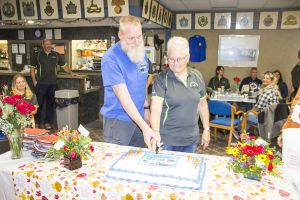
The Dauphin and District Handivan Association (DDHA) has provided safe, reliable and vital, transportation services for seniors, persons with disabilities, and others with mobility challenges.
DDHA celebrated 40 years with an event at the Royal Canadian Legion Branch No. 20, Saturday.
Board members, drivers and clients were invited for coffee or tea and cake following a short program.
DDHA president and board chair Marge Beyette said Ron Bourdin was the person who started the handivan services 40 years ago.
“I believe he only had himself working and one van,” she said.
DDHA now has five vans. Four of them, Beyette said, have ramps and one is ambulatory.
“We use that one a lot for people that don’t have wheelchairs or may have a walker. But we can fold that up and put it in the back,” she said.
“So it’s a little cheaper to run gas wise.”
Along with the five vans, there is one full-time driver and seven others who are casual, though they sometimes run into full-time hours depending on how busy it gets.
The need for such a service continues to grow.
Read the full story in this week’s Dauphin Herald.
Beardy takes on new role at TPFC
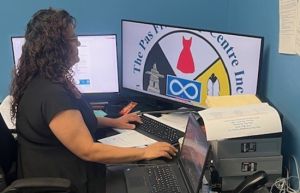
The Pas Friendship Centre (TPFC) has a new leader at the helm of its organization. Rhoda Beardy has accepted the role of executive director for TPFC after being with the organization for quite some time.
“My first involvement with the Friendship Centre Movement was back in 1999, when I worked as a Cultural Program Assistant,” said Beardy. “That summer, we organized a Teepee Village in Devon Park, which was a truly unforgettable experience. The community came together to camp, share meals, and tell stories around the fire.
“It was more than just a program; it was a celebration of culture, connection, and tradition. Seeing families gather, elders share wisdom, and youth engage with their heritage made it an awesome event that still holds a special place in my heart.”
TPFC takes two youth to Rise Up Conference
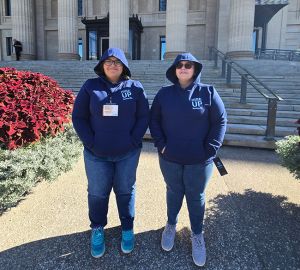
Two youth from The Pas Friendship Centre’s Youth Leadership Team attended the Rise Up: Youth Leadership Days at the Legislature in Winnipeg. Addison Ward and Gabrielle Fulmore are two grade 11 students who attend Margaret Barbour Collegiate Institute, went to the Rise Up: Youth Leadership Days with The Pas Friendship Centre Region Home Coordinator Tamara Nechvatal.
“At the conference, there was a drum circle with students in grades 10 to 12 and a choir performed songs in their traditional language,” said Ward. “We went to the Manitoba Legislature Building and met Premier Wab Kinew and Minister Tracy Schmidt.”
First winter storm comes early
The Thanksgiving weekend was a different one for everyone in the tri-community area this year. The first taste of winter arrived on October 12 and impacted hydro for many living in the area and even ruined Thanksgiving dinner as well.
“Manitoba Hydro started receiving reports of power outages throughout eastern and northern Manitoba and the Parkland area on Sunday night and into Monday,” said Manitoba Hydro Media Relations Officer Peter Chura. “At the most, on Monday, there were more than 12,000 customers without power due to severe weather province-wide.
Opaskwayak Cree Nation unveils next building project in Winnipeg

On October 17, 2025, in Winnipeg, Freedhome Developments Ltd., in collaboration with Opaskwayak Cree Nation (OCN), proudly celebrated the topping-off ceremony of La Cour, a six-storey mixed-income community at 366 Marion Street in St. Boniface. The project marks an important milestone in Winnipeg’s housing journey. Wholly owned by
OCN stands as a leading example of Indigenous-led economic sovereignty and a meaningful step forward on the path of reconciliation.
Vesselli Dance offers a new program for tots
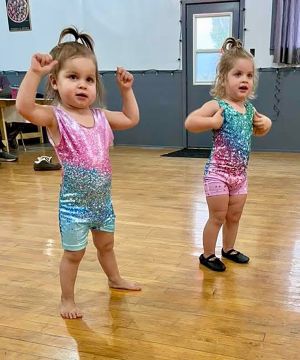
A new Ukrainian dance program is being offered through the Benito Vesselli Dance Club to help engage children at a much younger and earlier age into the art of Ukrainian dancing. It is important to see cultural programs continue and to create a succession plan where there is a variety of ages when it comes to participants.
“Our club has had an increase in enrolment every year for the past couple of years,” said Vesselli Ukrainian Dance Instructor Amanda Bulycz. “I know right after the pandemic, our club took a hit, we were down to only seven dancers total in the whole club. Now we have over 35 dancers and that number continues to increase.
“We are extremely excited to see such a large increase in enrolment and involvement in Ukrainian dance, especially in our small town. Our club works extremely hard to keep the Ukrainian culture and traditions alive, and having an increase every year helps. We look forward to welcoming our new families into our dance family and community.”
Bulycz is bringing a new age category for Ukrainian dancing that will engage pre-school-aged children. She has seen other communities in bigger centres offer Ukrainian dance programs for tots, but hasn’t seen anything like it in the area.
“Our club has offered a Rhythm and Movement Class for three to five year olds for many years and has had great success,” said Bulycz. “As for a toddler class, I have seen other Ukrainian dance clubs in cities offer a parent and tot class, but nothing within the Valley. I’m looking forward to bringing the Ukrainian Dance Tots Class to the Valley.
“Tots in Motion is for our littlest dancers to join in on the Ukrainian Dance Fun. It’s a brand new program that the Benito Vesselli Dance Club is offering new this season for children 18 months to three years of age.
“Tots will explore the studio, meet our instructors, enjoy movement and dance while building confidence, all while having fun with simple dance activities,” said Bulycz.
“Austin Spencer and I are the Vesselli dance instructors and will lead this group. Parents are encouraged to stay, help and join in on all the fun with their toddler.
“I’m planning something special for our Tots in Motion class to perform at our Year-End Concert on May 9,” said Bulycz. “We might even have a small performance at Vesselli’s Malanka on Jan. 10.”
There are several more reasons other than succession planning that led to the creation of the Tots In Motion class. Bulycz has experience working in Early Childhood Education and will use that to help create the programming for the Tots In Motion classes.
“I thought about creating a tots group for a few reasons, one being the younger siblings of our current dancers always trying to sneak into the gym to join their siblings’ dance group,” said Bulycz. “We have many siblings who weren’t old enough to join dance, but wanted in on the fun. I thought, why not create a fun class made just for them and other tiny dancers that are ready to move. The program is created to be welcoming for our youngest dancers, focusing on building connections and having fun.
“I have many activities planned, but our main focus and goal will be creating a fun and welcoming environment for children to build coordination, rhythm and confidence. We will dance with scarves, feathers, tambourines and drums, move to traditional Ukrainian dance music, and learn basic steps such as marching, running, skipping, clapping, etc.
“The class is designed with toddlers in mind,” said Bulycz. “I’m an Early Childhood Educator as well, so I have been able to combine my knowledge as an ECE when making up lesson plans for the tots class. The class will be laid back, calm and meet the dancers at their level. I’m really looking forward to all the fun we will have.”
There is still time for those who are interested in the Tots In Motion class to sign up. The first class started last week, but there is still time to try it out and register for the season.
“Our Tots in Motion Class started on October 16, and will be running Thursday evenings from 5:30 p.m. to 6 p.m. in Benito,” said Bulycz. “Tots are welcome to join anytime and our first two classes are free to try before committing. The fees for the Tots in Motion class are $125.00 for the dance season. Anyone interested in registering can contact me or message Benito Vesselli Dance Club on Facebook to register or for any questions.”
Late-Night Light Show

As our sun bombards Earth with coronal mass ejections (CME), those of us in Canada and other parts of the Northern Hemisphere have been treated to some autumnal aurora borealis this month, with some shows of Northern Lights getting strikingly bright and active.