


Submitted
Provincial Gold

The Swan Valley U15 Stampeders went undefeated during the weekend of March 1-3, bringing home the Championship banner from the U15 Rural B Provincials in Russell. The team captured the title after defeating the Minnedosa Bombers 3-1.
Snowbirds

Winter almost came and went without Swan River sculptor Derryl May crafting another creation in his front yard, with last week’s precipitation providing a medium to erect a representation of an osprey catching a fish, which melted down somewhat and re-envisioned into a chickadee. Here, the final result before the above-freezing temperatures melted it further.
Always exciting when the circus comes to town

By: Ed Stozek
For The Herald
Featuring trained animals and various other thrilling performances, the offer of free tickets to attend the circus was part of the excitement that my wife Janice and her fellow Grades 1 to 8 students experienced during the early 1960s. A large crowd aided local organizations in their fund-raising projects.
An open letter in the Dauphin Herald and Press by the Dauphin Junior Chamber of Commerce advertised the impending arrival of the King Brothers Circus with performances scheduled for 3:30 p.m. and 8 p.m. on Monday, June 20, 1960. Special convoys used for the transportation of 50 wild animals, circus artists and equipment soon followed.
Under supervision by the Dauphin Jaycees the proceeds from ticket sales were to be used for the Jaycee Little League Baseball Park.
Two years later the Shrine Circus was scheduled to arrive for its first ever appearance in Dauphin. Sponsored by the Dauphin and District Shrine Club the Gil Gray Shrine Circus commenced on Wednesday, May 23, with matinee and evening performances at the DMCC arena. The 2-1/2 hour shows featured 46 acts suitable for all round family entertainment.
Business firms and merchants had been contacted earlier with requests to help in sponsoring children’s tickets in accordance with a plan used in other centres where the Shrine Circus was an annual event. All proceeds from this new community project were earmarked for the Children’s Hospital in Winnipeg.
In mid-April a representative from the Shrine Circus organization, as well as two local members from Dauphin visited Ste. Rose to make preliminary arrangements for the distribution of children’s tickets by the town businesses. Since it was a first for the Shrine Circus to come to the area a large number of attendees were anticipated. In previous years one had to travel to Brandon or Winnipeg to attend the Shrine Circus. Dauphin’s ticket prices included $1.50 for adults and $1 for Grades 9 to 12 students. Tickets were available at the arena box office with no reserve seating. It was “first there, first served.”
One year later, on May 29, 1963, the Shrine Circus made its second appearance at Dauphin with local sponsors guaranteeing more than 3,000 free tickets to school age children for the action filled shows. For the second year the Shrine Club had been helped by sponsors who bought the tickets and distributed them to the elementary schools in the area.
“In addition to the 1,300 pupils in Grades 1 to 8 in Dauphin, tickets were also distributed as far east as McCreary, north to Winnipegosis and Pine River, west to Grandview and south to the park.” (May 29, 1963, The Dauphin Herald and Press)
The first performance at 1 p.m. at the DMCC arena was filled to capacity. The ensuing shows at 4 p.m. and 8 p.m. also anticipated a “full house” as families were encouraged to attend.
At a Shriner’s social event held at the King’s Hotel on June 22, 1964, John Gardner outlined the concept of a Shriner’s hospital for handicapped children and indicated that the first hospital was opened in Louisiana in 1922 to treat children irrespective of race, creed or colour. In 1925 the Khartum Temple developed a mobile unit in Winnipeg based out of the Children’s Hospital. By 1949 the project of a new self-contained Shriner’s for Handicapped Children’s Hospital was completed.
Located at 633 Wellington Crescent it replaced facilities at the Children’s Hospital and was turned over to the board of trustees in 1950 making the only occasion in all of Shriner history where a project was fully paid and completely free of debt. Gardner noted that 4,700 young children had already been treated.
The facility operated until 1977 when it was turned over to the provincial government and renamed the Rehabilitation Centre for Children. It closed in May 2016, and the buildings stood vacant, except for occasional use as movie sets, until being demolished in October 2022.
During the 1980s and 90s, Janice and I took our children to enjoy the Shrine Circus at the DMCC. Several years ago, we accompanied our grandson to a performance culminating three generations of our family members enjoying the sights, sounds and action associated with the circus.
Just three chords and the truth . . .

By Ed Stozek
For The Herald
Produced and directed by filmmaker Ken Burns, best known for his documentary films and television series chronicling American history and culture, PBS aired the first of eight two-hour episodes of Country Music on Sept. 15, 2019.
Along with the music and recording artists, the documentary also featured unforgettable stories based on the hardships and joys shared by everyday people.
Many of those stories became the basis for many country songs. The first episode, Beginnings-1933, introduced the first “hillbilly music” rising stars and included ballads, hymns and stories of the Carter Family, as well as Jimmie Rodgers and his combination of blues and yodelling.
The ensuing seven episodes covered a variety of country artists and some of my favourites, Hank Williams, Johnny Cash, The Judds, Garth Brooks, and Willie Nelson.
In one interview Willie Nelson referred to a quote originally made by Harlan Howard. “1950s country music is three chords and the truth.”
Howard originally noted that he was captured by the songs as much as by the singer. “They grabbed my heart. The reality of country music moved me. Even when I was a kid, I liked the sad songs, songs that talked about true life. I recognized this music as a simple plea. It beckoned me.”
Howard completed only nine years of formal education, though he was an avid reader. When he was 12 years of age, he began writing songs, “an enthusiasm fueled by an appetite for books and an ear for a telling phrase. I take a whole life story and compress it into three minutes.”
Howard became a songwriter mainly composing country music songs in a career spanning six decades with over 4,000 songs to his credit.
In 1961 Harlan Howard had 15 compositions on the country music charts. Some of Howard’s songs became country music standards including “I Fall To Pieces” (Patsy Cline), “I’ve Got A Tiger By The Tail” (Buck Owens), “Heartaches By The Number” (Ray Price), “Why Not Me?” (The Judds) and “Somewhere Tonight” (Highway 101).
On Mar. 23, 2023, Willie Nelson released his 73rd studio album, a tribute to Harlan Howard entitled, “I Don’t Know A Thing About Love: The Songs of Harlan Howard.”
Willie’s first job as a songwriter was initiated by Harlan Howard for the publishing company, Pamper Music. Willie Nelson ended up composing many songs that only had three chords and other originals such as “Crazy” that were very complex. Seeing Willie perform at the Minot State Fair in the early 1990s was a memorable musical highlight. We also made several trips to see other country recording artists including Reba McIntyre, Kenny Rogers, Highway 101, Garth Brooks and The Judds.
Another Harlan Howard quote noted, “A lot of songs you write are just for exercise - just pencil sharpeners.” As a person who has dabbled in writing poetry and songs, it always is a great deal of fun “noodling” on the guitar and writing down ideas. One can spend a great deal of time and energy trying to elaborate on a song idea. As Harlan would say it, “I’m always collecting emotions for future reference.”
As a young boy I recall one of my mother’s notebooks with her beautiful handwriting and the lyrics to many of her favourite songs including “Red River Valley,” “You Are My Sunshine” and “Keep On The Sunny Side.”
After ordering an acoustic guitar from the Eaton’s catalogue, it was a challenge to learn how to play it. In an era long before computers and the Internet one had to rely on other options of how to tune a guitar, learning those three basic chords and figuring out where they fit in a song. “Keep On The Sunny Side” was one of the first songs that I learned to play. It also helped that my sister had a Carter Family record for me to listen to.
I enjoy playing the three chord songs and especially lyrics that tell a story.
There’s an old joke. What do you get back when you play country music backwards? Your wife returns, your dog comes back to life, and you get out of prison.
Just three chords and the truth.
Shelterbelts - a problem solver and a big part of Prairie history
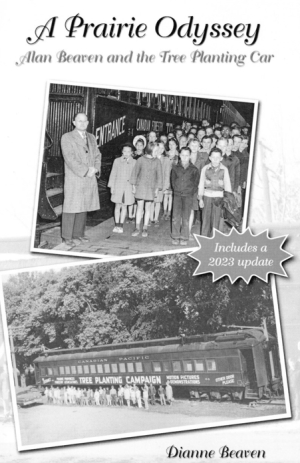
By Ed Stozek
In 1918 a group of Western Canadians met at Winnipeg to solve an urgent problem.
They wanted every prairie farmer to gain knowledge of the value of shelterbelts for home improvement, productive gardens, more pleasant living conditions and the betterment of farm values.
The Canadian Pacific Railway agreed to provide a railway car to the Forestry Association of Western Canada and along with the Canadian National Railway agreed to move the “classroom on wheels” free of charge to communities located by their tracks.
The railroad car was designed as a travelling classroom including living quarters for the “travelling lecturer.” Long rows of seats were set up like a motion picture theatre with a screen at the front and an operating booth at the rear. This facilitated the showing of lantern slides and motion pictures promoting the benefits of tree planting, forestry and shelterbelts.
The travelling lecturer planned and delivered the presentations, kept daily records and produced annual reports. One report noted, “Last summer a Tree Planting Car (TPC) was sent on a trip over the prairie provinces with the object of showing settlers how to improve their homesteads with shelterbelts. One rural school was found where out of eighteen pupils only three had ever seen a tree. There are said to be thousands of children in Southern Saskatchewan and Southern Alberta who have seen only the scrubby growth along the coulees.” (Jan. 26, 1923, Dauphin Herald and Press)
An article in the July 3, 1931 Dauphin Herald and Press acknowledged that the annual TPC tour included stops from Sinclair to Souris and along the Estevan line from that point to Pierson. “13 towns were visited, 33 lectures were held with townspeople, farmers and school children numbering 4,900.”
The car had a seating capacity for over 100 people and with free admission the average attendance was 148 with overflowing crowds at each stop. The TPC became a fabric of Canadian life and a social highlight for many prairie folks. The object of encouraging the planting of trees as windbreaks preventing soil drifting, moderating wind damage to grain crops, helping to conserve moisture and beautifying rural and urban home surroundings was very successful.
“Splendid assistance was given those in charge of the car during the tour by officials and employees of the TPC, postmasters, school teachers and editors of both local and city newspapers.”
For the 37th annual tour, Dauphin was part of the TPC itinerary. The TPC was parked at the CNR station on June 20 and 21, 1957. All Dauphin area residents were encouraged to take advantage of the car’s visit. Alex Paton, an experienced horticulturist noted for providing entertaining programs with practical lessons delivered the program, answered questions and helped with garden problems. Members of the Dauphin Horticultural Society took special interest and arranged to hold their meeting in the car on the evening of June 20.
The TPC never distributed trees. It relied upon various tree nurseries to provide the stock that the travelling lecturer advocated to be planted.
For example, in 1901 the government of Canada established the Forest Nursery Station at Indian Head located east of Regina with the purpose of researching, cultivating and supplying hardy trees and shrubs suited to the prairies.
Between 1901 and 2001 more than 570 million evergreen and deciduous tree and shrub seedlings were distributed. The site was dismantled and ceased operations in 2013.
When the TPC was “retired” in 1973 it was moved to the Sandilands Forest Discovery Centre near Hadashville. It was estimated that in its 53 years of operation it had travelled 420,000 kms, hosted 1.5 million visitors and promoted the planting of half a billion trees on approximately 100,000 farms. At the Sandilands location the car remained stationary and served as a teaching facility with displays and exhibits. On Nov. 8, 2022 the car was re-located to the Manitoba Agricultural Museum at Austin.
During its tenure as a classroom on wheels, crowds of students arrived in the afternoon and townspeople and farm folk congregated for the evening presentation.
All were eager to learn about the importance of shelterbelts on the prairies.
Assiniboine Effect Day closing in

By Carl Stewart
Parkland Campus Director
“Community.” It’s right there in our name. This is because Assiniboine Community College and its Parkland Campus belong to all of us.
As our region’s sole post-secondary institution, we are more than just programs and courses. More than classrooms and trades shops. We are more even than our valued students, staff and faculty. Assiniboine is the sum of all of these, and still more.
Building community is what we seek to do. Prospective and current students bring their aspirations, creativity and commitment to Assiniboine, as part of their journey to learn new skills and build successful career paths. As graduates, they represent a significant array of skills, education and experience, which they invest back into our region. Assiniboine alumni live, work and stay in Parkland; they grow our businesses and services, and enhance our community for all its residents. And in turn, the Parkland community - its citizens, governments, industry, school boards and service organizations - has embraced Assiniboine and looks to us to deliver education and training which meets the needs of our local labour market.
So when we get the chance to celebrate our community, we want everyone to be involved.
Assiniboine Effect Day, Feb. 6, is our opportunity to gather with our many Parkland friends and partners, and to acknowledge some very special alumni.
Our jam-packed day starts at the DRCSS with hands-on activities for high school students led by our faculty. Our team will be on hand to showcase all the Assiniboine programs offered at Parkland campus, including Business Administration, Social Service Worker, Early Childhood Education, Practical Nursing, Applied Electrical and other trades, Horticultural Production, and more.
After work, Feb. 6, our annual Assiniboine Alumni Awards dinner will recognize three individuals who represent the best of Assiniboine. This year’s recipient of the One to Watch Award is Tyler Antoniuk, who has made exceptional achievements and significant contributions to his profession and community since graduation. Antoniuk graduated from the Business Administration program with an Accounting specialization in 2020, and is currently working with the Province of Manitoba in Workforce Development, Training and Employment. Because of his exceptional work ethic and curiosity, he has already secured two promotions since starting with the province, gaining more responsibility with each role. He consistently exhibits a positive and collaborative attitude inspiring those around him to strive for excellence.
The Excellence in Education Award honours an Assiniboine staff member or retiree for extraordinary contributions to teaching and the student experience. This year, the award goes to two outstanding instructors - Cindy Shroeder and Scott Willing. Shroeder is a valued member of the Early Childhood Education faculty at Assiniboine’s Parkland Campus. Throughout her time at the college, she has demonstrated a deep commitment to teaching and a genuine passion for helping her students succeed, and shows a remarkable level of dedication and professionalism.
Willing’s first experience at Parkland Campus was as a student, graduating from Assiniboine’s pre-employment Construction Electrician program in 2011. He has since returned as an instructor, teaching Applied Electrical Installation at Parkland Campus, in addition to holding contract instructing positions in communities in the region. His dedication to the college and his students extends beyond the classroom. He gives his time to promote trades at Assiniboine in the surrounding communities and to ensure his students are supported.
And there’s no better way to wrap up Assiniboine Effect Day, than having our entire community join us at the Dauphin Kings game, the evening of Feb. 6. Let the CUP box office know you’re with ACC to get $10 tickets.
For more information, or to purchase tickets to our Alumni Awards dinner, at 4:30 p.m., Feb. 6 at the Ukrainian Orthodox Hall (8th Ave. Hall), contact This email address is being protected from spambots. You need JavaScript enabled to view it. or 204-622-2222.
The road to Medicare was not always smooth

By Ed Stozek
For the Herald
My parent’s income on their mixed farm stemmed from selling grain, eggs, cream, pork and poultry.
In an era long before universal health care, their medical expenses included fees for appointments to see a doctor or for a hospital stay.
At a time when dollars were hard to come by, I recall one visit for an appointment with Dr. Ed Hudson at the Hamiota Hospital. A ready to roast chicken and several dozen eggs were used as part of the payment for his services. At our next visit Dr. Hudson noted that he enjoyed the farm products.
It’s always interesting to peruse my father’s expense records. My mother had health issues resulting in some major medical expenses. In 1947 several trips were made to Shoal Lake to see a doctor. Along with paying Dr. Bardal for his services, other expenses included fees for x-rays and for prescriptions filled at the local pharmacy.
Since my parents didn’t own a car, they also paid a neighbour to drive them to their appointment. The following year precious income was spent for five medical related trips to Winnipeg.
My contribution to my parent’s medical expenses included $81.15 for Dr. Hudson’s “delivery” fees and for my mother’s hospital stay when I was born. Seven years later the costs associated with getting my tonsils and adenoids out added up to $36. I still recall the awful feeling when ether was administered prior to the operation. Following the procedure, a treat of ice-cream helped to alleviate some of the distress.
As leader of the Co-operative Commonwealth Federation Party, Tommy Douglas led North America’s first socialist government and served as premier of Saskatchewan between 1944 and 1961. His government initiated the concept of the Hospital Services Plan, the first publicly-funded medical insurance system in Canada.
The road to universal health care began in 1961 when the Saskatchewan provincial government announced a plan to have visits to the doctor paid from taxes rather than having individuals pay out of pocket. Premier Douglas noted that people had a right to medical care whether or not they had the money to pay for it.
Most doctors opposed this idea stating that the government was turning them into civil servants and that it would interfere in their relationship with their patients.
Premier Douglas noted that the only thing that would change was the method of payment with doctors billing the government rather than the patients for the services that they provided.
Initially the doctors had support from the “Keep Our Doctors Out Committee” launching a well-organized campaign against the government with rallies, petitions and advertisements.
On July 1, 1962, most of the province’s doctors went on strike. Loud demonstrations and the potential for violence arose from the bitter division over the government’s proposal.
Families with health problems were very concerned. The government brought in doctors from Britain and encouraged others to come from the USA and other parts of Canada to combat the emergency. Local groups organized medical clinics and hired doctors to attend them. After 23 days the Saskatchewan doctors went back to work.
In 1964, the Royal Commission on Health Services delivered its report to Prime Minister Lester B. Pearson. The commission was established after Saskatchewan’s introduction of “the merits of single-player, universal medical insurance as compared with the alternative of the state providing targeted subsidies for the purchase of private insurance as championed by provincial governments in Alberta, Manitoba and Ontario as well as organized medicine.” (Canada: Health System History)
In 1966, the federal government passed the Medical Care Act, with federal cost sharing transfers to begin in 1968 to those provinces that conformed to the four conditions of “universality, public administration, comprehensiveness and portability.” By 1971 all of the provinces including Manitoba implemented universal coverage.
Throughout my formative years some of the farm-related chores included herding and milking the cows, as well as feeding the poultry and gathering eggs from the chicken coop.
The cream cheques derived from milking the cows, as well as funds from selling eggs and poultry were put to use by my parents in an era when payment was required for medical care.
Checkmate

Jon Bettner of Dauphin, took first place on tiebreaks in the Winnipeg Open Chess Tournament U1600 section with a score of 4/5 from three wins and two draws.
The tournament was held from Jan. 5 to 7, at the University of Manitoba with 41 players contesting the U1600 section and a further 33 playing in the higher-rated Premiere section.
Valley roots leads USA to a WJHL Championship

When Canada was eliminated in the quarter-finals of the recently completed World Junior Hockey Championship in Sweden, there were plenty of disappointed Canadians who realized the defending champions wouldn’t even medal this year.
However, there were a few pockets here and there who were cheering loudly when the American team defeated host Sweden for the gold medal, including some, right here in the Valley.
Or should we say they were cheering on Lane Hutson, the dynamic 19-year-old defenceman from Team USA. His father, Rob Hutson, was born in Bowsman and they still have family here in the Valley, guaranteeing a strong local Hutson cheering contingent.
Hutson wasn’t just a member of Team USA, he was a key cog, playing huge and important minutes. The five-foot, 10-inch, 161-pound left-shot blueliner finished with six assists and 14 penalty minutes in the tournament (anyone who watched the tournament can attest the officiating was suspect at best). The second-round draft pick of the Montreal Canadiens was also a solid plus-eight in his plus/minus.
But most importantly, Hutson – who was born in Barrington, Ill., got to hear the American national anthem played after the final game of the tournament, and had a gold medal draped over his neck, signifying his team was the best in the world.
“It felt really good to win – to be with this team, at that moment, I couldn’t be happier,” said Hutson. “I was really part of history.”
Many observers expected a final between Sweden and the United States. These two teams, in various forms, have met each other in high-profile games over the past two years, with each claiming victories over each other – including Sweden defeating the USA in the final of the Under 18 championship two years ago.
“With our age group, the rivalry really started in the Under 18s,” said Hutson. “We were able to beat them out for the bronze last year (at the World Juniors), but beating them for the gold this year, that was the cherry on top.”
And the Americans were literally in hostile territory, as Sweden rallied around their team in a major way. The cheering was never-ending, and that was something the young Americans had to contend with.
“I don’t think I’ve ever played in an atmosphere like that before,” noted Hutson. “There was constant clapping, cheering – it was really special.”
Gold medal in hand, Hutson is now back in North America, playing with his college team Boston University. As well, Hutson has to think about his hockey future. Before the tournament, Hutson spoke with some representatives of the Canadiens, who wished him well in not just the World Championship, but the rest of his school year.
“We talked about my goals this year, and winning gold was one of them, so that’s checked off,” says Hutson.
“I also have goals with Boston University (currently ranked second in the nation behind Boston College), and that includes winning a championship with them as well,” he added. “So, they have encouraged me to keep going, as I’m going to have a lot more meaningful games coming up.”
As of early January, the soon-to-be 20-year-old Hutson has nine goals and 23 points in 16 games with Boston University – his second year with the team. The alternate captain really turned heads last year as a rookie, scoring 15 goals and adding 33 assists in 39 games. So, a Frozen Four appearance is definitely in the cards for this up-and-comer.
Hutson’s college career mirrors that of his father Rob, who after a strong junior career in the BCJHL with Bellingham, went on to star with the University of Illinois-Chicago before enjoying a long career in professional hockey.
And Lane is quite aware of his father’s roots – he spoke about spending the summer in the Valley as a youth, and has nothing but positive memories of spending time where his dad grew up.
“Dad grew up there, and when I was younger, we would go there every summer,” says Hutson. “I remember enjoying my time there – the weather was great, and my uncle had a place we would stay at with a huge garden and there was always lots to do.”
Hutson isn’t the only one following in his father’s footsteps. His older brother Quinn is a current teammate at Boston University, while his younger brother Cole is already committed to joining the team next season. Cole is also ranked to go in the first three rounds of the upcoming NHL draft as well. Finally, the youngest of the bunch, Lars, is a talented 15-year-old prospect himself.
So, with a World Junior championship in hand, a run at a national championship in the NCAA on tap this spring, and a professional hockey career on the horizon, 2024 is shaping up to be quite the year for Hutson and his family.
Always read the fine print before diving in

By Ed Stozek
For the Herald
Tuning into 630 CKRC on the transistor radio, or watching The Ed Sullivan Show on Brandon’s CKX television provided an avenue for the latest music trends by musical groups and solo artists.
While attending Grades 10 to 12 at the Elphinstone Collegiate, my classmates and I often discussed those latest trends in music. Starting a record collection became an important component in a teenager’s life.
During those high school years, the school bus dropped rural pupils off at the Oakburn Elementary School and then we boarded another school bus bound for the Elphinstone Collegiate.
When we returned to Oakburn at 4 p.m. there was just enough time to run to the post office, pick up the mail and then catch the school bus home.
One day a magazine advertising the fabulous benefits of joining a record club came in the mail. Mail-order record clubs like Columbia House and the Capitol Record Club offered amazing super-cheap albums. Both companies offered a generous sign on promotion of a given number of records for one cent providing that the applicant agreed to purchase the same amount of records in the next 12 months.
On a monthly basis each club produced a magazine roughly the size of a letter-sized sheet folded in half featuring small sized pictures of all the current album selections. Without reading the fine print, I promptly filled in the pertinent information to receive my long-playing records. Several weeks later my “free” albums came in the mail. It was too good to be true.
Ordering the required records as part of the contract agreement wasn’t cheap. Along with paying $4.98 per record there were additional shipping and handling fees. One also had to respond each month to the club selection notice or else automatically receive the recommended album of the month and be charged for it. To make a long story short, my parents were not very pleased with my record club membership obligations. The matter was eventually resolved when the “free” records were sent back to the company.
The Columbia Record Club was formed in 1955 by CBS/Columbia Records as an experiment to market music directly by mail. It spurred sales to many rural customers.
As recording formats evolved, 8-track tapes, cassette tapes and finally CDs were added. If a family didn’t initially own a record player, Columbia had an interesting marketing scheme with an opportunity for one to enjoy the newest dimension in recorded music-stereophonic sound. “If you join under the terms outlined you can receive the Columbia Stereo Phonograph, a $39.95 value for only $7.95 pus postage for shipping and handling.”(Columbia Record Club advertisement)
”To begin a membership, simply select a stereo record at $4.98. Indicate your choice on the attached postage paid card.”
Along with the $7.95 record player fee a total bill of $12.93 was charged. Upon receipt of payment the record player was automatically shipped. Thankfully I already had a record player.
The experiment used by Columbia House to gauge the public’s response to marketing music through direct mail was very successful reporting 128,000 members in its initial year of operation. Seven years later, Columbia House had delivered 7 million records to its members and accounted for 10 per cent of all sales in the recorded music industry. 1975 marked more than 3 million members. In the 1980s the company created the Canadian Music Club and the CBS Video Library expanding their selections to include VHS videos of television shows. Videos accounted for half of their sales.
By 1990 Columbia House had shipped 1 billion records to consumers. At the end of the decade there was a significant decline in sales due to competitors such as Amazon. Columbia House was unable to compete with digital streaming music and in 2010 ceased selling music, turning its focus to DVDs. In 2015 the company filed for bankruptcy protection.
As a thank-you for a recent purchase using Amazon, I received a “join today” e-mail noting that I was eligible for a 90-day free trial of Amazon Music Unlimited with access to millions of songs, always ad-free and numerous other benefits.
This time I carefully read the fine print.