


Submitted
Cemetery Stroll back for fourth year
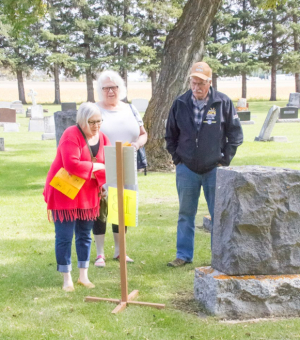
The local family history group Family Ties will be hosting its fourth Cemetery Stroll honouring those than came before us, and who lie in Dauphin’s Riverside Cemetery.
On May 28, Family Ties will host a self-guided tour within specific areas of the cemetery that will allow visitors to read and learn about the people that helped shape Dauphin and district.
Sixteen individuals will be spotlighted in the general cemetery blocks and an additional 15 graves of the airmen who met their death while training here in Dauphin during the war years of 1941 to 1945 will make up this year’s Cemetery Stroll.
This is a great opportunity to learn about some of the historical people and their lives while paying your respects to those that you may personally know.
The Cemetery Stroll begins at 1 p.m. on May 28, and concludes at approximately 4 p.m. In the event of inclement weather, an alternate date is set for the following Sunday, June 4.
Members of the Family Ties group will be in attendance.
This is a free event to attend. A registration table will be set up for guests to sign in. A donation jar will be at the registration table for those that wish to make a contribution. Guests are encouraged to wear appropriate footwear, wear, headwear if needed, and bring along water for yourself.
Where's Waldo?:
The Swan River Curling Club hosted Where’s Waldo, a fundraiser for the Swan River Community Centre that consisted of search for living ‘Waldos’ around the community as well as a supper and backyard party filled with fun and games. There were 48 teams (220) people that participated in the Where’s Waldo with another 100 that attended for supper or the backyard party.
Swimming lessons could be an adventure
By Ed Stozek
For the Herald
It was quite the adventure to partake in the swimming lessons first offered at Lake Dauphin in 1956.
My wife Janice recalled that along with her older brother and sister, their mother drove them each day to Ochre-Beach to attend a two-week session with lessons starting at 10 a.m. Janice recalled that at times the water was cold and if it was windy the waves made it difficult to swim.
A week prior to the inaugural swimming lessons, W. Bumstead, chairman of the Rotary committee in charge of registration, indicated that the response was excellent and those slow to register might be disappointed to find the classes filled to the maximum.
In a Dauphin Herald editorial on July 5, 1956, the editor noted, “There is no better community service than to teach young people and older citizens the proper methods of swimming and the rules for water safety and life-saving instruction.”
In the third and final course that year, 59 of 88 students gained certificates in their class. A grand total of 223 students received certificates at the completion of the six-week summer swimming program sessions. Instructor Arnold Taylor indicated, “Dauphin has been most pleasant and I can assure you the town and especially the people have a new Dauphin booster.” (Aug. 23, 1956, Dauphin Herald)
1962 marked the most successful year for swimming and life-saving lessons with over 300 participants. Assisting swimming instructor Miss Baylis were three local girls who had participated in the inaugural lessons in 1956. The lessons were held at Campbell’s Point located between Ochre-Beach and the Crescent Cove Road on the property owned by Jerry Wilson. The Rotary Club offered thanks to Wilson and asked the public to respect the private property and not use it as a public place for outings.
At this time the Rotary Club “had a dream that one day in the not so distant future an artificial pool will be located in the Vermillion Park.” (Aug. 15, 1962, Dauphin Herald) They noted that having the lessons in town would alleviate the necessity of having six to eight cars provided by Rotary Club members to transport some students to the beach each day. Several years later students enrolled in the swimming program had the opportunity to catch a bus from the current MacKenzie Middle School at 9:30 a.m. and 1:30 p.m. Besides the distance for students to travel to their lessons, losing 40 per cent of time during swimming lessons included high winds causing rough water, low water levels necessitating students having to wade a long distance from shore to swimming depth, insect pests on shore and in the water, as well as green algae causing unpleasant and unhealthy conditions.
For the upcoming Canada's Centennial in 1967, the recreational subcommittee proposed an indoor swimming pool at an estimated cost of $112,200. In a referendum on June 11, 1965, the $75,000 debenture bylaw proposed for the purpose of constructing an indoor pool as a centennial project was soundly rejected by taxpayers. With a turnout of 52.8 per cent of eligible voters, 1,155 voted no and 522 voted yes.
A front-page story in the May 22, 1968 edition of the Dauphin Herald revealed that town council accepted a proposal from a delegation of a joint committee of Kinsmen and Lions Club members offering to build an outdoor swimming pool and giving it to the Town of Dauphin as a gift with the understanding that the Town be responsible for the operation and maintenance of the pool. After two hours of questions and discussions, Council passed a motion in favour of the proposal.
Numerous fund-raising activities included a Walk-To-Swim walkathon on June 23, with crests presented to all participants. All participants were also eligible in a draw for 25 free season swimming passes that could be used on Aug. 17, 1968, when the new pool was opened to the public.
A Hoof-It-To-Roof-It walkathon also occurred on May 27, 1970, with funds earmarked to help pay for a pool enclosure.
During the 1980s and 90s when our children were old enough to take swimming lessons at the pool they didn’t have to battle the elements like their mother did at Lake Dauphin.
The fascinating life story of former Valley resident Sam Kublick

Writer’s note: It is with great gratitude that I am gifted with working closely with our seniors to ensure they are all doing okay. When I started working here a few years back, we were approaching Remembrance Day and at that time we had three World War 2 Veterans living in our home. I decided to sit with each individual and ‘interview’ them about their life story. I eventually turned those interviews into a written story. I was so amazed to see what this did for the resident. To have someone be curious about their journey was such a gift for them. I had one Veteran tell me it helped him with healing in what he experienced in the War.
From that point on, it was my mandate to continue being curious with our seniors and to continue writing stories! These stories need to be heard and told as they contain in them powerful medicine.
We have a couple residing here currently named Sam & Mina Kublick. They lived in the Swan River and Minitonas areas. I have written Sam’s story and thought it would be a lovely piece for your newspaper. In the past, there have been some lovely reconnections of friendships due to the stories being shared in the communities where our seniors once lived.
A man of many trades and talents, Sam Kublick led an adventurous life, never allowing fear to get in his way of pursuing new business adventures. An inventor, council man, mayor, entrepreneur, talented construction tradesman, auctioneer, and more, Sam did everything with his whole heart invested.
Sam is one of six children and was born on the family farm in Minitonas, Manitoba on February 8, 1934.
His parents, Helen and Edward Kublick arrived in Manitoba from Poland in 1930 just as the Great Depression swept through. Although money was scarce, they were able to find themselves some farmland on highway 366. The property held a number of small rundown buildings, one of which was used as a granary in the years prior. The farmland itself consisted of a lot of slough and low land which wasn’t drained and not very much open land. Helen and Edward would work very hard, including scrubbing out the big trees, cutting the roots on one side and waiting for a strong wind to blow them over. They would then burn it over the next 3-4 years in order to eliminate the large fallen wood. In 1940 a steel-wheeled tractor and breaking plough was purchased and wisely used to earn an income. Sam recalls his dad charging out at $2.00-3.00 per acre! His father wanted to build a family home and at that time, the municipality allowed households to collect 3000 feet of timber per year. Edward harvested the timber and built the family home out of 4” by 4” timbers, on end, which was very rare, but kept the home warm and secure!
Due to no road maintenance during the winter months and with growing children, the Kublick family chose to move into the Town of Minitonas. Sam learned a lot from his father growing up, however, as he gained work experience and through trial and error, Sam seemed to exceed in his ability to farm, build, or do whatever job was in front of him.
He recalls his first job working on someone else’s farm and bringing home only $4.00 per day!
That winter, National Mills was cutting pulp and so at 16 years of age, Sam learned to fall logs. This would open the door to many more work experiences to come including, but not limited to, painting grain elevators (with no safety harness), and running heavy-duty equipment. In 1951, Sam started working in a garage, thinking he would be a mechanic, however, that only lasted one month due to another opportunity to work in the bush in BC.
Sam endured and experienced a variety of jobs along the way. In 1952 Sam went to work at Pioneer Gold Mines located in the community of Bralorne and a year later he had his shortest work experience ever where he joined 3 other fellas from Creston and worked for Natural Resources in Radium Hot Springs. Sam chuckles as he shares that when the guys got to the job site, they found themselves with no tools, no outhouse, NO NOTHING!! Off to the next job, they would go! Moving on, in 1954 Drayton Valley would welcome Sam! Here he would work on a survey crew, run heavy equipment and work on the oil rigs. Because of the booming oil industry, there were few accommodations in the area.
This resulted in six strangers coming together and sleeping in a local barn where they had no running water or plumbing, so the river nearby was the ‘bathtub’! In 1955, the Hudson Bay Company in Winnipeg hired Sam. It was here that he was connected to an elderly man named Al Kelly who taught him more than he could have ever wished for in the carpentry industry. They were building all the displays for the store, which kept them quite busy.
In the fall, Sam heard that they were hiring on the DEW line and that the wage was far greater than what he was currently making.
So, at $2.87 per hour, Sam thought, why not! Off to the Arctic, he went where he would be involved in building copper line modules that would not be detected on radar. Fascinated and inspired, Sam was intrigued and went on to build his very own gyrocopter while he was residing in the Arctic!
There would be other opportunities for Sam while living in the north such as grader operator, heavy equipment foreman and carpenter foreman. Overall, Sam gained much valuable work experience as well, and he was able to participate in some cultural events, playing his harmonica for the locals and watching as they danced.
There would be other stops along the way, however, in 1957, Sam landed in Fox Creek, Alberta where he would once again run the equipment. This would be a short stopover before going to northern Manitoba in 1958. It turns out that Sam would be recognized as a hard, wise worker and asked to join a team on a coffer dam. Not knowing exactly what a coffer dam was at that time, his colleague would show him the way. Sam soon became the man in charge of this dam, and he claims this to be the most challenging and exciting work he has ever done! But a challenge was always an invitation for Sam, so, he gladly leaned into this opportunity! “We would build these coffer dams and sink them in 96 feet of water! It was unbelievable; you almost have to live it to believe it”, says Sam! The coffer dam was built on 9 feet of ice which was no easy task, but, he was offered a $4000.00 bonus if he could complete the coffer dam before the ice went out! Needless to say, it was a success!
In 1959, Sam went to work for a construction company where he was sent many miles away to a community called Snow Lake. He was sent there to build a service station and found himself, one more time challenged as he had to improvise many things such as the scaffolding which was made of ‘timber’ from the bush!
Life has a funny way of preparing us for the next chapter. Each job that Sam took on gave him the skills and experience he needed for the next job and the next, until finally the development of his very own company - Kublick Construction. Sam joined a partnership with a fella from Winnipeg and together they formed a company called K & S Construction. The business built as many as 17 homes in only one year! The company grew and Sam was able to make a decent living up to the early seventies. During this time, Sam was also farming and acquiring more land. The decision needed to be made, ‘do I want to stay in construction, or do I want to farm?’
Farming pulled on his heartstrings and the decision was made.
Backing up, let us not forget to mention one of the most important dates of Sam’s life – his wedding day! It’s funny how things unfold without us even knowing it! Sam first noticed Mina at a young people’s meeting, but, his pursuit of her did not happen right away. At that time Mina was working as a telephone operator and Sam had his eye on another gal whom he would try to call on the phone. “Every time I would ring this girl’s number, Mina would tell me the line is busy”, says Sam with a chuckle. I guess God had another plan for Sam! Before they really began to get to know each other, Sam had to go up to Cambridge Bay in the Yukon for work. While he was away, he began to write letters to Mina. The mail system was extremely slow at that time, and several months passed. Sam did not receive any letters back and so he thought she must be interested in someone else.
But, much to his delight, upon his return to Swan River in Manitoba, he received a large bag of mail. Mina had written 2 letters every single week, but they failed to reach him in the Arctic. Her quietness and the sound of her voice is what stirred within Sam’s heart and after a short courtship, Sam and Mina would get married on April 3, 1961, and begin their life together! They went on to have three children, Kandase Joy, Lonna Jane, and Glen Samson.
In 1962, Sam built their first family home in Swan River from the ground up where the family would reside for a short few years. In the fall of 1967, they moved out to the farm that adjoined the homestead that Sam grew up on. Initially, they would purchase a quarter of land near the family farm in Minitonas RM for $7000.00, which was a bit more expensive than the going rate because it was wide open land, but the next quarter they purchased was $6400.00. Many, many hours were spent operating and maintaining the farmland, and yet, Sam managed to find time in 1969 to become the acting councillor for the local Rural Municipality. He served on council and many boards, including but not limited to, bringing in the ambulance service. Sam devoted the next 14 years of his life to this position. Life became very busy between travelling around Alberta to auctioneer, farming, building and serving on council. Sam realized it was time to let something go, so he resigned from serving on council and carried on with his passion for farming. This only lasted for a short time; Sam would run for Reeve of Minitonas and win! He served for 9 more years as acting Reeve and enjoyed every minute of it.... except public speaking! Sam was never a fella to not have his hand in many pots which explains why he was always on the lookout for prime land to rent and farm. Sam did things a little differently than most farmers, he would pay upfront rather than wait on the crop to come in. Sam’s reputation in the farming community was held with much respect due to his passion and diligence in how he farmed.
“I was very particular in how I seeded and harvested my crops,” says Sam. Sam went on to say with a chuckle, “Every row was just so!”
It was a very busy time for the Kublick family with Sam busy multi-tasking with different jobs and Mina raising the children and keeping the home. Despite the busyness, however, the family values remained intact with spending quality time together and this generally occurred during the Christmas holidays and in the summer when the kids were younger they would go camping at Madge Lake.
Let’s talk about Texas!! Sam got to know some people while he was auctioneering and there happened to be a gentleman with the last name of Gallagher.
Well, this fella happened to be travelling through Texas and on his way through he happened to come across a property for a really good price in a place called Canyon Lake. Soon after, he purchased a bunch of land, sublet it, and sold it off. One of Sam’s friends who were connected to Gallaher told Sam about this land that was for sale. So, as mentioned earlier, Sam Kublick could not sit still for too long and was not afraid to take a risk. Off he went to Texas to view these properties! A phone call to Mina and it was done! Sam bought 23 acres of land and a five-bedroom home in Texas. “Our first year in that house we only had one weekend to ourselves,” laughs Sam.
People were coming out of the woodwork wanting to come to Texas and tour the Alamo. Sam and Mina lived down there in the winter months and rented it out in the summer months. The Kublick’s were hardworking people who like to give people a hand when they could. The home would eventually sell for a profit, but not before Sam and Mina helped the purchase along by carrying the buyer.
Eventually, the Texas land was sold off and so was the farmland in Manitoba.
While they were living in Texas they had their home built in West Kelowna overlooking Okanagan Lake just above the Kelowna Marina. With the kids now grown and out on their own, Sam and Mina would make out on their next adventure – moving out to West Kelowna! Retirement would be an odd thing for Sam as he was always so busy, but, his retirement did not involve sitting in a recliner chair and enjoying tea and cookies! Oh no, Sam Kublick would soon get busy advertising his carpentry skills and being hired out on an hourly rate to build basements – 4 in total! When that was completed he went to work for the Ericksons. “We almost bought the golf course”, says Sam, but after gathering more information, he chose to not go down that path. Instead, Quails Gate would hire Sam on for the next 7 years doing everything under the sun with maintenance and upkeep! Whatever they wanted, Sam made for them and made it with great pride. Life never got boring for Sam as he always found ways to stay busy. There is a quote that goes, “wholehearted people cultivate creativity and meaningful work!” And this describes Sam very well. He is a man of integrity and honesty. He creates and builds things that bring joy to himself and others.
His work ethic and value system have served him and his family well! “Sam is just one of those guys that you will never forget, he has a way about him that draws people in,” says Carrie O’Neill.
“Mina too, she is a gem! Just a solid, true, caring and compassionate woman!”
A man of his word, Sam shares a few beliefs he lives by, “the most important thing that business people can do is be honest. Be a team player in your marriage, and be kind”!
And so the story goes on, and Sam and Mina would find themselves faced with some health challenges which contributed to their next move to Armstrong, BC.
It was decided that they would move into Heaton Place Retirement Residence which is a short distance from their daughter Lonna’s home. Sight unseen, the couple arrived at Heaton Place on Dec. 18, 2020 and settled into a lovely one-bedroom suite. It took some time, but Sam would eventually set himself up a little shop where he could spend his days puttering, creating, and building with wood, all of which filled his heart up again! “He even created special wooden bowls for me to take to a retreat that changes lives,” says Carrie. It was such a labour of love and we are so very grateful for Sam and his handiwork.
Sam and Mina have been such a beautiful addition to our home here in Armstrong, however, we are now faced with saying farewell. The couple has made a decision to return to West Kelowna to be closer to friends from way back and also to have peace of mind knowing that should their ability to drive be affected, they would be within walking distance of the amenities they need and desire.
We will miss them so much, but as the saying goes everything in life is temporary! We were given the gift of their presence for a short while and now God is leading them to bless another home.
We will send them off with gratitude in our hearts for having the privilege of being of service to them in their first experience living in a Retirement Community!
To conclude, I asked Sam if he had any advice that he would like to leave you all with and here are his words: “Follow your dreams! There is nothing in this world that is too big, or too challenging that you cannot accomplish if you believe in yourself!
Thank you for sharing your story with us Sam! Farewell to you and your beloved Mina.
Dauphin Country Club springs from a humble start
By Ed Stozek
For the Herald
Canada’s first golf course was established at the Royal Montreal Golf Club in 1873.
This was followed by the Royal Quebec Golf Club in 1875, the Toronto Golf Club in 1881 and the Royal Ottawa in 1891.
In Manitoba a golf course was built for the warden around the penitentiary at Stony Mountain circa 1890. It closed in 1894. Other courses opened with Virden (1892), Winnipeg (1894), Portage la Prairie (1896) and Brandon (1900).
After WWI people had more time for recreation and the game of golf grew in popularity. By 1919 there were nine golf courses in Manitoba and the number rose to 68 by 1926. From the city of Thompson to the U.S. border, there are currently over 100 golf courses in Manitoba.
One of the front page stories in the Nov. 11, 1920, edition of the Dauphin Herald indicated that a very enthusiastic meeting of gentlemen proposing the start of a golf club in Dauphin was held earlier that week at the King’s Hotel. A unanimous decision recommended “a golf club was a necessity and arrangements were underway for a suitable location with the intent that construction was to proceed that spring.”
Mr. E. Penfold, a well-known professional from the Winnipeg Golf Club, was present and offered his expertise as to the proper property required for a course.
Those in attendance agreed to get in touch with as many people as possible who expressed an interest in playing golf. For those interested in the progress of the club or answers to any questions, they were encouraged to send a letter to P.O. Box No. 500.
The following spring another meeting was convened in the Ante Room of the Town Hall. The committee appointed to look for suitable land for the course made their presentation.
In the ensuing weeks, the executive worked hard to put the finishing touches to the fairways and greens. With the help from many of the members contributing a great deal of labour, it was expected that by mid-July the course would be open.
“A few weeks ago, it was a wooded pasture and now a golf course practically ready to play. Dauphin will now have a nine-hole course second to none in the Province.” (July 21, 1921, Dauphin Herald) It was also reported that some of the “devotees of the sport had been already trying its merits for the past week and found it highly satisfactory.”
Continued wet weather in September posed some problems at the new course for match play to be finished. People in automobiles were also passing through the course and leaving the fences down.
Located on leased land from Mr. A.A. Bond, the golf course was the private property of the stock holders and only open to members.
“Mr. Bond has been more than considerate in his attitude towards the Country Club and members are asked to report to directors any case of trespassing or damage to the property of the Club.” (Sept. 22, 1921, Dauphin Herald)
The following year several of the holes had been greatly improved by the surrounding greens being cut out and packed with sand significantly reducing the stroke count by the members. The Dauphin Country Club also received a “handsome cup” from W.S. Arnold and R.J. McGuckin from the
Winnipeg firm of Salter and Arnold. The cup was on display for everyone to admire at the office of Bowman, McFadden and Company and would be presented annually to local members in open handicaps.
Various social activities were associated with the club. Two annual functions for the female and male members included the banquet in December and the Golf Club dance at the Town Hall on Easter Monday.
On Dec. 8, 1927, the annual banquet took place at the Hamilton Hotel. At that time the club had 68 members. President J. A. Campbell spoke of the near future and indicated that instead of playing nine holes they would soon have 18 holes at the prettiest golf course in Western Canada.
Not bad for a country club that started near Dauphin Beach with 50 shares initially selling to individuals at $50 apiece.
Bringing the Bling
On Saturday (April 1) the athletes at Lidstone Combat Sports Academy (LCSA) competed in the annual Western Kids Open 2023 Brazilian Jiu Jitsu Championship in Regina...
Thirty (We Are)
Swan School of Dance held their annual recital on March 22 at the SVRSS gymnasium.
School bus rides . . . where memories are made
By Ed Stozek
For the Herald
This past year our grandson Syd started Kindergarten.
Since his parents live on a farm near Cartwright, Man., they initially drove Syd to school. Several months later Syd started to take the school bus. It was a big step of independence in the life of a five-year-old boy and it made me think of my school related experiences during my formative years.
The term consolidation meant the joining together of two or more school districts under one board of school trustees with provisions made for transporting students to school. Amalgamating into larger groups would provide many benefits so that children in rural school districts could receive educational advantages more nearly equal to those who attended city schools.
The first consolidation in rural Manitoba occurred in 1905 at Virden and at Holland and in the ensuing years more schools followed suit.
In the Oakburn area consolidation had been discussed as far back as 1915, however, it was not achieved until 1958, following the creation of divisional systems in 1956.
Eleven one-room rural schools with a student population totaling 286 students joined and formed the Oakburn Consolidated School District No. 255 and became part of the Pelly Trail School Division No. 37. That same year construction of a new elementary school began at Oakburn.
It is interesting to note that if one travelled on the gravel road running past our farm, one passed three one room country schools. Each of the schools were located three miles apart. The schools at Rogers and Zaporosa consolidated in 1960 and the school that I attended, St. John, consolidated in 1964.
At this time high schools were located at Inglis, Russell, Binscarth, Angusville, Rossburn, Oakburn and Elphinstone.
Prior to consolidation, attending high school was a challenge for the graduates from the rural one-room country schools. Many students took their Grade 9 courses by correspondence since rural folks had the added financial burden of providing daily rides to school or paying for room and board in town for their children attending Grades 9 to 12.
By 1960 the need to stay in town to attend high school came to an end. That year my father got a school bus route. He took the train to Lethbridge and purchased a yellow school van and drove it home. It was the beginning of daily school bus rides for the high school students from the Seech area.
St. John did not close its doors until 1964. By that time my father was no longer a bus driver. As a Grade 7 student, I officially boarded a school bus that September and amid the chatter and excitement of seeing familiar faces the bus made several more stops to pick up students who lived closer to town. We finally arrived at our destination and entered a modern six room elementary school. We learned to experience the daily routine of learning the three R's with the added challenge of the concept of new Maths and some basic French.
An added bonus included a gymnasium and a large playground that catered to our indoor and outdoor physical activities.
The nine-mile school bus rides to Oakburn continued until Grade 12. For Grades 10 to 12 an extra bus ride was necessary as the university entrance courses were offered at Elphinstone, adding an extra 13-mile journey from Oakburn.
The trips to Elphinstone were always interesting as we were all high school students. We had a lot of things in common.
Discussions often involved the latest rock n' roll music, a great deal of local student “news” and getting last-minute answers to the geometry assignment questions.
Consolidation proved to be a successful venture as we were exposed to a wide range of experiences that were not available in a one-room country school setting.
This included teachers who specialized in subject areas and the option to participate in school sports teams. Our school population was akin to a close-knit community.
As for Syd and his school experiences, he has adapted well to his new role as a student. He recently noted that he looks forward to his rides on the school bus because he has a buddy to sit with.
We are the Champions

The SVRSS Tigers made history on Sunday, winning their first ever Westman High School Hockey League Championship Title. The team took the Neepawa Tigers in two games for the title. See the full story on B2...
Vipers conquer the hardcourt

The Parkland Vipers 14U girls volleyball team won a tournament in Brandon, Mar. 3 and 4.
The Vipers began the tournament, Mar. 3, with a 20-25 and 25-18 split with the Predators, then split with Club West Rage, 22-25 and 25-16.
Another split, this time with Phoenix Flames, 25-18 and 20-25, had the Vipers finishing second in their pool, setting up a quarterfinal match on Saturday against Pirates Gold.
The Vipers came out on top, 20-25, 25-22 and 15-5. The Vipers then defeated Phoenix Aces, 25-13 and 25-8 to advance to the final where they beat Vision Black, 25-9 and 25-18 to win the title.