


Submitted
Keeping in touch with the past always a treat
By Ed Stozek
For the Herald
The Sunday closest to Aug. 15 commemorates a special church event. On Aug. 13, the annual Mass occurred at the Our Lady of the Assumption Roman Catholic Church located six miles northeast from Oakburn.
Completed in 1902, the St. John Cantius Church was built from logs and was inadvertently situated on the road allowance. The church soon became the spiritual centre for the Polish and Ukrainian settlers who arrived in 1899 and settled north of the CN line.
Church records show that from 1901 to 1910 there were 178 marriages, 1,103 baptisms and 76 funerals. Once other churches were built in the district, membership at St. John Cantius began to decline. A new church was constructed in 1925, however, it burned down on Nov. 2, 1928. It was replaced with the current church building in 1929. On Aug. 15 of that same year Archbishop Sinnot gave it the title of Our Lady of the Assumption.
Even though the church is presently used only once a year, it still holds many interesting family stories. On Feb. 12, 1906, my maternal grandparents exchanged their wedding vows in the original church building. Even though they practiced the Ukrainian Catholic faith, the St. John Cantius Church was one of the few churches in the district where a priest was available. In the early days when a priest visited a parish it was not unusual to see couples standing in a row in front of the altar waiting to be married. There were also many other couples waiting to have their babies baptized.
My parents joined the congregation shortly after they started their mixed-farm operation in 1945. My father became the organist and choir director. When my sister Cornelia passed away at the age of 10 in 1951, my father played for her funeral service.
In conversation with my older sister Alice, she noted that going to church was a regular Sunday event. Everyone got up early in anticipation of the 11 o’clock morning service. First the daily chores were quickly completed. Then the family dressed up in their “Sunday clothes.” My father wore his suit and my mother and sisters wore dress clothing ordered from the Eaton’s catalogue. Traditionally the men sat in the pews on one side of the church and the ladies sat on the other side.
During the winter months the roads were often full of snow drifts and driving a car was not possible. Instead, two horses were hitched up to the caboose. With the small stove providing heat for the passengers, everyone sat in comfort for the trip to church.
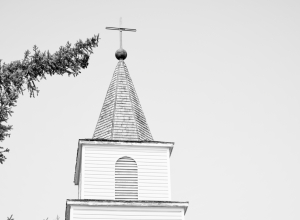
In the 1940s and 1950s, the loft would have been occupied with a choir and an organist. For the Aug. 13 service, Fr. Bisson brought his guitar and we all sang familiar hymns. At the end of the service Fr. Bisson drew our attention to an impending problem with the church structure and noted, “While it looks picturesque there is a need to keep it that way as water in the last few years is infiltrating the church at the steeple. If this is not soon remedied the structure of the church will be compromised and will over time become too costly to be repaired if we keep delaying the problem.”
Even though the interior of the church is still in excellent condition it would be a tragedy if the leak in the steeple led to the deterioration of the historic building.
Following the service, Fr. Bisson carried out the tradition of blessing each grave. Then it was time for food and fellowship in the outdoor setting on the church grounds. Since it had been many years since I last attended a service, it was great to recognize some familiar faces and names and touch base with the past. Along with a cup of coffee, cold cuts, buns and a variety of desserts, there was ample fellowship and all too soon it was time to head back home to Dauphin.
Hopefully, the leak in the steeple will be fixed and we can look forward to many more Sundays closest to Aug. 15.
Annual ride addresses needs at DRHC

Nearly 50 motorcyclists took part in the sixth annual Memorial Ride in late August 2023 and through their support, helped contribute towards identified needs at the Dauphin Regional Health Centre (DRHC).
This year, the Memorial Ride, spearheaded by Tony’s Auto Electric and JDS Laundromat in Dauphin, made its way through Parkland communities along Highway 5 and Mountain Road and reached its final destination in Erickson.
The 300-kilometre return trip raised a total of $2,200 that was donated to the health centre, through the Dauphin Hospital Foundation.
The Memorial Ride is held in loving memory of those lost over the past year. It aims to bring people together in celebrating and recognizing the lives of those lost and it does not matter if people rode a motorcycle or just purchased tickets. The goal was to enjoy the day, visit with people, share memories and contribute to a worthy cause.
Organizers were very pleased with the support of communities and individuals along the way. The Dauphin Hospital Foundation and Dauphin Regional Health Centre sincerely thank the organizers, participants and all who contributed to this worthy cause.
A top instrumentalist on radio and television
By Ed Stozek
For the Herald
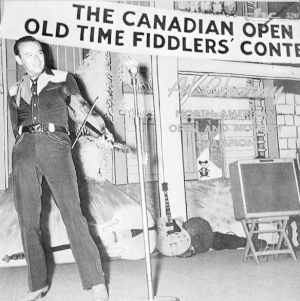
As a child growing up at Medicine Hat, Alexander Peter Chernywech received a violin from his father at the age of nine and began studying classical violin under the instruction of Frank Nowak. Cherny’s interest in playing the violin eventually led to joining the high school orchestra.
One day Cherny happened to hear “Rubber Dolly” as well as “Don Messer’s Breakdown” and this inspired him to play country music on weekends for money.
“I needed the money, it was just when I started to go out with girls.” (Aug. 9, 1974, Dauphin Herald)
Cherny also became passionate about country music after buying a 50 cent ticket to see Wilf Carter perform. He formed a country band and played at western fairs including the Calgary Stampede.
The “fiddle” music gained him popularity locally in the Medicine Hat area. He got further experience by joining Vic Siebert's group, The Sons of the Saddle in 1951 and attained success through broadcasts on Medicine Hat’s CHAT radio.
His next step included an audition on CKNX-AM Radio’s Saturday Night Barn Dance that aired from Wingham, Ont. He was very nervous but he passed the audition and became a regular from 1952-59 performing with artists such as the Mercy Brothers, Gordie Tapp, Tommy Hunter, Gordon Lightfoot, Myrna Lorrie and Wilf Carter. Cherny eventually made it to television starring in CBC’s Country Hoedown.
In 1960 and 1961 Cherny entered the Annual Old Time Fiddle Contest in Shelburne, Ont., and was named both North American (Old-Time) Champion and Novelty Class Champion becoming the first Canadian to win in both categories.
While doing the Barn Dance shows Cherny had two major influences, comedian Gordie Tapp of Country Hoedown fame and singer Tommy Hunter.
Cherny was a leading studio session musician recording with Gary Buck, Dick Damron, Tommy Hunter, Jessie Winchester and Sylvia Tyson. As a solo artist Cherny released more than 10 studio albums and received the RPM Big Country Award for Top Country instrumentalist in 1978. He covered notable standards such as “The Orange Blossom Special”, “Back Up and Push”, “Road To Boston”, and “The Black Velvet Waltz.”
The accomplished fiddler’s travels sponsored by CBC for the armed forces took him to France, Germany, England, Cypress and even behind the Iron Curtain. He managed to get a visa and visited his baba in Ukraine, noting that it was a great experience to meet her and that he would love to do it again.
Cherny’s travels also included performing at Canada’s National Ukrainian Festival in Dauphin in 1967.
As noted in the April 28, 1967, edition of The Dauphin Herald, “Top instrumentalist on radio and television, Al Cherny, selected to be one of the stars of the second annual National Ukrainian Festival.”
His performance later that year inspired several hundred fans to write letters requesting to bring him back for 1968. He also was the feature grandstand entertainer in 1972 and 1974.
Lineups were a common sight for the ninth annual festival. My wife Janice and I attended a grandstand show in 1974. That year it was estimated that over 12,000 people attended the shows with 3,700 on Friday night, 3,800 on Saturday afternoon and 4,000 on Saturday night. Some of the performances included stage and radio performer Joan Karasevich, Canada’s National Ukrainian Festival Choir, Dauphin's Troyanda Singers, various dance troupes including Dauphin’s Zirka Dance Ensemble, Rushnychok, a four-piece band from Montreal, and one of the finest professional fiddlers of the day, Al Cherny.
It was great to see Cherny entertain at the grandstand. “Al is forever smiling and who can’t picture him playing his fiddle. He can play the fiddle in almost any position, behind his back, over his shoulder, under his leg and even with his teeth.”
The audience was very familiar with Cherny’s music, as most had followed him on Gordie Tapp’s Country Hoedown from 1959-65, as well as The Tommy Hunter Show. Hunter’s show initially aired in 1965 and Cherny regularly appeared on it until his death in 1989.
Personally, it brought back memories of a Friday night television ritual watching Cherny perform fiddle tunes on the black and white television set in my parent’s living room.
Celebrating the Harvest
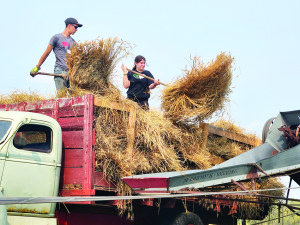
The Swan Valley Historical Museum held their 2023 Harvest Festival this past Sunday (Aug. 27), with a great showing of support from visitors. Here, William Piwish (left) and Rae-lene Piwish toss sheaves of wheat into the old threshing machine...
Kindergarten is a place to nurture and grow
By Ed Stozek
For the Herald
Kindergarten is a German word translated as a “children’s garden’ and refers to a place where children are nurtured and allowed to grow at their own pace.
In the 19th century the original goal of early kindergarten was to promote the assimilation of newcomer children to life in Canada with provisions including clothing, meals and even shelter.
Throughout the years programs in our education system have evolved. For example, kindergarten programs were offered by organizations or private individuals at a variety of venues. My nephew attended kindergarten classes taught by the minister’s wife at the Plumas United Church.
The Manitoba government first provided grants for kindergarten in 1967 encouraging all school divisions to establish such programing. In 1968 Manitoba Education issued the first kindergarten curriculum guide. Every school division across Manitoba now offers a kindergarten program. Some operate for a full-day everyday while in rural Manitoba some operate on a full day on alternate days. At Cartwright, our grandson Syd attended half-days every day.
Getting ready for school in the morning, learning the alphabet, counting, and playing with other classmates were all part of the of the daily routine for Syd who started kindergarten this past September.
Shortly after he began his scholastic journey I asked him what he liked best about school. He promptly answered, “recess and snacks.” Syd ended up enjoying his year and along with recess and snacks progressed from learning the ABCs to reading age-related books. At his kindergarten graduation he received a certificate indicating that he was a “rocking reader.” In a recent conversation with Syd, he proudly noted some of the books that he had read.
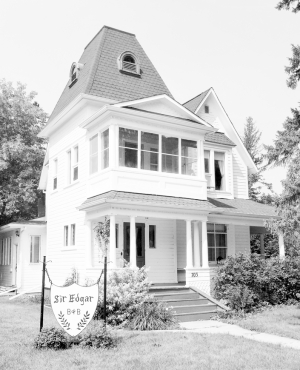
In Dauphin, the Edgar House had an interesting history regarding kindergarten. An advertisement in the Aug. 31, 1939 edition of the Dauphin Herald, announced that Mr. and Mrs. Dahlgren were opening their studio at 703 Gartmore (Main) St. North. Along with piano and singing lessons, daily classes in “general kindergarten work for pre-school age” were offered.
The couple had just returned from Toronto having spent the summer at the Royal Conservatory of Music. That September, six five-year-old students were enrolled with Mrs. Dalhgren for piano lessons held twice a week. From that original class, Mrs. Dahlgren soon developed a daily kindergarten program with classes in the morning and afternoon.
It became a very successful venture. “The big white Dalhgren house on Dauphin’s Main Street has been ringing with the sounds and noises of children every school day for thirty years. It wouldn’t have gone for thirty years were it not for the enthusiasm of every new class. It was exciting for children to learn to play and get along with other children so that they would be prepared socially for formal schooling.” (April 2, 1969, Dauphin Herald)
Daily routine included the children sitting in desks for part of the time, doing informal reading and learning to recognize words. They also learned songs, listened to stories, honed their co-ordination skills by using scissors for cut-outs and colouring with crayons. They also played games, exercised, had rest periods, snacks and were sometimes allowed to go upstairs to watch Mr. Dress-Up on television. Occasionally Mr. Dalhgren told them stories.
Mrs. Dalhgren’s kindergarten program changed and developed over the years but one thing that remained constant since the early years was the annual production presented at Christmas and in June.
Music was a very important component of the kindergarten program. Mrs. Dalhgren felt that music helped the children develop their sense of rhythm and time. The productions included performing Sleeping Beauty, Little Red Riding Hood, Cinderella, or Snow White.
My wife Janice recalled that her mother enrolled her midway through the school year. She ended up practicing for the Snow White production and noted that the students wore elaborate costumes when the operetta was presented to the public.
Today we can reflect upon some of the differences between the past and present programs and especially at some of the similarities that have stood the test of time.
After attending daily kindergarten classes Syd was looking forward to summer holidays. He was also excited at the prospect of starting Grade 1 in September.
Dogs are a man’s, and a boy’s best friend

By Ed Stozek
For the Herald
Upon arrival at a farmyard the first contact usually involves a greeting by the official “guardian” of the premises, the family dog.
The term “a dog is man's best friend” was first coined in 1789 by King Frederick of Prussia claiming, “the only, absolute and best friend that a man has in his selfish world, the only one that will not betray or deny him, is his dog.”
For many years our farm dog was my best friend. We had many great outdoor adventures during my formative years.
After listening to the exploits of Sergeant Preston and his dog King on the radio, as well as reading novels regarding sled dog Buck in The Call of the Wild, it made me think of the possibilities of training my dog to pull a sleigh or a wagon.
After several futile attempts he flatly refused to co-operate. Other young lads raised in a rural setting had more success in training their farm dogs.
Clifford Hadway’s parents, Morris and Helen, lived one-half mile south from the Rigby one-room country school.
Walking or riding a bicycle was the preferred way to get to school during the non-winter months. When snow blanketed the countryside, seven-year old Clifford, a Grade 2 student, had an alternative mode of transportation.
Rintie, the Hadway’s farm dog, always gave Clifford a ride to and from school. As noted in the February 24, 1955, edition of the Dauphin Herald, “This has been going on for two years. Clifford trained four-year old Rintie well. Rintie is a faithful dog. He has never refused to do his duty.”
In the morning Rintie was harnessed and then hitched up to a small wooden sled. Clifford hopped on and off they went to school. When they arrived at the school Clifford told Rintie to go home. As 4 p.m. approached, the Hadways hitched Rintie up to the sled and sent him off with the command, “Go for Clifford.”
When Rintie arrived at the school Clifford was always waiting for him. He boarded the sled in preparation for an exciting journey home from school.
In a recent conversation Clifford noted that Rintie was just an ordinary farm dog, totally white in colour. Under Rintie’s “dog power” the rides to school on the wooden sled with red runners and a steering wheel continued for several more years.
My friend Elmer told a story of the use of “dog power” at Winnipegosis. He remarked that his cousin used a dog to haul water as the well water at his farm was not suitable for drinking. Many rural and town people got their water from a well next to the Sass store in Winnipegosis. When drinking water was needed, Elmer’s cousin harnessed the dog and hitched him up to a toboggan. Two empty cream cans were loaded onto the toboggan and the journey began. Once they arrived at their destination the cream cans were filled with well water and it was time to head back to the farm. On one occasion the dog was in a hurry to get home and took off at full speed. By the time Elmer’s cousin caught up to the toboggan, the dog had navigated the load into a ditch and all of the water spilled. They had to go back to town and start the process again.
Another friend shared another dog story. Using a homemade harness that his mother made, Delmar first harnessed and then hitched up the farm dog, Toby, to a small sleigh.
Walking side by side, they ventured several times a month on a two-mile trek to get groceries at Smaluck’s Store at Petlura. Delmar also mentioned that Toby was easy to train and loved pulling the sleigh so much that he would eagerly step into his harness in anticipation of any upcoming trip.
A young boy and his dog always have a special connection. Even though my dog didn't co-operate in pulling a sleigh or wagon, his affection, loyalty and dedication made for many good years of sharing our company with each other.
Countless adventures were experienced on weekends and on days when I arrived home after school.
Walkathon fund-raiser leads to new outdoor pool
By Ed Stozek
For the Herald
There have been times when we purchase a raffle ticket or pledge someone for Jump Rope for Heart, Relay for Life or other fund-raising events.
A walkathon is a popular fund-raising event involving participants collecting pledges and sponsorships from donors in exchange for walking a set distance. Participants then collect money for every mile that they walk or get a flat donation to raise funds for a charity or an organization.
Walkathons are often community events that involve fun, action and appeal to a large audience.
Several weeks prior to a 25-mile “Walk to Swim” fund-raising event sponsored by the Lions and Kinsmen clubs for Dauphin’s new outdoor swimming pool, Lions club president, Bob Robinson, issued a challenge to all of the other service clubs. Dressed in a knight’s outfit and a multi-layered pair of work socks, Robinson challenged the presidents of other organizations including Rotary, B.P.O. Elks, Oddfellows, Knights of Columbus, Masons, Shriners, Dauphin Commercial Travellers, Kinsmen, Toastmasters and the Dauphin Volunteer Fire Department to participate.
“Because of my youth, my energy, and my unparalleled physical condition, I feel confident that I will not only finish the walk, but I will win the race.” (June 14, 1968, Dauphin Herald).
There was a friendly rivalry between the various clubs and their members. For example, Bill Zaporzan, president of the Dauphin Toastmasters club, announced that he would accept the challenge and believed that Robinson would lose ground by at least a quarter mile for every mile that the two walked. Zaporzan also counter challenged for the loser to pay $5 per mile towards the pool project.
As an added incentive for the June 23 fund-raiser, all participants were promised a crest as well as a ballot for a draw. Free season passes would be awarded to 25 lucky winners. The slogan, “Help youth, help yourself and help Dauphin, sponsor someone in the walk”, encouraged my wife Janice and her good friend Carol to canvas for some pledges, slip on their running shoes and along with many other participants, enjoyed a 25-mile walk on a warm sunny Manitoba day.
The walkathon commenced at 8 o’clock on Sunday morning from the front of the court house. The participants walked down River Avenue and turned left at the highway leading to Winnipegosis. The group then turned right at the Stoney Point Road and walked east for eight miles, turning south and walking in the proximity of Lake Dauphin before heading west and arriving on Main Street. The end of the route occurred at the CKDM radio station.
Almost 400 people took part in the “Walk to Swim’ walkathon. A group of pastors and others who could not walk on Sunday did their bit on Saturday. Toby Dick, a Dauphin student from Cormorant, completed the course in four hours and 25 minutes. He was closely followed by Calvin Chute. The first female to cross the finish line was Sandra McKillop.
With pledges amounting to $11 per mile, Dauphin’s mayor, Hugh Dunlop, agreed to walk 10 miles. A final walkathon total was unavailable, however, with widespread interest both locally and nationally, at least $6,000 was pledged. Monies were to be turned in to the Royal Bank.
The Lions Club publicly thanked all of the citizens, “who generously contributed financially, walking, publicity, supplies, food, etc. It is felt that each and every one gave their fullest in making the project a total involvement.” (July 5, 1968, Dauphin Herald).
Built by Panoramic Pools from Winnipeg, the 30x75-ft. aqua container was the largest of its kind in Manitoba and opened to the public on August 17. With scheduled public swim times at 10 a.m. to noon, 1 p.m. to 5 p.m. in the afternoon and 6 p.m. to 9 p.m. in the evening, 25 cents garnered admission for children 12 and under, 50 cents for students and 75 cents for adults.
Recreational director Coots Riehl noted that standard pool regulations included, “No running around the pool, no food or drink in the pool area and everyone must shower before being allowed into the heated pool. For added safety, two lifeguards were to be on duty at all times.” (August 16, 1968, Dauphin Herald).
Nice buns
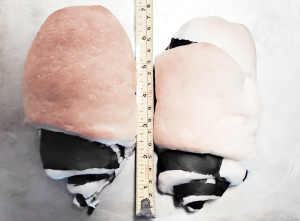
Dawn Recknell recently tried her hand at making beet leaf buns for the first time, but in addition to making a bunch of regular sized buns, the 79-year-old decided to make two supersized buns, which measured seven inches in length, each one enough for one meal.
Recknell made the two extra large buns just for fun.
Long playing records take the place of once popular 45s
By Ed Stozek
For the Herald
Thumbing through a collection of vinyl LPs (long playing records) evokes many memories.
During my teen years an old Philips record player in my parent’s living room made it possible to listen to a modest collection of music on LPs and 45 rpm records.
In 1948, Columbia Records unveiled the 33-1/3 rpm LP. Rpm denoted revolutions per minute, an indication of how fast the record was meant to spin on the turntable.
Sized at 12 inches in diameter, 15 to 22 minutes of recorded music was formatted per side. In response to Columbia, RCA Victor came up with the seven-inch 45 rpm record with approximately five minutes of music per side. Major record labels used the 33-1/3 format for LPs and the 45s for single record songs. Record players had a switch to change speeds for each record format.
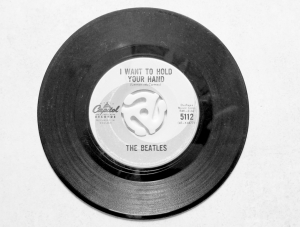
My parents occasionally drove to Shoal Lake to shop for groceries. My favourite stop included the local radio and television shop to peruse the store’s collection of 45 rpm records. Nickels, dimes and quarters were used to purchase popular titles such as “I Want To Hold Your Hand” by The Beatles.
Since LPs and 45s had different sized centres most people of my generation recall the yellow “spider” adapter used to make the 45s compatible to the spindle utilized for LPs. Since the 45 record only had one song per side it was time to switch to only buying LP records. LPs featured 10 to 12 songs from a favourite solo artist or group and generally cost $3.99.
My classmates and I often discussed the latest popular hit songs and rock bands during our high school years. We brought our favourite 45s or LPs and used the school record player to listen to songs by The Monkees, The Beatles, The Rolling Stones and other popular groups.
During my university years, my appreciation of popular recording artists continued. Over 50 years later, several songs from that era still stand the test of time. Recorded in June and July 1970, the double live album, “4 Way Street” by Crosby, Stills, Nash and Young featured great harmonies and interesting guitar arrangements in stereo. It became an instant classic offering songs such as “Teach Your Children” and “Ohio.” It was the best of both worlds featuring an acoustic set, as well as a full rock band set.
James Taylor released Sweet Baby James in 1970. “Fire and Rain” soon became my favourite song. It was a challenge to learn its intricate guitar riffs. In 1971, “Horse With No Name” was released by the group America. It was an easy song to learn as it only had two chords. It was also the first song that I performed in public at a function at Brandon University. 1972 heralded Neil Young’s solo album, “Harvest”, with a number one hit song, “Heart of Gold” and another favourite, “Old Man.”
Gordon Lightfoot also proved to be a popular choice of a recording artist. For one of my university courses, the “Canadian Railroad Trilogy” and “Black Day in July” were used for a presentation showing how songs related to historical events.
One of the first household items that my wife Janice and I invested in shortly after we were married included a turntable, amplifier and a pair of sweet-sounding speakers. Other popular formats for playing music included 8-track tapes. Our car had an 8-track player and it always “clicked” to another track during the best part of a song.
The cassette format also became popular. Tapes periodically got tangled up and it was always an adventure to take the case apart to untangle the mess or try to splice a broken part with Scotch tape. Until the advent of digital compact discs in the mid-1980s, we continued to listen to our collection of
LPs played on our stereo system.
LP records are currently making a comeback as the vinyl format provides a warmer, more authentic sound compared to digital recordings.
Nostalgia also plays a part for those who lived through the golden age of vinyl.
Even though records occasionally “skipped” or got a scratch from a well-used stylus, it was always exciting to listen an LP on a stereo system.
Honouring the 16 lost

David Liwiski’s Grade 6 French immersion class at MacKenzie Middle School hosted Chiaki Caplan, June 26, who did a presentation about her job as a settlement worker for newcomers to Canada at Regional Connections, Japanese language, origami and Japanese calligraphy.
The students made origami cranes. In Japanese culture, the crane represents peace, long life and healing. The project in the photo above has eight rows with 16 cranes and is dedicated to the 16 people who lost their lives in the June 15 crash.
This project was also created with the spirit of helping the survivors, and friends and families of those implicated in the accident heal.
The finished project was presented to the Dauphin Active Living Centre where it is on display. A big thank-you to Mrs. Caplan for inspiring the class to create this heartfelt project.