

Submitted
Comic books helped to fuel a love of reading

By Ed Stozek
For the Herald
My sisters and I were first introduced to the three Rs in a Grade 1 to 8 country school setting.
These basic skills also inspired us to explore and appreciate a variety of reading material and art concepts.
A small room at the back part of the school housed a limited collection of library books.
My sister Adell loved to read. She noted that she read all of the books from the school library “several times over.” One year she had to miss an extended period of time from attending school due to illness. Her teacher, Mr. Kiez, stopped by for a visit at our farm house and dropped off homework and some comics. Adell really enjoyed reading the comic books.
Several years later when I attended the same one-room country school the amount of reading material at the library was still very limited.
One of my favourite books included, Scrubs on Skates, written by Scott Young. The adventures of young hockey players on a Winnipeg high school hockey team made for an interesting read. As a note of interest, author Scott Young, a Canadian journalist, sportswriter and novelist, was Neil Young’s father. I also read and reread Lost in The Barrens by another Canadian author, Farley Mowat. Following the adventures of Jamie and Awasin’s survival in the Arctic stirred a young boy’s imagination.
My sister’s collection of comic books also expanded my reading horizons. An occasional investment of a dime or a quarter netted a new comic book with an exciting story line and interesting artwork.
Along with the usual superheroes and westerns I especially enjoyed the Classics Illustrated Comic series with titles such as The War of the Worlds, Treasure Island and The Three Musketeers. Many years later my sons became avid collectors of Spiderman and Alien comics.
My comic book collection increased the day of my tonsillectomy.
On our way back from the Hamiota Hospital, my father and I stopped at the pharmacy at Shoal Lake to pick up a prescription. The pharmacist handed over some comics to help distract my pain.
None of the comics had covers. Back in the day comic books were sold to distributers and retailers on a returnable basis. This meant unsold comics could be returned for credit. To ease the cost of shipping back the whole comic book, retailers were allowed to strip off the covers and receive full credit as if they returned the entire book. Legally, the retailer was obligated to destroy the remaining copies. Some retailers destroyed the comic books while others sold them at a discounted price. In my case the pharmacist gave me some free reading material. Dennis the Menace, Tarzan and The Lone Ranger were thoroughly enjoyed.
Art was another popular activity at the one-room country school.
Typically participating in art projects occurred on a Friday afternoon. A former schoolmate of my older sister recently recalled an interesting story. Cornelia did not like to draw. For one art lesson Mrs. Ewashko handed out a sheet of paper for each student to draw on. Cornelia quickly passed the paper to Janet who was seated in the desk in front of her. Janet quickly drew a picture and passed it back to Cornelia without the teacher catching on to what was happening.
After I started to attend school, I thoroughly enjoyed the Friday afternoon art lessons and our attempt at creating a masterpiece. Drawing was a passion of mine and it was a great deal of fun to sketch some of my comic book heroes. We also did other art projects.
I recall bringing a potato from home, cutting it in half and drawing a shape on the surface of the potato. We cut out around the shape, dabbed the potato in paint and then stamped the potato on paper. We came up with some interesting designs.
Many years later I used that same art concept for one of the first Grade 6 classes that I taught in 1974-75.
Literature and art concepts initiated in the early childhood years sure did help to inspire, enrich, educate and entertain.
It’s still a great deal of fun to “doodle.”
Tickling the ivories all the way to victory

By Ed Stozek
For the Herald
The thought of moving a heavy object conjures up images of the time when my friend Gerald helped move an upright Kawai piano.
If we had the right equipment it would have been a much easier task, nevertheless, “us two former farm boys” managed to move the piano to its new location.
During WWII pianos destined for American troops serving overseas were moved to new locations in a much different manner.
Steinway and Sons produced specially-built pianos for the American troops. Called the Victory Vertical or G.I. Steinways, pianos were crated and airdropped by parachute onto battlefields to provide musical relief and relaxation for the soldiers.
At this time all kinds of production involving metals such as iron, copper and brass that was non-essential to the war effort was prohibited by the American government because these metals were essential to manufacture guns, tanks and artillery. The instrument maker companies were affected by the new regulations. They had to alter their merchandise to comply with the new regulations and manufacture a product that the military could use or face bankruptcy while waiting for the war to end.
One of the “Big Four” piano makers, Steinway and Sons, had manufactured pianos for over 90 years. Instead of shutting down their factory, the company fabricated coffins and parts for troop transport gliders.
The Baldwin Piano Company constructed wooden airplane wings and the Gibson Guitar Company assembled wooden toys.
Although these ventures weren’t profitable, the projects enabled the companies to keep their operations running.
Steinway was rewarded when the US military granted a contract to make heavy duty military pianos for commissioned officers. By June 1942, the company workers also had designed a small upright piano, “no more than forty inches high and weighing 455 pounds, it was light enough to be carried by four soldiers. The pianos did not have legs like the usual upright models as they would not have withstood an airdrop. Each piano was treated with special anti-termite and anti-insect solution and sealed with water-resistant glue to withstand dampness.”
Ivory keys were coated with white celluloid to protect them from tropical climate conditions and soft iron was used instead of copper for windings on the bass strings. To comply with the government restrictions only 33 pounds, roughly one tenth of metal was used compared to a typical grand piano.
Along with tuning equipment and instructions, the finished products, identified by their military colours of olive, blue and gray, were packed into durable shipping crates and then dropped by parachute from a B-17 bomber.
Approximately 2,500 Victory Vertical pianos were dropped to American soldiers fighting the war in Asia, Africa and Europe.
For example, Victory Verticals were played by a dance band in the Philippines, a special service unit in Alaska and by accompanied performers from Bob Hope to violinist Isaac Stern as they toured on behalf of the United Service Organizations.
For the American troops, music gave peace of mind from the horrors of war and helped to alleviate them from being homesick. The pianos played a vital role in providing soldiers with countless hours of diversion, education, worship, enrichment and outreach.
One soldier wrote home to his family, “Two nights past we received welcome entertainment when a jeep pulling a small wagon came to camp.
The wagon contained a light system and a Steinway piano. We all got a kick out of it and sure had fun after meals when we gathered around the piano to sing. I kept smiling and even today am humming a few of the songs we sang.” (Steinway.com)
Much like the Victory Vertical or G.I. Steinway, the piano that Gerald helped me move also became an important fixture in our new house. My children spent countless hours practising their scales and test pieces for their music lessons from Mrs. Scinocca and Mrs. Borgfjord.
This past summer my friend Frank came from Edmonton for a visit. It was like old times from our university days. We congregated around the piano. I strummed my acoustic guitar and Frank “ickled the ivories.”
Like the soldiers during WWII we really enjoyed making music.
Canadians encouraged to invest in Victory Bonds

By Ed Stozek
For the Herald
During WWI and WWII the federal government sold Victory Bonds via Victory Loan campaigns to Canadian citizens, private corporations and various organizations in order to raise funds to help pay for the war.
The bonds were a loan to the government and could be redeemed with interest after five, 10 or 20 years. The Victory Bonds were released during five different campaigns between 1915 and 1919 and raised over $2 billion.
Each Victory Bond release was accompanied with a supporting poster campaign appealing to patriotic feelings to help sell the idea of helping to finance military campaigns. No bond issue in Canadian history had raised more than $5 million, however, Ottawa’s first drive exceeded all expectations.
The concept of Victory Bonds was actively reintroduced to the Canadian public two years after Canada became involved in WWII. In a radio broadcast a day after the first Victory Bond campaign was launched, Prime Minister Mackenzie King appealed to all Canadians’ patriotism and strong connections to Britain.
Canada’s minister of Finance noted, “In money alone, the war costs Canada $4 million a day, some three and one-quarter times the daily cost of the last year of the last war.” (May 29, 1941, The Dauphin Herald and Press)
An advertisement in the June 19, 1941 edition of The Dauphin Herald and Press revealed the eminent danger of a direct attack on Canadian soil. “To every mother, wife and sweetheart, beware of the vanishing Atlantic. Help keep the Front Line away from your doorstep. You can no longer depend upon the Atlantic Ocean for protection.”
Examples were given as to the possibility of a bomber flying from Greenland to the Maritimes, Quebec, Winnipeg or Vancouver. Another scenario included a bomb laden plane flying in less than 10 hours from German occupied France carrying destruction to Toronto, Ottawa and Montreal. It was also noted that the soldiers fighting in the war needed to be supplied with the tools to fight the enemy from occupying Canadian soil. Victory Bond sales were ear marked to buy more ships, planes and tanks. “Lend your money by buying Victory Bonds now! The money will come back to you with interest Lend to preserve the things money can’t buy.”
Victory Bonds were advertised as very safe loans. For example in seven and a half years a $4 bond would be worth $5. Larger investments would be worth even more. Citizens were encouraged to give their order to canvassers or by going to any branch of any bank, trust company or sending it to the local Victory Loan headquarters.
Bonds could be bought in denominations of $50, $100, $500, $1000 or higher. One could also buy in installments with 10 per cent down and the rest of the pledge in easy terms over a six-month period.
Children were also encouraged to participate. Rather than purchasing bonds, children bought War Savings Stamps each costing 25 cents. Once $4 worth of stamps were saved children could send their form to the federal government and receive a War Savings Certificate. Stamps were also made available to adults who could not afford the one-time $4 payment but still wanted to purchase a Victory Bond.
When the third Victory Loan campaign was made available in mid-October 1942, Canadian farm families were also able to invest in Victory Bonds either with cash payments or through the new Victory Tickets plan.
The Victory Ticket itself indicated a statement by a farmer that by a certain date he would deliver to a buyer that he had designated and had instructed to pay the proceeds from the sale of products such as hogs, steers or produce directly to the National War Finance committee for investment in Victory Loan bonds or War Savings certificates. Victory Loan salesmen were scheduled to come calling at farmers’ homes within the next two weeks.
The Canadian government no longer participates in the Victory Bonds program.
In 1946 the Victory Bonds program gave way to the Canada Savings Bonds with the goal of encouraging Canadians to continue their savings habits from the WWII era.
Due to various economic factors no new Canada Savings Bonds have been issued since 2017.
Awards handed out

Will Miner, left, accepted the Norris Aitken Memorial Award from Cam Bennet at the Dauphin Clippers football team’s awards banquet, Nov. 15.
Miner also won the Offensive Most Outstanding Player Award. Riley Lobert took home the Defensive Most Outstanding Player Award, as well as sharing the Playoff Most Outstanding Player Award with Sully Fox.
Owen Tyschinski also won two awards, taking home the Offensive Line Most Outstanding Player Award and the Wellbourne Most Dedicated Award.
Declan Waggoner won the Most Improved Player from Last Season Award, while Blake Thacker won the Most Improved Player In-Season Award.
Lars Gudbjartson was the Defensive Line Most Outstanding Player Award winner and Chayne Paziuk was this year’s Rookie of the Year.
The Best New Player in Grades 11 or 12 was Ahren Lautt. Gail Henton won the Ron Rockets Family Award.
The Coach’s Choice Award went to Alexander Tomkins and the Special Teams Most Outstanding Player Award went to Cody Zurba.
Transition from horses to autos provides memories

In an era of transitioning from horses to automobiles it’s interesting to note some of the stories associated with these modes of transportation.
During my formative years I had the opportunity to experience actual horse power, as well as the “horsepower” from the Chevy that my father purchased in 1952.
In 1945 my parents started their farm operation in the Oakburn district. They bought four horses for $120 and bought two more the next year.
The horses provided the power to pull the farm equipment and were also utilized for the nine-mile trip to town for supplies, going to church or for visits with the neighbours.
My sister Adell recalled travelling in a cutter (open sleigh) a distance of eight miles to my grandparent’s farm near Horod for family Christmas celebrations. She also noted trips in the cutter to the annual Christmas concerts at the one room country school that she attended. On one occasion they upset the cutter when it hit a snowbank.
In 1956 a van (caboose) was purchased from a neighbour. The comfort of winter travel improved significantly. As the team of horses pulled the van, we sat inside in its heated comfort courtesy of the small box stove.
Roads were often blocked after a winter storm and travelling by car was not possible. After one bad snow storm my father and I took a trip in the van to Oakburn to get supplies and the mail. Several days later it was a welcome sight to see the rotary snow truck blowing away the huge snow drifts and making the roads car friendly again.
For the trip to town the road took a left turn to skirt around a lake. Since there was a steep incline on the sharp curve there were several instances when someone came to our house at all hours of the night to ask my father to hitch up the horses and pull out a vehicle from the ditch.
During one particular winter of heavy snow, neighbours regularly took a short cut through our farm yard and bypassed that sharp curve by going through our field. In the mid-1960s a road was constructed right across the lake and a straighter and safer route was established.
If horse power in the late 1940s wasn’t feasible for transportation then hiring a neighbour to take his car for a trip to town typically cost $2.
My mother had medical issues that necessitated procuring the services of a neighbour and his car to drive to Winnipeg for several appointments. In June 1949, on one of the medical trips to Winnipeg, my father purchased a used 1939 Pontiac for the sum of $825. My father’s records showed that the Pontiac kept breaking down. After several years of footing numerous expensive repair bills a more reliable Chevy coupe was purchased.
Along with family trips to various destinations, my father also used the new car to drive neighbours to town for supplies or for doctor’s appointments.
On Sunday afternoons my father and I occasionally went for a drive in the Chevy to John Prosak’s country store located next to Seech Lake. At the refrigerated cooler one could buy a bottled soft drink and at the counter a variety of confectionary items and canned goods were sold.
One of the store’s regulars, an old bachelor, John Grzebinski, bought the best canned meats for his array of cats while he got by on soda crackers and peanut butter.
Our Sunday afternoons usually concluded with a visit with John. If he was at the store we would give him a ride home. He was a kind gentleman farmer who lived in a clay plastered log house and was well read and well versed in history. John and my father usually spent their visit talking in Polish about politics and the homeland. John appreciated our company and occasionally gave me a quarter for spending money.
The Chevy was permanently retired and parked in the woods in 1964. At my parent’s auction sale in 1975 it was sold for $200 and it was the last time that I set eyes on the Chevy.
Home Opener

The SVRSS Tigers Hockey Team started their season on home ice this past weekend in the Swan River Centennial Arena. The games were well attended but, for those that could not make it, the teamed offered a treat for at home viewers with a multi-camera production thanks to the SVRSS Visual department...
Paratroopers invade Manitoba seeking support
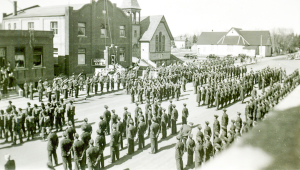
Victory Loans were appeals to Canadians by the federal government for funds to help finance the war effort during WWII.
Nine appeals were launched between June 1941 and November 1945. War revenue was roughly evenly split between corporate and individual contributions amounting to approximately $12 billion.
“Paratroopers invaded Manitoba and inaugurated the 6th Victory Loan campaign. Following a ceremony at the Legislature Building in Winnipeg, twenty-two paratroopers carrying Victory Shields by plane, parachuted to many units throughout the province.” (Apr. 27, 1944, Dauphin Herald and Press)
Local residents turned out in record numbers on the Saturday afternoon of Apr. 22, 1944, to watch 18-year old Canadian paratrooper, Private Fred “Sticky” Stokotelny, make a spectacular jump from a twin-engine Lodestar aircraft flying at 800 feet above the fairgrounds. Skilled in spot landing it took Private Stokotelny less than a minute to drop to the infield of the race track. Upon touchdown he disengaged himself from the parachute harness and did an “on the double” sprint to deliver Unit 38’s Victory Loan shield to Mayor Johnston.
On behalf of the armed forces he appealed to citizens of the Dauphin area to lend every possible dollar in order that “our fighting men may continue to have the best of equipment in sufficient quantities.”
The jump on Saturday afternoon was the eighth one for Stokotelny and the 15 mile per hour wind nearly carried him right into his parent’s backyard. After the presentation, Stokotelny and the mayor embarked on a car ride through Dauphin’s main streets.
The next evening the official inauguration of the 6th Victory loan in Dauphin was marked by an official presentation of Unit 38’s shield at a rally held at the Dauphin Theatre.
The shield was presented by Private Stokotelny to local war finance chairman W. L. Breadner. In accepting the shield Breadner pledged full support to the unit to attain Dauphin’s commitment of raising $425,000.
Stokotelny also presented similar shields to Group Captain J.C. Huggard and Wing Commander H.E. Stewart, commanding officers of the two local air training facilities.
On behalf of No. 10 S.F.T.S and No. 7 Bombing and Gunnery School both pledged campaigns of $75,000 and $80,000.
As part of the evening program, Flying Officer Donald Keith, a Nova Scotian stationed at the Elementary Flying Training School in Neepawa, gave an inspiring presentation of his enlistment as a pilot.
After 85 hours of training he was deemed combat ready. Keith was one of the first 44 Canadians to land in England and on April 5, 1940, he saw his first action. After spending a year as a Spitfire pilot, Keith was transferred to Singapore. On February 5, 1942, the boat transporting the troops was bombed for seven hours by the Japanese. Nine hundred servicemen were killed and another 400 wounded.
Keith escaped with four other airmen in a small boat and was later picked up by a battleship heading for Java. Fighting with the Dutch army the five airmen went to the front, held out for seven days and then headed for the hills. For 29 days they lived on coconut milk, bananas, berries and fruit.
They came upon a sampan and started on the 2500-mile trek to Australia. Five days later they were rescued and landed at Ceylon. Several weeks later they were sent to Australia where Keith was issued a tropical uniform consisting of a pair of shorts, a shirt, a pair of boots and a pistol.
He was wearing the same uniform when he returned to air force headquarters in Ottawa on July 24, 1943. Keith’s description of his escapes and sheer horror of modern warfare served to prove to the audience of backing “our fighting men to the full.”
The evening continued with violin and accordion solos by members of the paratroop show who had earlier entertained at No. 10 and No. 7. They were followed with some spirited community singing. Two war related films, “Target Berlin” and “War Department Report” concluded the evening’s program.
Victory Loan appeals during the course of WWII encouraged the citizens of the Dauphin area to contribute to Manitoba’s provincial quota.
Swan River Roots well represented in Canada’s National Ukrainian Festival

No matter where they go in their lives, Swan River connections stay strong in the Ukrainian Dance world. Alexis Denischuk with Vohon (Edmonton), Olivia Chmelowski with Zabutnyy (Regina), Myley Brunel with Zirka (Dauphin) and McKayla Hnatiuk with Bratsva (Dauphin) were all on the big stage at Canada’s National Ukrainian Festival in Dauphin from Aug. 4-6.
McKayka Hnatiuk
McKayla has been dancing with Bratsva in Dauphin for eight years. She is the daughter of Jason Hnatiuk as well as Sylvia Hnatiuk’s grandaughter.
She received four gold medals for her solo dances at different competitions and this year her dancing group was chosen from the talent competitions to perform at the grandstand on the final night of the festival.
Myley Brunel
Myley attended her first Canada’s National Ukrainian Festival as a spectator with a family friend, the summer of 2014 and fell in love with the costumes, especially the red boots and floral Vinoks, so in that fall, her parents Robert and Erin Brunel (nee Immerkar), registered her with Zirka and she has loved Ukrainian dancing ever since. Myley is the grandaughter of Evelyn Immerkar of Swan River.
Myley started dancing in Grade 2 in 2014.
Myley competed in competitions in Brandon, Yorkton, Regina and Dauphin.
She received most outstanding effort award with Zirka in 2014-2015 dance year and the Dedication Award in 2022-23 in memory of Chris Perih.
Presently Myley and her group are preparing to perform in Disney World, both on stage at Epcot and during the Disney evening parades in 2024.
Myley loves the opportunity to meet with her dance group at practices and enjoys meeting other dancers.
She is now old enough to wear the red boots that she fell in love with all those years ago.
Sara Synk
Sara is the daughter of Niomi (nee Hrappstead) and Joe Synk (former RBC Bank manager in Swan River).
Sara started dancing at the age of three with the Dolyna Dancers in Swan River.
She continued dancing, joining Troyanda Ukrainian dance group when she moved to Brandon, where she attended high school and her first year at Brandon university.
Since then she has moved to Regina to join Zabutnyy Dance Company as she finishes her education at the University of Regina.
During the Ukrainian dance festival Sara joined Alexis Denischukdancing the hopak.
Sara’s father also taught Ukrainian dancing in Swan River.
Sara enjoyed travelling to places in Manitoba and Saskatchewan to dance and still continues to love the art of dance.
Alexis Denischuk
Alexis started dancing with the Swan River Dolyna Dancers and continued on until graduating from high school.
From there she went on to continue her education at the University of Regina and danced with the Zabutnyy Dance Company for 3.5 years. The highlight of these years was travelling to Ukraine to dance at numerous dance festivals and workshops. Dancing in the famous Opera house in Lviv, Ukraine, was an amazing experience for Alexis.
Upon graduation she moved to Edmonton where she successfully auditioned for the Vohon Ukrainian Dance Ensemble. She was honoured to dance at the 50th Vegreville Pysanka Festival. She also performed in Portugal’s International Dance Festival with the Vohon dancers where she shared the stage with multiple countries.
The National Ukrainian Festival in Dauphin was where she was reacquainted with Myley, Olivia and Sara.
It was an honour to Alexis to return to her home roots and experience dancing on stage in her home province alongside so many talented dancers. Alexis is very grateful for the lifelong friendships she has made during her Ukrainian dance career.
Olivia Chmelowski
Olivia started dancing at the age of three and never looked back as she absolutely loved it from the get-go.
Throughout her years as a Dolyna Dancer, she was privileged to have incredible and dedicated instructors: AnnaLee Fuhr-Parnetta, Joe Synk, Becca and Jen Guay and Maks Zabutnyy (the latter three drove out from Regina weekly to teach them), Kelsa Unruh, and finally Amanda Yaschyshyn were all instrumental in fostering her love of dance and in her eagerness to give back, she also helped out with the instruction of the younger students in her last few years with Dolyna.
As she made her way to Regina for university, the pandemic was still in full swing, so there was no dance to pursue. By the time it was over, Olivia had fallen into a comfortable school/work routine but missed dancing, so returned to the familiar world of Ukrainian dance when she joined Regina’s Zabutnyy Dance Company. They practice twice per week and she’s had the opportunity to perform at many events in Saskatchewan and Manitoba, most recently Canada’s National Ukrainian Festival in Dauphin. When asked what she enjoys the most about dance, Olivia says she obviously loves the actual dancing, but the best part is the friendships she’s formed along the way.
Bible camp provides decades worth of memories

By Ed Stozek
For the Herald
“In the spring of 1946 Mr. Hugh Campbell rode into my father’s farm yard on horseback. He introduced himself and said that he and his wife Maime wanted to start a year-round Sunday school in the community.” (Dean Durston)
That summer the Campbells also organized the first Bible camp scheduled from July 17 to 24. The Geisel Point Camp was located several miles northeast from Ochre River on the shore of Lake Dauphin on property owned by Alex and Christine Geertsema.
As one of the 40 attendees of that first camp, Dean recalled sleeping in a granary. A large tent served as a cooking and dining facility. He also noted that some activities included boating, swimming and making friendship sticks from diamond willows. Everyone attending the camp signed their names on a friendship stick. Dean still has his friendship stick as a keepsake.
In 1947 the camp was relocated to Durston Park where land had been previously purchased by William Durston next to the Riding Mountain National Park. Several acres had been cleared and grass was sown with the goal of making an area suitable for groups of people and families to camp or to have picnics. It was an ideal location for a Bible camp.
The Campbells stayed in the district for approximately seven years and organized the Bible camps each summer.
In 1952 the camp became affiliated with the newly-formed Parkside Gospel Church. The Bible camp was operated by the church board and directed by the church pastor, Carl Frost.
That spring it was found that the dining hall and cookhouse at the camp were flattened by heavy snow. During a Sunday morning service an urgent plea was given asking for assistance. The same afternoon a group gathered at the camp and made plans to raise the roof and add a new kitchen. Within one week all the material was donated and the project was completed. Only one week of boy’s camp occurred in 1952.
“The following years, Kids and Young Peoples’ camps were held with attendance of 60 to 70 children and 25 to 30 young people. Money was scarce as camp fees were insufficient to pay expenses. Speakers and workers came on a gratis basis. Community assistance increased and donations of food were gratefully received.” (Carl Frost)
In April 1964 the grounds were leased to the Canadian Sunday School Mission (CSSM) and it took over the camping program. The Sunday afternoon on Aug. 1, 1965, marked the end of the first two sessions by the CSSM. Two weeks of camps were held with the first session for children 12 years old and over. Between 50 and 60 campers participated in a full program of sports, horseback riding, swimming and Bible studies. Morgan Brown, a local high school teacher, fulfilled the role as camp director and Rev. Peter Unrau from Kelowna, B.C., served as teacher and guest speaker.
For the second week over 100 children attended. Don Lee from Amaranth led the camp while Pastor James Gregor was in charge of teaching and Bible lessons.
The camp was filled to overflow requiring tents rushed into use. Campers arrived from various locations including Amaranth, Kelwood, Erickson, Winnipeg, Dauphin and Flin Flon.
Most of the camp workers gave their time and money with only a few of the staff receiving remuneration, and even then, they were paid very little. Many others donated their time doing carpentry, cooking and general labour to make the camp experience for the campers a resounding success and it was anticipated that three weeks of camp would be hosted the following year. A local farmer, Ross Seale, was chairman of the board consisting of men from four areas in Manitoba.
Aug. 31, marked the end of another successful year of operation of the Dauphin Bible Camp. Eighteen one-week sessions for age groups ranging in ages from six to 17 were offered with 448 campers attending.
From July 10 to 14 my grandson participated and experienced the many positive and enriching programs associated with the camp. When I picked him up after his week of camp was over, he was already asking if he could come again next year.
Conscientious objectors choose to appear in court
By Ed Stozek
For the Herald
A total of 72,354 men throughout Canada applied for conscientious objector status during World War II.
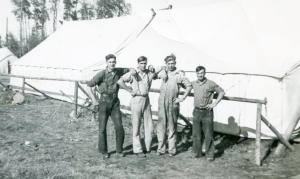
In Manitoba, Judge Adamson vigourously challenged individual applicants with personal questions based on their pacifist beliefs and then decided if that person qualified as a conscientious objecter. The conscientious objector status allowed the men to participate in doing alternative service as opposed to enlisting with the armed forces.
Farmers’ sons could also be exempt from enlisting because they were essential workers needed to support the country at home.
Ben Kroecker’s father was a pastor at Morris. He also was a farmer who operated a mixed farm and derived his income from farming. When Ben got his draft notice in the mail, the church made an appointment and he practiced his obedience by going to Winnipeg to appear before the judge. In his 10-minute interview, Judge Adamson asked if Ben was ready to go to the barracks. Ben replied that he was needed on his father’s farm. After some deliberation, Judge Adamson deemed that it was not necessary for Ben to leave the farm. Ben’s older brother had previously served in a camp for four months in the Riding Mountain National Park doing alternative service work. Having two sons leave a farm could spell economic disaster as farm help was in short supply. As a consequence Ben’s father had to pay $15 per month to the Red Cross.
Some young men from other parts of Manitoba attempted to use their religious beliefs in objecting to serve in the armed forces. Mike D. from the postal district of Ukrainia was sentenced to nine months of imprisonment for failing to report for his four-month training stint after having been pronounced physically fit and after having received notice to do so.
Arrested earlier that week, Mike appeared before Magistrate Little and declared, “According to the word of the Lord, I am not guilty.” (May 1,1941, Dauphin Herald) Half an hour later he changed his plea when he admitted that he had misinterpreted the charge.
Mike had previously applied for a postponement of training and with 13 others from the Dauphin Judicial District, appeared before Judge Adamson in Winnipeg on Mar. 25.
Adamson heard the 14 young objectors and then advised them to report to their training. Except for Mike and two others, all were farmer’s sons asking postponement in order to help on their familys’ farms.
Mike declared that he would not appear for his training and was warned that he would be prosecuted if he did not turn up in camp on the designated date. Evidently having thought about the matter, Mike admitted that it would probably have been better if he had reported. He noted that he was not disloyal to the country and was willing to do some other sort of work that would help the war effort.
Walter B., age 21, became the second objector from the RM of Dauphin to be convicted under National War Service Regulations and was sentenced to one year’s imprisonment with hard labour at the Dauphin jail.
Walter was convicted in front of Magistrate Thomas Little on a charge of failing to report for medical examination for compulsory training after having received notice to do so.
Evidence produced in court showed that Walter had received his notice on Mar. 26, 1940, and was to have reported almost immediately.
He wrote to the Department of National War Services in Winnipeg explaining his stand. If he was not going to fight why should he take his examination for training? He was advised by the department to report within a reasonable amount of time and was warned twice of the penalty.
Walter noted that he had taken up studying the Bible, “Pretty near two years; since the war started.” (June 3, 1941, Dauphin Herald) He had been baptized in July 1940, by a farmer who lived north of Sifton. Six months later he was studying the Bible himself.
Some young men faced the consequences of failing to comply with the enlistment process. Others were deemed as conscientious objectors or as essential workers needed to work on the family farm.