

Staff Writer
Nominees announced for chamber awards
The nominees for the Parkland Chamber of Commerce’s annual appreciation awards have been announced.
Nominated in the Business Person of the Year category are Marion Pernarowski, Angela Kotyk, Kathy McLennan and Brenna Haverluck.
Young Entrepreneur of the Year nominees include Kara Braschuk of Parks Edge Physiotherapy, Gabrielle Carriere of Hair Maiden, Amy Thompson of Amy Rae Maker and Kayla Luky of Old September.
In the Community Appreciation Group category, nominees include the Parkland Ukrainian Family Fund, the Ste. Rose Art Hives, Regional Connections and Habitat for Humanity.
Darren Eddie, Ashley Shaw, Peter Nadolny and Rodney Juba are all up for the Community Appreciation Individual award.
Winnipegosis Meat Market, Tim Hortons Dauphin and Steiner Plumbing and Heating are all up for the Outstanding Business award, while Side Hustle Business nominees include Terry Bloomer of Sweet Legs Dauphin, Craig MacCarthy of North Mountain Adventures, Jeff Schulz and Joe Houston of Go Beyond Games and Johnny Braschuk of Braschuk Plumbing and Heating.
Finally, the Start Up Business nominees include Grand Vieux Liquor Co., EXTFIT, Baxter Home Service, Hockridge Trade School and 5'1 Perspective.
The awards will be presented at the chamber’s Celebration Night, which will also include the presentation of the Legacy Business Award, Mar. 14, at Countryfest Community Cinema beginning at 7 p.m. Tickets are $15 for chamber members and $20 for non-members.
Those who are unable to attend in person, but would like to watch online can do so for $5.
For tickets and more information, contact chamber executive director Stephen Chychota at 204-622-3140.
Earlier in the day the organization will hold its 2023 Chamber Appreciation Lunch at Aspen Lodge at the Parkland Recreation Complex at 1 p.m.
The event will recognize 40 members with Milestone Achievement Awards.
Clippers, Raiders have company in race for first in WHSHL
The Dauphin Clippers remain in the hunt for first place in the Westman High School Hockey League despite a setback over the weekend
Dauphin opened the weekend with a 6-3 win over the Glenboro/Carberry/Baldur Wildcats, Saturday in Dauphin.
Jake Kuzmiak scored twice and added an assist to lead the Clippers to the victory.
Also scoring for Dauphin were Liam Chartrand, Ethan Carnegie and William Miner, while Owen Chubka made 34 saves for the win.
Trey Dickson with two and Jaren Waldner scored for the Wildcats. Sawyer Wiebe made 32 saves in a losing cause.
On Sunday, Kash Henkelman scored twice and Owen Martyniuk stopped 24 shots to lead the Swan Valley Tigers to a 2-0 win over the Clippers in Swan River.
Chubka took the loss after stopping 24 shots.
With the Killarney/Wawanesa Raiders winning both of their games, last week, they now hold down sole possession of first place with a 24-2-0-1 record for 49 points, two ahead of the Clippers.
And with three wins last week, the Tigers have all of a sudden moved into the hunt for first, as they trail Dauphin by just a single point.
Each team has three games remaining in the regular season.
This week, the Clippers are on the road to face the Reston/Elkhorn/Melita/Pierson Renegades, Friday, and the Vincent Massey Vikings, Sunday in Brandon.
Medical students get a taste of rural life

In partnership with the Manitoba Health Care Providers Network (MHCPN) and Max Rady College of Medicine, Faculty of Sciences, Prairie Mountain Health (PMH) hosted the University of Manitoba medical student Rural Interest Group (RIG) in Brandon, last week.
The RIG weekend promotes the benefits of practicing medicine in rural communities and available lifestyle opportunities. Some 34 first and second-year medical students participated.
PMH has advocated for the initiative as it provides the health region with additional opportunities to engage medical students early in their training.
Clinical workstations were set up at Brandon Regional Health Centre to allow the students to put their skills to the test by undertaking tasks like suturing, casting and airway management.
Prior to the two days, tudent RIG co-president Sydney McLaughlin says participants looked forward to the event after a brief pause due to the state of the COVID-19 pandemic.
“On behalf of both the Rural Interest Group and the University of Manitoba medical classes of 2025 and 2026, I would like to extend a huge thank you to PMH for the preparations and for welcoming us again this year,” McLaughlin said. “These events are so important for our education as they expose students to what it is like to work in rural medicine, provide opportunities for students to network with doctors and residents, and give us an idea of what it is like to work within the health region.”
Hedley receives prestigious award from Manitoba Credit Unions
A former CEO of Fusion Credit Union was honoured with the Order of Merit from Manitoba Credit Unions.
Ron Hedley received the honour last week as a demonstration of his significant commitment to the credit union system at the local, provincial, national and international levels.
“It was such an honour to receive this award,” said Hedley, who retired from a 40-year career in the credit union system in June 2020. “I accepted it on behalf of all the terrific people I had the good fortune to work with. All of the staff, management teams, and boards were such a large part of the successes and the happiness of my career. It was because of all of them that I enjoyed the first day and the last day of my 40 years.”
Those selected to the Order of Merit have made tangible contributions to the development and operations of credit unions and have demonstrated leadership in the philosophy of people helping people.
Get the full story in this week's Dauphin Herald!
Clippers sweep weekend tilts
A pair of wins to start the new year has the Dauphin Clippers hockey team maintaining its hold on first place in the Westman High School Hockey League.
William Miner had two goals and added a pair of assists to lead Dauphin to a 5-2 win over the Birtle/Shoal Lake/Rossburn Falcons, Saturday.
Boston Karlson, Liam Chartrand and Ethan Carnegie also scored for the Clippers, while Noah Street and Aiden Lewis replied for the Falcons.
Owen Chubka made 44 saves to earn the win in goal. Fred Hrycak stopped 28 shots in taking the loss.
On Sunday, Trayden Guiboche netted the winner 38 seconds into overtime to lift the Clippers to a 3-2 win over the Boissevain/Souris Broncos.
Tyron Sweetman had both goals for Dauphin in regulation. Kolten Barwick and Rayan Sprott tallied for the Broncos.
Chubka picked up the win with 13 saves, while Griffin Albrecht was tagged with the loss with 41 saves to his credit.
Dauphin’s record is now 16-2-0-0 for 32 points. They are two points ahead of the Killarney/Wawanesa Raiders.
MPI shares top five frauds of 2022
Social media likes, multiple sets of keys and a laundry detergent container might, at first glance, seem like they have nothing in common? But those all helped all helped Manitoba Public Insurance’s (MPI) Special Investigations Unit (SIU) saved Manitoba ratepayers nearly half a million dollars in 2022.
Insurance fraud comes in all forms and costs everyone. The price tag in Manitoba is approximately $50 a year for each customer, according to MPI data.
To raise awareness of this additional cost to ratepayers, the public auto insurer compiles and releases an annual list of unique cases based on the estimated financial savings to MPI’s ratepayers and the techniques used to confirm fraudulent actions and statements.
“Our SIU team works tirelessly to investigate suspicious claims in order to ensure the right claims are paid and for the right amount,” Marnie Kacher, chief operations officer with MPI said. “Thanks to their dedicated efforts in 2022, MPI closed nearly 3,000 investigations, which resulted in claims savings of over $14 million for customers.”
Here are the top five fraudulent claims made in 2022
Dirty laundry
After reporting to police and MPI that their vehicle was stolen from their home, a policyholder signed a sworn statement to an MPI adjuster claiming that the insured vehicle had been stolen and was destroyed by fire.
When found, a plastic container used to hold laundry detergent pods was located near the burned car.
After further investigation by law enforcement and SIU, reports surfaced that the claimant and the car had been spotted earlier in the day at a gas station, filling a similar container with gasoline.
After being presented with the evidence, the individual admitted the fire was accidental and the vehicle was not stolen as stated in their original statement.
The claim was denied based on the policyholder making a false statement, saving MPI ratepayers approximately $24,400.
Inflated injuries
After having their vehicle hit while another driver was changing lanes, a policyholder was deemed eligible to receive income replacement benefits and personal care assistance through MPI’s Personal Injury Protection Plan, based on the extent of their injuries.
The person claimed their injuries included a concussion, headaches, dizziness, back, knee and neck pain, an ankle injury and more. They reported that their ailments were so severe that they could not open water bottles or lift a pen and had limited mobility due to balance issues, nausea and full body pain. They claimed they could barely get out of bed.
An investigation was initiated, and surveillance showed the person was much more active than they reported to be. They were observed walking long distances, including shopping for hours at several stores, lifting bags of groceries, and driving a motorcycle on multiple occasions.
Based on the investigation, the individual was informed that their benefits would be terminated. MPI saved ratepayers more than $300,000 by denying the claim.
Fibbing friends
An insured individual reported returning to their vehicle to find it damaged by a nearby semi-truck. They also said that the other driver had already reported the collision to MPI and accepted liability for the collision.
After further investigation by the SIU team, it was discovered that the two people were known to one another and often interacted publicly on social media networks. A search of the damaged vehicle revealed jugs of coolant and oil in the back seat and after a full inspection, it was determined that the vehicle’s engine had seized due to lack of oil. The repair cost for the severe mechanical issues was anticipated to be $45,000.
When interviewed, the second driver confirmed they intentionally hit the vehicle with a rented moving truck after being asked for help by the vehicle owner. The owner also admitted to staging the collision.
Denying this claim saved ratepayers over $50,000.
Impaired interpretation
After being involved in a single-vehicle rollover, three heavily intoxicated people were found by law enforcement outside of a heavily damaged truck with all of the air bags deployed.
There were no witnesses to the incident and law enforcement had no way to determine who was driving the insured vehicle. However, one individual provoked more suspicion than the others, as the truck was registered in their spouse’s name.
One of the individuals was arrested for intoxication, held overnight and released the next day without any charges. Days later, the same person opened a single vehicle collision claim with MPI, indicating that they had hit a rut, lost control and rolled the vehicle. They also claimed they were alone in the truck and had not consumed any drugs or alcohol in the previous 24 hours.
After receiving a sworn statement from the individual, the claim was referred to the SIU, who quickly learned that the police had attended the scene. The claim was denied due to the false statement provided, saving ratepayers an estimated $62,000.
A key story
A person opened a theft claim on their vehicle, reporting that their SUV was stolen from their place of employment during an overnight shift. While speaking with law enforcement, they noted that they were in possession of one set of keys, after misplacing the only other set. However, when filing a claim with MPI they said they had both sets of keys at the time of the alleged theft.
The vehicle was recovered and towed to the MPI compound where it was examined by technicians. The examination concluded that the installed immobilizer was operational and functioning as designed. A coded and programmed transponder radio frequency signal is required to enable the engine to start and remain running, therefore a programmed key is the only way to start the vehicle. Additionally, the investigation found that the vehicle ignition was not manipulated or damaged.
As both sets of keys were determined to be in the customer’s possession despite the initial conflicting reports, the claim was denied, saving MPI’s ratepayers over $38,000.
Anyone with information about auto insurance fraud is encouraged to call the MPI TIPS Line toll-free at 1-877-985-8477, or submit information online at mpi.mb.ca.
All calls and reports are anonymous.
Christ is Born! Let us Glorify Him!
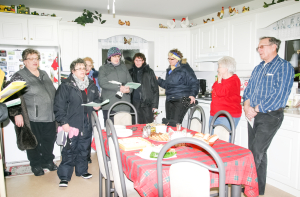
While for many the observance of Christmas this year is in the rearview mirror, for those who celebrate the holiday according to the Julian Calendar are currently in the midst of their celebration.
For Ukrainian people Christmas is the most important family holiday of the whole year. It is celebrated solemnly, as well as merrily, according to ancient customs that have come down through the ages and are still observed today.
Ukrainian Christmas festivities begin on Christmas Eve, Jan.6, and end on the Feast of the Epiphany, on Jan. 19.
Ukrainian Christmas customs are based not only on Christian traditions, but to a great degree on those of the pre-Christian, pagan culture and religion. The Ukrainian society was basically agrarian at that time and had developed an appropriate pagan culture, elements of which have survived to this day.
Christianity was introduced into Ukraine in 988 A.D. The flourishing pagan religion and traditions associated with it were too deeply rooted in the people to allow the Church to eradicate them completely. Therefore, the Church adopted a policy of tolerance toward most of the ancient customs and accepted many as part of the Christian holidays. In this way, the ancient pagan Feasts of Winter Solstice, Feasts of Fertility became part of Christian Christmas customs. This is perhaps why Ukrainian Christmas customs are quite unique and deeply symbolic.
The Christmas Eve Supper or Sviata Vecheria (Holy Supper) brings the family together to partake in special foods and begin the holiday with many customs and traditions, which reach back to antiquity. The rituals of the Christmas Eve are dedicated to God, to the welfare of the family, and to the remembrance of the ancestors.
With the appearance of the first star which is believed to be the Star of Bethlehem, the family gathers to begin supper.
The table is covered with two tablecloths, one for the ancestors of the family, the second for the living members. In pagan times ancestors were considered to be benevolent spirits, who, when properly respected, brought good fortune to the living family members. Under the table, as well as under the tablecloths some hay is spread to remember that Christ was born in a manger. The table always has one extra place-setting for the deceased family members, whose souls, according to belief, come on Christmas Eve and partake of the food.
A kolach (Christmas bread) is placed in the center of the table. This bread is braided into a ring, and three such rings are placed one on top of the other, with a candle in the center of the top one. The three rings symbolize the Trinity and the circular form represents Eternity.
A didukh (meaning grandfather) is a sheaf of wheat stalks or made of mixed grain stalks. It is placed under the icons in the house. In Ukraine, this is a very important Christmas tradition, because the stalks of grain symbolize all the ancestors of the family, and it is believed that their spirits reside in it during the holidays.
After the didukh is positioned in the place of honour, the father or head of the household places a bowl of kutia (boiled wheat mixed with poppy seeds and honey) next to it. Kutia is the most important food of the entire Christmas Eve Supper, and is also called God’s Food. A jug of uzvar (stewed fruits, which should contain twelve different fruits) and is called God’s Drink, is also served.
After all the preparations have been completed, the father offers each member of the family a piece of bread dipped in honey, which had been previously blessed in church. He then leads the family in prayer. After the prayer the father extends his best wishes to everyone with the greeting Khrystos Razhdaietsia (Christ is born), and the family sits down to a 12-course meatless Christmas Eve supper.
There are 12 courses in the supper, because according to the Christian tradition each course is dedicated to one of Christ’s Apostles. According to the ancient pagan belief, each course stood was for every full moon during the course of the year. The courses are meatless because there is a period of fasting required by the Church until Christmas Day. However, for the pagans the meatless dishes were a form of bloodless sacrifice to the gods.
The first course is always kutia. It is the main dish of the whole supper. Then comes borshch (beet soup) with vushka (boiled dumplings filled with chopped mushrooms and onions). This is followed by a variety of fish - baked, broiled, fried, cold in aspic, fish balls, marinated herring and so on. Then come varenyky (boiled dumplings filled with cabbage, potatoes, buckwheat grains, or prunes. There are also holubtsi (stuffed cabbage), and the supper ends with uzvar.
While many of the Ukrainian Christmas Eve customs are of a solemn nature, the custom of caroling is joyful and merry. Ukrainian Christmas songs or carols have their origins in antiquity, as do many other traditions practiced at Christmas time. There are two main groups of Christmas songs in Ukraine - the koliadky, whose name is probably derived from the Latin “calendae” meaning the first day of the month and which are sung on Christmas Eve and Christmas Day; the second group of Christmas songs is called shchedrivky, which is a derivation from the word meaning generous. The latter are sung during the Feast of the Epiphany.
Both koliadky and shchedrivky have pagan elements in them, but many have been Christianized. For example, one pagan carol tells of a landowner who is awakened by a swallow and told to make preparations, because three guests are coming to his house: the sun, the moon and the rain. In the Christianized version the three guests become Jesus Christ, St. Nicholas and St. George. The very popular Ukrainian carol in the United states, “Carol of the Bells”, in its originality is a shchedrivka and tells of a swallow (herald of spring) that has come to a landowner’s house and asks him to come out and see how rich he is, how many calves he has, and so on.
The themes of Ukrainian Christmas songs vary. Many, of course, deal with the birth of Christ and that occasion’s joyful celebrations, and many of them have apocryphal elements. Another group of carols contain purely pagan mythological elements. Still another group deals with Ukrainian history of the 9th to 12th centuries, mostly with the heroic episodes in the lives of some of the princes that were favourite among the people. One of the largest groups of carols are glorification songs - glorifying the landowner, the farmer, his wife, his sons, his daughters, every member of the family. These songs glorify their work, as well as their personal traits.
Caroling required extensive preparation. Each group had a leader. One member dressed as a goat. Another as a bag carrier, the collector of all the gifts people would give them. Yet another carried a six-pointed star attached to a long stick with a light in its center, which symbolized the Star of Bethlehem. In some places the people even had musical instruments, such as the violin, tsymbaly (dulcimer), or the trembita (a wooden pipe about eight-to-10 feet long, used in the Carpathian mountains by the Hutsuls).
Caroling was not a simple singing of Christmas songs; it was more of a folk opera. The carolers first had to ask for permission to sing. If the answer was yes, they entered the house and sang carols for each member of the family, even for the smallest child. Sometimes they even performed slow ritualistic dances. They also had to present a short humorous skit involving the goat. The custom of the goat accompanying the carolers has its origin in the pagan times when the goat represented the god of fertility. The skit showed the goat dying and then being brought back to life. This also symbolized the death of winter and the birth of spring. The caroling always ended with short well-wishing poems, appropriately selected for each home.
Koliadky and shchedrivky are the oldest groups of Ukrainian folk songs. They are sung by Ukrainians at Christmas time throughout the world.
Schedriy Vechir, or the Eve of Epiphany, on Jan. 18 according to the Gregorian Calendar is the “Second Holy Evening.” The meal is similar to the one served on Christmas Eve. After the evening meal, carols and songs expressing good wishes for the New Year, are sung. The Christmas tree would be taken down.
Epiphany is the final day of the Christmas season. It commemorates the baptism of Christ in the river Jordan by St. John the Baptist. On this day, it is the custom to bless water. The ceremony was usually held by a river, or now in modern times a vessel of water. Each family takes some of the holy water home.
After Epiphany the priest visits the homes of his parishioners and blesses their homes with holy water.
Local man gives a special gift to the community
It’s a Christmas time gift that will benefit many.
Dauphin resident Jim Mulligan provided a yuletide boost to the Dauphin Hospital Foundation with a generous donation of $150,000. The donation was also made in recognition of his late wife Judy.
Mulligan was more than happy to help by donating to an organization that provides needed assistance to many health-care projects and initiatives.
“I am pleased to be able to assist the Dauphin Hospital Foundation with their work. I believe the hospital, and health care, needs all the help it can get,” Mulligan said. “I look forward to seeing the donation put to good use to assist health care staff on the tremendous work they do each and every day.”
Dauphin Hospital Foundation chairman Greg Thompson was pleased to accept Mulligan’s contribution and grateful for the strong support he threw behind the foundation.
“Mr. Mulligan is very community-minded and wanted to ensure that organizations like the foundation can continue making a difference with various projects which assist the hospital, personal care home and community health services,” Thompson said. “We can’t thank him enough.”
ACC partnership paves way for new initiative at Parkland Campus
Assiniboine Community College (ACC) has partnered with Algonquin College of Applied Arts and Technology to offer a tuition-free Applied Building Construction program at ACC Parkland campus in Dauphin, beginning this February.
Selection into the six-month program will focus on engaging Indigenous youth from 18 to 30 years of age, who are not in employment, education or training (NEET Youth). There is space for 15 students. Tuition, textbooks, personal protective equipment, supplies and tools are all covered at no cost to those enrolled in the program.
“The Applied Building Construction certificate program provides students in this region an opportunity to receive training in a field with in-demand career opportunities, supporting an industry need for skilled trades workers,” said Kevin Poirier, dean of Trades at Assiniboine. “We’re thrilled to have Algonquin College on board to advance this opportunity for Indigenous learners. This funding strikes down a barrier for many of those looking to enter this field and goes a long way toward both transforming students’ lives and strengthening Manitoba.”
Applied Building Construction consists of six months of theory and practical learning followed by a seven-week paid practicum.
The program will be accredited with Apprenticeship Manitoba. Students who complete the accredited program with an average of 70 per cent or better in core trades subjects, gain employment and register as an apprentice within two years of graduating, will receive credit for Level 1 in-school technical training and 900 hours in the carpenter apprenticeship program.
“Costs for training that supports entry into the job market are an ongoing barrier to employment,” said Assiniboine’s director of Indigenous Education, Kris Desjarlais. “It’s welcome news when we’re able to offer opportunities where students can receive hands-on training free of this financial strain. With this, students are free to focus on learning.”
The program, funded by Algonquin College, prepares students for in-demand careers within a trade that employers report has a shortage of skilled workers.
Interested candidates must attend a free program information session as part of their admissions process.
Sessions are available on January 11 and 26, and February 1 and 8.
For more program details and to register for an information session, visit assiniboine.net/appliedbuilding.
RCMP D Division has a new commander
While Assistant Commissioner Rob Hill took over command of Manitoba RCMP in July, the change in leadership was officially recognized in a special ceremony last week.
Officers, employees, and special guests from across the province and nationwide welcomed the new commanding officer in a traditional RCMP Change of Command ceremony at the Manitoba Legislative Building in Winnipeg.
The ceremony is an RCMP tradition that marks the symbolic handover of authority from the outgoing Commanding Officer to the new leader of the force in the province. The ceremony involved RCMP Pipes and Drums, a ceremonial troop, and a flag party. There was a parchment signing and the transfer of the Divisional ensign from outgoing Commanding Officer Assistant Commissioner Jane MacLatchy to Hill. RCMP Commissioner Brenda Lucki oversaw the ceremony.
“While we are sad to see Assistant Commissioner MacLatchy go, she is leaving the province of Manitoba in very good hands,” Lucki said. “Assistant Commissioner Rob Hill brings a breadth of experience to the role. He has Manitoba roots that tie him firmly to the people of this province. He is committed to building relationships, employee wellness and rural crime reduction, and I know he will tackle these issues with the same enthusiasm he brings to everything involving public safety.”
Hill joined the RCMP in 1997 and spent 10 years in Manitoba with postings in Morris, Island Lake and Winnipeg Drug Section. While in Manitoba, he became involved in the Critical Incident Program as a Tactical Medic with the Emergency Response Team.
In 2007, he accepted a position with the National Critical Incident Program in Ottawa, where he developed and oversaw the implementation of the RCMP’s Tactical Casualty Management Program. During his time in Ottawa, he was involved in planning and operational deployments to the Vancouver 2010 Olympics and the 2010 G8 and G20 Summits.
In 2013, Hill was promoted to Inspector and moved to the Arctic where he was a Critical Incident Commander and the Administration and Personnel Officer for Nunavut RCMP.
In 2016, he transferred to Alberta and was the officer in charge of Stony Plain/Spruce Grove/Enoch Detachment. He was later promoted to Superintendent as the Assistant District Officer of the Central Alberta District. During this time, he continued duties as a Critical Incident Commander.
In February 2019, he was appointed to the position of Criminal Operations Officer with the Manitoba RCMP.
“I am humbled and excited to take on the role of Commanding Officer,” Hill said. “I commit to continue to learn from the lived experiences of diverse RCMP employees and the diverse communities we serve to make sure we are having the necessary discussions and are moving in the right direction. We are living and policing in challenging times, but I am optimistic about our future. I think the more we work together as people, as communities, the better we will be able to forge a path forward.”