


Shawn Bailey
It’s early, but temporary emergency department working well: Slate
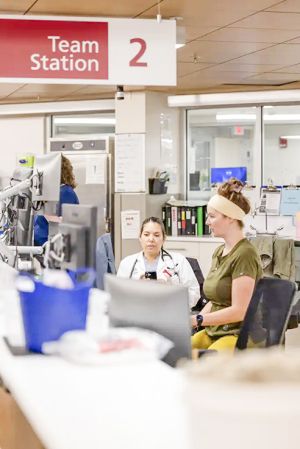
It has only been operating for a week, but operation of the temporary emergency department at Dauphin Regional Health Centre has been smooth.
“Any little challenge that has come up, we’ve been able to quickly work together to find solutions,” said Prairie Mountain Health chief executive officer Treena Slate.
“Thanks to the excellent planning that went into establishing the ER in Dauphin with the concerted efforts of our clinical teams, the physicians and nurses, and support staff and the lab and diagnostic staff, everything has gone very well.”
The idea of temporarily rebooting emergency medical services in the existing space came up late in the process of evaluating options, Slate added, which included evaluating other spaces, as well as the use of trailers and tents.
Once the idea of moving back into the main floor of DRHC was identified, everything came together quickly.
“Our contracting partners informed us that we might be able to access and energize undamaged air handling units on the roof of the emergency department. Once we found out that it was going to be a possibility to use the actual emergency room space, we were very excited about that,” Slate said, adding the advice was received in mid-August.
“We quickly came together to get plans in place to make it happen. So, it’s just tremendous that we were able to achieve that.”
The project was possible due to recent renovations on the emergency department, which included new, dedicated air handling. However, Slate stressed the solution remains a temporary one as much of the infrastructure for that newer part of the building was submerged in flood water in the basement and damaged.
“But fortunately there was several air handling units positioned on top of that newer part that we were able to tie power into,” she said.
“We’re still dealing with temporary power. It’s not generator power, it’s directly from Hydro, but it’s shunted more temporarily into the building than the permanent structures will be. If you look at the outside of the building, you’ll see some cabling going up to the air handling units.
“That was all done in recent weeks. So, it’s just amazing what the electrical engineers were able to accomplish, and the contractors, the construction company, and the mechanical engineering people, as well.”
With this big hurdle out of the way, PMH can now start to focus on returning other services to the community.
Saying she wants it all, right now, Slate knows that is asking a bit much under the circumstances, given the situation.
“We know that there’s limitations, given that we’re dealing with limited power sources and still most of the air handling units for the building were damaged and have to be replaced. So, there’s limited capacity, with what we have and with what was not damaged, what can we do? I think that’s the question right now,” she said.
“We’re looking at what else can be accessed on that main floor space as a starting point. We still need our elevators in service, so that we can access our upper floors. Several of our elevators actually have to be replaced, which is going to take a little while. So we’re looking at all possible solutions.”
Those solutions might included repurposing space on the hospital’s main floor into interim care space, she added.
In the meantime, a mobile CT scanner is on its way and should be operational by the end of the month, however, while the MRI is located on the main floor of the facility, there is not a sufficient enough power supply to get it operational.
“We’re exploring every option and we’ll know more in the weeks to come from the engineers involved on what might be possible. But we definitely want to get that going as soon as we can, for sure,” Slate said.
Work is also underway to move care services such as dialysis and cancer care closer to home, especially considering winter is approaching and travel will be difficult for patients, she said, adding PMH hopes to make some announcements soon.
In the meantime, clean up continues in the crawl space of DRHC, while restoration work is underway in other parts of the basement.
A timeline for the complete reopening of the facility remains elusive.
“But we are working actively with our contractors to get that as soon as we can. We want to know more than anybody what we can open next,” Slate said, adding endoscopy is high on the list of priorities.
“We keep working and haven’t slowed down our pace on this at all just because the emergency department is open. Everything is still in action. We’re still working really hard to get some solutions to open more services as soon as we can,” she said, adding parts are being ordered and will be installed as they arrive.
“I know (having the hospital closed) creates so much concern for folks, especially those who have limited access to transportation. We recognize that and it causes lots of angst for us as a service delivery organization not having all the inpatient bed capacity that we’re used to in Dauphin.
“I just want to reassure the public that all emergency room services that normally were available in the Dauphin ER are available right now in the Dauphin ER.”
Conservative leader, caucus visit Dauphin to get a lay of the land

When you want to know how people are doing, the logical thing to do is ask them.
That is exactly what the Manitoba Progressive Conservative caucus did during a three-day visit to Dauphin last week.
“Anytime we can get out and meet the great people of Manitoba, it’s well worth it and Dauphin, with all the stuff they’ve gone through in this last year here with the flood and the hospital, it’s great to get the caucus out . . . and hear from them what their concerns are,” said party leader Obby Khan.
“When you get 20 MLAs up here and all of the staff, it’s a great time to get out and meet people in Manitoba. So, I take full advantage of it as a leader and I’m really enjoying our time up here.”
Following a meeting with area municipal councils and community organizations, as well as some good old fashioned door knocking, Khan said it was clear what is forefront in the minds of community residents.
“The issues, they cover a wide range, but they’re all focused on the same thing. They’re all on the flood and what this government is doing to help, the delay in response and action from this government when the premier promised that he will help every Manitoban,” Khan said.
“So people are really concerned about that, that the premier said he’ll leave no Manitoban behind and they feel like they’re being left behind.”
Public safety and crime was another major theme, the same as it is across the province.
“I was actually shocked to hear from the chamber and a few other organizations that that was their number one concern after dealing with the floods, crime and safety in Dauphin and surrounding communities,” he said, which ties in with uncertainty around the future of Dauphin Regional Health Centre.
“People are tired of announcements. They want action. So, although the ER is opened, they want to know when surgeries could be back online, when people will be able to receive chemotherapy, when the MRI machine will be operating. People want answers, they don’t want empty announcements. That’s the overarching message I take away, dealing with the floods and just empty announcements.
“When are they going to build the jail like they promised? When are they going to tackle the real problems that they’re having in the community? So that’s been the reoccurring theme is that people don’t want announcements, they want action.”
Information like that gathered in Dauphin last week, informs the PC strategy as it goes forward in attempting to find practical solutions to the challenges Manitobans are facing, Khan said.
And the challenges are the same across the province, Riding Mountain MLA Greg Nesbitt said.
“No matter where you go, cost of living is a big thing, affordability. People are having trouble putting groceries on the table, saving money, things like that. Young people are having trouble saving money to make down payments on houses and things like that,” he said.
“So, we’ve got to get the economy moving, that’s what we’ve got to do. The economy has been stagnant under Wab Kinew, nothing’s been happening.”
Manitoba has so much untapped potential, Khan added, but the NDP government doesn’t seem to support development.
“What has our premier done in the last year and a half? He said no to a pipeline in the south that Ontario, Saskatchewan, and Alberta said yes to. He said no to a $4 billion investment in the province of Manitoba. He has said no to every major project. There’s not one major project in this province happening right now,” Khan said.
“And there’s nothing on the horizon in real terms other than the talk of Churchill, which, although I think most Manitobans and we agree is an amazing aspiration to work towards, but it’s not going to help people today put food on the table. That’s the reality of the world we live in and the premier doesn’t live in that world.”
And while effecting change can be difficult from the opposition side of the Legislature, Khan promised he will continue to hold the premier and the government to account on the issues which matter most - the economy, health care, public safety and more.
“What I can hopefully get him to do is admit the truth to Manitobans, that he has failed them on every single one of his promises,” Khan said, adding he hopes last week’s caucus retreat in Dauphin sends the message that his party is looking out for them.
“The Parkland plays a key role in Manitoba’s growth and economic success. But it’s not enough to just say that. We have to make sure that local communities actually see themselves as partners in Manitoba’s prosperity, and that no one is getting left behind.
“Dauphin families have been hit from all angles over the past few months - a shuttered hospital, devastating flooding, tariffs, and so on. Our Progressive Conservative team wants to show these families that we are here for them every step of the way.”
Fire department sees small year-over-year increase in responses

While an emergency call prevented him from walking councillors through it, Dauphin fire chief Cam Abrey submitted his report outlining the first seven months of fire department operations to City council at its Aug. 31 regular meeting.
From Jan.1 to July 31, DFD responded to 171 calls for service, about an eight per cent increase over the same time period in 2025.
The report indicated that false alarms remain the most frequent reason the department is dispatched with 51 incidents - 30 per cent of calls - during the first seven months of the year. Motor vehicle collisions continue to be the second largest volume of calls with 33 received so far in 2026, which amounts to 19 per cent of dispatches.
Structure fires accounted for 12 per cent of responses, while outdoor fires made up six per cent, kitchen fires four per cent, EMS lift assists five per cent and carbon monoxide alarms at three per cent.
The catchall category of “other”, at 17 per cent, saw an increase over previous years.
“This category typically includes incidents such as hazardous materials, elevator rescues, items that don’t necessarily require a category of their own as there are not very many in a typical year,” the report read.
“For this report, however, we included the calls related to the flooding of July 1, that DFD responded to.”
During that one day, DFD responded to 18 separate incidents, 13 of which were specifically for callers reporting flood related incidents. The remainder were for lift assists, downed hydro lines, mutual aid assistance and the evacuation of Dauphin Regional Health Centre.
When broken down by jurisdiction, 87 per cent of all calls -148 in total - were responses inside the city - including all vehicle collision responses regardless of where they occurred. The city has always paid for the motor vehicle collision response regardless of the location, the report said, as the fire chief looks after any eligible claims with Manitoba Public Insurance.
Twelve per cent of all dispatches were in the RM, while mutual aid calls accounted for one per cent of responses.
Broken down further, 2,511.5 firefighters hours were expended on city responses, about 74 per cent of all hours recorded. Again, those numbers include all hours spent on vehicle collision responses, regardless of where they occurred, the report said.
When it comes to staffing, Dauphin Fire Department currently boosts its highest membership in several years, Abrey indicated in his report, with 16 members participating in level I firefighter training this fall.
On the flip side, however, Abrey indicated the department lost one of its captains as Cameron Popiel resigned from the department as he is relocating to Brandon.
“Cam came to DFD in March 2018 and quickly rose through the ranks attaining his level I and II firefighter qualifications, as well as completing a number of other training seminars,” Abrey wrote in his report.
“He was promoted to lieutenant in 2022 and then captain in 2025 and will definitely be missed by all.”
Training
At the end of July, DFD celebrated Ryan Murray, Nicholas Shmon, Jesse Shuttleworth, Samuel Smith, and Oleksiy Vlasov after they successfully completed level I firefighter training. As a result, the department now has 24 members with level I and/or II certifications.
The department has also hosted some training seminars on behalf of the mutual aid district including school bus rescue training, May 29 to 31, involving local firefighters, as well as firefighters from Ethelbert, Roblin and Swan River.
On Aug. 28 and 29, 24 firefighters from across the mutual aid district took part in a heavy rescue seminar, learning skills required for incidents involving larger vehicles such as tractor trailers and other motor vehicles.
A number of other specialized programs are planned for the coming months including Critical Incident Stress Management, Fire Department Safety Officer, Fire Ground Management, and other seminars related to operating department equipment.
Justice system is in crisis, MPs tell townhall attendees
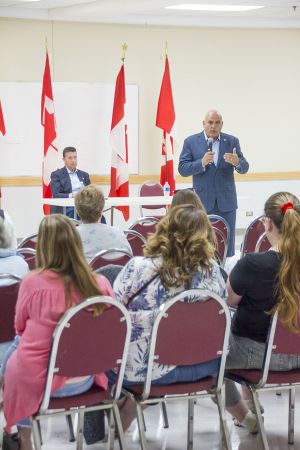
Years of neglect and missed opportunities to improve the country’s criminal justice system under successive Liberal governments has left Canadians vulnerable, Larry Brock told a small crowd assembled at a townhall gathering in Dauphin, Aug. 18.
The Brantford-Brant South Conservative Party of Canada member of Parliament joined local Riding Mountain MP Dan Mazier at Aspen Lodge for the information evening.
“Crime is increasing and it’s more profitable for low risk, bigger reward now these days,” Mazier said in introducing Broack, who was a longtime Crown attorney before entering politics.
“Criminals know we’re very vulnerable. We’re by ourselves at night, especially on rural properties. There’s no one around, so we’re easy to pick off.
“Things are happening here and and this is why I thought it was a pretty important reason to have a a townhall on on crime.”
Political ideology, Brock began, has nothing to do with a desire for community safety. Regardless of of their political bent, he stressed every Canadian wants to live free of fear about home invasions, property thefts, or the safety of their children at playgrounds and community centres.
“That is the reality of most Canadians right now after 11 years of failed criminal justice policy,” Brock said, adding Dauphin is a bit of an outlyer in that regard, the result of the good work of local police and Crown attorneys, who he had the opportunity to speak with.
“I was actually impressed with the things that they are doing to ensure that you are raising your families and living in a peaceful neighbourhood. Now, we’re all going to have some issues . . . but of all the police services I have spoken to across this country and crown attorneys I’ve spoken to across this country, I think you can take credit for the hard work that those two institutions are doing to keep you safe. Because it’s not the case in many places.”
Canadians deserve a federal government which does everything possibile to keep them safe, which Brock said is a federal government’s overarching priority. But that has not been happening.
“Notwithstanding that for the last five years, they have heard an earful from your premier, Mr. Kinew, from your MP, from MLAs, from mayors of Manitoba, other premers across the country and provinces and territories, police chiefs, presidents of police unions and victim advocacy groups that have been coming to Ottawa consistently over the last five years asking the government to do their number one job,” he said.
“Regardless of who’s in government, that is their primary responsibility.”
Recent Statistics Canada data shows that crime is decreasing overall, but when you take a closer look at the numbers, Brock said serious and violent crimes are actually on the rise.
“While the national picture may say we’re becoming a more safer country, when you take a look at the actual specific offenses, it paints a different picture,” he said.
“Violent crime is still on the rise. In Dauphin, according to your Crown attorney, homicides are exploding in Dauphin, attempted murders are exploding in Dauphin, weapon offenses, gun offenses are exploding in Dauphin.”
It is well known that most criminal offenses are committed by a small number of prolific offenders, who are continually treated with kid gloves and easily get released on bail with very few conditions, Brock said.
“Then ultimately breaches those conditions, doesn’t live up to their promise, and ultimately gets sentenced and receives a sweetheart sentence,” he said
“That’s what’s happening. I’m hearing from victims, I’m hearing from police officers that that is what’s happening and that’s why we are losing trust and confidence.”
The problems, Brock maintains, began when Justin Trudeau rose to power and gutted a “tough on crime” system developed under Stephen Harper.
“His mandate was law and order. He introduced a whole host of changes to the Criminal Code of Canada to make us a safer country. In fact, our crime rate was at its lowest in this country under his leadership in 2015,” Brock said.
Then along came Trudeau, Brock said, who oversaw, in his estimation, the most fundamental shift ever in Canada’s criminal justice system.
Brock said Trudeau ushered in the “prinicple of restraint” through Bill C-75, which guided judges to “release the accused at the earliest opportunity on the least restrictive conditions.” That was followed by the elimination of mandatory minimum senternces.
This year, Bill-C14, Bail and Sentencing Reform Act, which came into force last month further eroded the system, despite Opposition efforts to improve the legislation.
“We had close to 35 amendments to Bill C-14 to make it stronger, to make it better, to make it more responsive to make it better, to provide better protections for victims and communities, and it was shot down by the Liberal government,” Brock said.
“I fought like hell, as did Dan, as did our entire party to warn the government.”
While effecting change is difficult in opposition role, Brock said, those improvements will be part of a comprehensive justice strategy when the CPCforms government.
“When we form government, Pierre Poilievre has a plan, a plan that I’m working on right now in terms of policy ideas to implement as a campaign pledge when it comes to criminal justice issues. He’s got a plan for the first 30 days, the first six months, the first year of implementing the suite of changes,” Brock said.
“In fact, what he said very clearly in the 2025 campaign is if he was granted the privilege of being the prime minister of our country, this country would see the biggest sweep of changes that this country has ever seen.
“We need an overhaul. We need a paradigm shift that puts community safety and victims first and not accused. Our job is to ensure that the accused have a fair trial. Our job is not to make it simpler and easy for them to ply their trade and to terrorize communities across this country. That is our plan.”
City bike paths getting upgrades

Work is well underway on upgrades to the City’s Active Transportation Route along Mountain Road North.
Three blocks of the bike path - from River Avenue to Davidson Avenue - are being moved from the roadway onto a widened sidewalk following the boulevard.
The city’s focus on active transportation reflects a desire to create a cycling culture, which revolves around the Northgate trail system and feeds tourism in the future.
Mountain Road, mayor David Bosiak said, is an important part of the overall vision.
“When we contracted with urban systems to facilitate our active transport plan for the whole city, one of our priorities was we wanted to connect all of the schools and our major public facilities, parks and stuff like that,” Bosiak said.
“So we’ve always thought that Mountain Road is a tremendous spine of the system to get people going north and south.”
Other existing trails, such as the Kingsway Trail and a planned trail along Whitmore Avenue, branch off for east and west travel and spawn other active transportation routes, such as the Allen Dowhan Campus Connector.
“If we’re trying to create a bike culture up at Northgate and in Riding Mountain National Park, we have got to, by extension, do it in town. It’s got to be a complete culture of active transport, so, that’s what this is.”
City council, Bosiak said, has committed to spending up to $500,000 annually on active transportation and the work on Mountain Road will be completed in phases, along with other active transportation developments.
“We’re spending about that amount on a number of things, because we’re finishing the Al Dowhan trail to the college. We’re spending with urban systems on the design of the Whitmore Avenue Trail that’s going to go from AC towards Main Street and we’re going to spend some money this year on that first piece of the Mountain Road connection,” he said.
Bosiak added work on moving the bike path off the roadway will be done in phases as infrastructural renewal takes place along the street.
“It’s always been a plan to get that bike path off of the street,” Bosiak said, adding the former city council spearheading the Mountain Road bike path made the decision to develop the on-street option based on logistics and funding.
“They got a little grant and that’s all that they could do. That’s all they did and that’s all we got.”
Bosiak added he has heard complaints about the project and the decision to spend money on the upgrades.
“Give us the benefit of the doubt and comment on this when you see it done, Active Transportation Routewhen it’s complete. Not before it’s even started,” he said.
City council agrees to new day care funding agreement

Dauphin city councillors got together for their only meeting of July last week.
Added to taxes
Councillors opted to add two outstanding water accounts to the tax rolls in the amount of $334.44. That total is comprised of $206.80 outstanding at 224 5th Ave. SW and $127.64 at 7 Jackson St.
In both cases a final water bill was not paid.
Recycling
Council received the 2025 annual report from Multi-Material Stewardship Manitoba, outlining recycling statistics for the year. The report indicated the City of Dauphin recycled 525,589 kilograms of material in 2025, amounting to 62.8 kilograms on a per capita basis. That result is down seven per cent from 2024 when 567,041 kilograms, 67.8 kilograms per capita, was recycled.
Property bylaw
Deputy city manager Lisa Gaudet updated councillors on the progress of a new comprehensive property enforcement bylaw package. The process involved refinement of the property standards bylaw, general enforcement bylaw, administrative penalties bylaw, vacant and boarded buildings bylaw, derelict buildings bylaw, and amendments to the fees, fines, and charges bylaw.
Gaudet said the overall package has been reviewed by the city’s lawyers and represents “one of the most significant updates to the city’s property enforcement framework in many years and will provide clearer, more consistent, and more effective enforcement tools.”
The new bylaws will be reviewed by council at its next planning and priorities meeting.
Accounts approved
Council authorized the issuance of 84 cheques totalling $1,026,386.71 to cover outstanding accounts. Also authorized were 27 electronic transactions totalling $242,959.19.
Building permits
Councillors were informed there were five City of Dauphin building permits issued in June for work totalling $218,200.
There were also two Department of Labour permits issued with a total value of $842,117.
That brings the year-to-date totals to 20 City of Dauphin permits representing $1,539,710 and eight Department of Labour permits valued at $11,318,210.79.
When other City of Dauphin permits are considered, there has been $12,857,920.79 in valued added construction in Dauphin so far this year.
Funding agreement
Given an increase in provincial funding for the development of Prairie Park Place Early Learning Centre council agreed to the mayor and city manager signing a new funding agreement related to the project. The amended agreement was necessary when the province increased its contribution from $6,561,116.66 to $8,074,527.14.
State of emergency
Council passed a resolution accepting as information the circumstances of the State of Emergency declaration made on July 1, by mayor David Bosiak pursuant to the Emergency Measures Act. City manager Sharla Griffiths said the resolution was prepared with an eye toward public transparency as the declaration was not made through a formal council decision.
Municipal letter
Also related to the flood event, council accepted as information a joint municipal letter to provincial and federal representatives requesting continued support for disaster recovery, enhanced flood forecasting and river monitoring, improved emergency communications, infrastructure renewal, agriculture recovery, strengthened emergency management resources, and the timely restoration of full services at the Dauphin Regional Health Center.
The letter was the product of a recent meeting between municipal leaders, CAOs and municipal emergency co-ordinators from affected communities to discuss the ongoing impacts of the flood, identify common recovery challenges, and establish shared priorities for regional advocacy.
Financial assistance
Council passed a resolution formally requesting disaster financial assistance from the province to assist with eligible public sector response and recovery costs incurred as a result of the flood. The resolution also called on the provincial government to extend DFA benefits to eligible residents, businesses, agriculture producers, and property owners who have incurred eligible losses and expenses. The resolution is procedural step, Bosiak said, which kickstarts actions at senior levels of government to get mony flowing.
“The City, right from July 2 or July 3, has been in contact with DFA,” Griffiths added.
“They know that this resolution was coming, so there should not have been any delays for any residents creating a DFA claim and we’ve heard anecdotally that the province is accepting those applications.”
Better monitoring
Council passed a resolution calling on the province to install additional flow an water level monitoring stations upstream and within the city of Dauphin and provide riverbank elevation data to improve flood forecasting, emergency preparedness, and long-term flood resilience.
Currently there are only two such stations on the on the river in the vicinity, one at the Vermillion Dam and the second where the rivers crosses Hwy. 20 north of Dauphin.
Diversion
Councillors called on the province to work collaboratively with the City and neighbouring municipalities to evaluate the feasibility of a Vermillion River floodway to reduce future flood impacts while avoiding adverse conditions for those downstream. The resolution called on the Province to commit to the necessary hydrological studies, engineering assessments, planning, design and construction of a potential Vermillion River floodway.
“One of the things that we also discussed with EMO was the concept of a floodway for the Vermillion River,” Griffiths said, most people’s idea of a floodway relates to the Winnipeg floodway or the Portage diversion.
“However, talking to EMO, there’s communities that have 78 residents that the river is diverted if it goes up above certain levels. So, um again, when we look at Dauphin being a city, and it’s the largest urban concentration in the Parkland, I think it’s valid for us to ask the province to entertain a discussion about this.”
Hospital rehabilitation is underway, but complicated
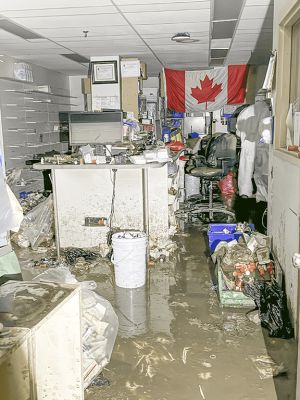
Getting Dauphin Regional Health Centre back up and running is not as simple as plugging in a generator and firing up the x-ray machines.
Prairie Mountain Health CEO Treena Slate said all systems in the hospital are intertwined and operating such a facility requires a significant amount of power.
“The medical gases, for instance, so the oxygen, the suction and the gases that are required in the operating room and obstetrical care, they alone require probably the most significant amounts of power. All of the diagnostics services in the building require a significant amount of power,” Slate said.
“Those two systems have to be in place before we can do anything in the building. We need to have our electrical infrastructure in place before we can power up the HVAC systems and the mechanical structures in the building. It’s not as simple as hooking up an external generator and turning everything on. The building requires so much power that that’s not an option. We do need to have that electrical infrastructure and the mechanical infrastructure in place before we can resurrect services.”
Slate added, as the building is a clinical space, ensuring the hospital is safe and healthy for occupation is essential.
“Safety guides all of our decision-making as we move through this process,” she said.
“This is a clinical space. It is not a residential space. We need to ensure that everything is safe.”
The DRHC was closed at the beginning of July due to extensive flooding affecting the basement of the facility. Recent indications are that it will take months to get the hospital back functioning fully.
However, the health region is working hard to restore as many services as possible, as quickly as possible, with the focus currently on establishing a functioning emergency department and diagnostic services, said Dr. Abdi Sokoro, the chief operating officer of Provincial Diagnostic Services.
“The work is continuing as a priority for diagnostic services, basic diagnostic services in the community,” Dr. Sokoro said, adding the focus is on services for non-urgent, non-symptomatic patients, who are less likely to need physician interventions.
“Patients who are ill are advised not to be seeking these services. For those patients, we continue to urge them to report to the nearest emergency department which has the appropriate diagnostics.”
Again, safety takes the wheel when it comes to identifying a space in the community to house such services, Dr. Sokoro added, citing the Health Standards Act as a guiding piece of legislation.
“Which means that the facilities in which we operate has to meet the safety requirements of infection prevention control stability, but also are not a source of harm to the patients,” he said, adding work is underway to provide phlebotomy services - the medical procedure of puncturing a vein to draw blood - as well as an EKG service and X-ray options.
“It is our priority and we hope to have those in the next while. We don’t have an exact concrete timeline, but that is something we’re working on with PMH and government, as well.”
Slate added PMH and Shared Heath staff are also working to provide dialysis and oncology services in the community as soon as possible. Possibilities under consideration include vacant buildings in Dauphin and the surrounding area, or even mobile options.
“We are looking at every possible option. We have to consider safety first and ensure that we’re meeting clinical standards by providing those services. It is not as simple as moving equipment over to a building in Dauphin,” she said.
“So much work and clinical experts are involved in that planning.”
In the meantime work will continue on properly assessing the damage at DRHC to determine a more concrete timeline for the return to normalacy.
Slate said a restoration company is evaluating the damage as it cleans the space. Photos of each room and an inventory of items to be replaced through insurance are being compiled as the work progresses.
“Really painstakingly working to clean spaces in a way that we can access the electrical and mechanical equipment and the clinical equipment that was damaged during the flooding,” she said.
“One of the main barriers to getting that completed is they can’t yet access the crawl space. It s still full of water and silt and so they are working to remove that so they can fully evaluate the wiring and the infrastructure in those spaces to understand the degree of damage.”
Slate added PMH and its engineers are eagerly awaiting that report so reconstruction work can begin.
DRHC closure: Mazier critical of PMH response to “serious situation”
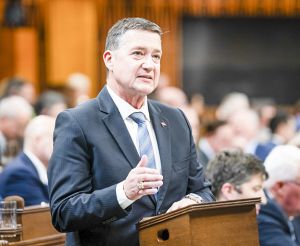
Riding Mountain MP Dan Mazier is concerned about Prairie Mountain Health’s response to the situation at Dauphin Regional Health Centre.
In a letter to Uzoma Asagwara, Minister of Health, Seniors and Long-Term Care, Mazier indicated as the federal representative for the area, he has been effectively stonewalled in his attempts to tour the facility and assess the damage for himself.
“Despite repeated efforts by myself and my office, Prairie Mountain Health failed to respond in a timely manner or facilitate a visit. Instead, they offered a Microsoft Teams meeting nearly two weeks later,” Mazier said in the letter, adding a virtual meeting weeks into the closure of a critical regional hospital is insulting to the seriousness of this situation and demonstrates an unacceptable lack of urgency.
“This is particularly troubling given that Premier Wab Kinew and members of the media were permitted to visit the facility, suggesting that political considerations may be influencing what should be a non-partisan response.”
While he continues to work with his federal counterparts on a response to the crisis, Mazier indicated the community, which expects all levels of government to work together, should not have to wait for PMH to engage their elected representatives.
“Even more concerning, health care professionals raised serious concerns with me about the lack of timely information and visible attention from Prairie Mountain Health’s senior leadership,” Mazier continued, indicating it is unclear whether PMH CEO Treena Slate has personally visited the facility.
“Leadership cannot be exercised from a distance during a time of crisis. Frontline workers are operating under extraordinarily difficult circumstances while being left without adequate updates or clear direction.”
Mazier indicated he has also heard concerns about the temporary triage clinic established in the wake of the closure, including a lack of medications, equipment or clinical capacity required to treat patients who arrive with a medical emergency.
“Physicians have proposed practical temporary solutions, including a mobile medical unit, yet I am advised that these proposals have received no meaningful response from either your department or Prairie Mountain Health,” Mazier wrote.
A lack of communication between PMH’s senior leadership, physicians and other health care professionals has frontline workers operating without consistent information or a co-ordinated plan.
“These reports require immediate investigation and a clear public explanation from your department and Prairie Mountain Health,” Mazier said.
The community is facing uncertainty when it comes to health care and a lack of communication is further eroding their confidence, Mazier wrote.
Regular communication with health care professionals and the public, providing clear information on the plan and timeline for restoring hospital services is crucial, Mazier indicated, adding he has been actively advocating with the Minister of Emergency Management to ensure the federal government understands the severity of the flooding and the urgent needs facing the region.
“I have also called for targeted federal assistance to support the restoration of hospital services. However, delayed responses and absent leadership undermine that co-operation and our ability to support affected residents,” Mazier indicated to Asagwara.
“Every level of government should be working together to support the people of the Parkland region.”
Police seek public’s assistance in ATM theft

On July 13, at approximately 4:50 a.m., RCMP responded to a commercial alarm that was triggered at a business on the 1400 block of Main Street South in Dauphin.
Officers went to the scene and learned two individuals had driven up to the business in an orange utility task vehicle (UTV) and smashed a window.
They pried the business’ door open by connecting a strap to the UTV, then hooked the strap to an ATM inside and dragged it out. The suspects then left the scene.
Police are looking for the public’s help in identifying the two suspects, whose images were captured on surveillance video, and tracking down the UTV, which had been stolen a night earlier from a nearby Main Street business.
The UTV is a 2012 Kubota RTV 900XT, Alberta license plate UTZ62.
One suspect was wearing a black sweater with a hood and a white Reebok triangle logo on the front.
The other suspect was wearing a full-face covering ATV helmet with what appears to be a “V” or “VH” written on the side.
They were wearing dark-coloured masks and gloves.
Anyone who can help identify the suspects, or provide information on the incidents is asked to contact Dauphin RCMP at 204-622-5020, Crime Stoppers toll-free at 1-800-222-8477 or to provide a secure tip online at www.manitobacrimestoppers.com.
Future flood fights: City council explores mitigation options

The City of Dauphin is looking for ways to mitigate the damage if the flooding experienced in the community at the beginning of July should ever happen again.
At their regular meeting July 13, Dauphin councillors discussed ways to lessen the effects of the Vermillion River on the community in the future and passed resolutions calling on the province to aid them in those efforts.
Among the discussions was the need for better monitoring of the river upstream of Dauphin, and within city limits, and improved riverbank elevation data, along with the possibility of developing a river diversion project.
When it comes to river monitoring, there currently is just one station upstream of Dauphin at the Vermillion dam, and one downstream where the river crosses Hwy. 20 north of the city.
Additional monitoring, when combined with accurate and comprehensive riverbank elevation data can go a long way to forecasting potential flooding, identifying vulnerable areas, and implementing timely mitigation measures, city manager Sharla Griffiths told council.
In this latest incident, when city administrators were looking for information about river levels, the capacity of the Vermillion River within city limits and how close the river was to spilling its banks, that information was not readily available.
“We didn’t know where to look for that. We assumed it was there and it was on us that we hadn’t found it,” Griffiths said.
“Unfortunately, it’s not there. There is no Vermillion River monitoring upstream of Dauphin except at the Vermillion Dam, there’s nothing in Dauphin and it’s at Highway 20 on the other side.”
Realtime information on river flows and water levels is used to great effect when it comes to flood preparations in other communities, she added.
“We see people in other communities, sandbagging certain areas to different levels and stuff like that,” Griffiths said, citing Brandon as an example of a community
“It's the province who monitors the river levels. They have a whole hydrologic department that runs scenarios based on those levels and it alerts them what when things are happening. So we want to be part of that monitoring system.”
While some communities might get two to three weeks of notice about potential flooding, that would not be the case in Dauphin, given the topography of the area.
“Just doing some really quick and dirty analysis with EMO, we would get 24 to 48 hours notice of something happening,” Griffiths said, adding advance warning would help improve flood forecasting, emergency preparedness, and long-term flood resilience..
“We do have to get that information, be proactive, learn what those levels are so that we can mitigate, and there might be have to be some more permanent mitigation measures put in because we wouldn’t get that (lengthy) heads up.”
One of those more permanent mitigation measures being considered is some sort of river diversion infrastructure designed to reduce flood risks, protect homes, businesses, and essential public infrastructure and improve long-term community resilience.
On the recommendation of Griffiths, councillors passed a resolution calling on the province to undertake the necessary hydrological studies, engineering assessments, planning, design and construction of a potential Vermillion River floodway in collaboration with the city and neighbouring municipalities to reduce future flood risks while avoiding adverse impacts on surrounding municipalities.
“I really only knew of like the Winnipeg floodway or the Portage diversion. It seemed like it had to be something massive that was protecting a lot of things. However, in talking to EMO, there’s communities that have 78 residents that the river is diverted if it goes up above certain levels,” Griffiths said.
“When we look at Dauphin being a city, and it’s the largest urban concentration in the Parkland, I think it’s valid for us to ask the Province to entertain a discussion about this.”
It is important that any such project would not cause problems further downstream, she added.
“The last thing we want to do is cause more flooding downstream at the cost of saving the city. However, there has to be a trade-off and it would be in consultation with our neighbours.”