
Stories from the North Pole

The North West Regional Library, Swan River Branch welcomed Mrs. Claus to their building this past weekend, Dec. 7, reading books with all the children that came to visit. Grayson Moshenko (left), Jesse (centre) and Jackson Rooks (right) all stand with Mrs. Claus for a photo.
Banner unveiling held

Goose Lake High students and staff gathered in the gym Wednesday for a banner unveiling ceremony for the Junior Varsity Raiders volleyball team, the 2023-24 A/AA provincial champions.
It was GLH’s first provincial banner since the 2018-19 school year.
Read all about it in this week’s issue.
Importance of main tourism draws backed up through studies

The benefit to Dauphin brought by the community’s two major festivals and the economic potential of the new Northgate Trails development are widely known . . . anecdotely.
But thanks to the City of Dauphin’s Economic Development (ED) department, there is now some hard data to back it up.
Utilizing some of the proceeds of last year’s accommodation tax, this past summer Dauphin ED, in partnership with Sport Tourism Canada and The Data Jungle, conducted an economic impact assessment of Dauphin’s Countryfest, Canada’s National Ukrainian Festival and Northgate Trails.
The assessment looked at three factors: the spending of out-of-town visitors while they attend the events; the expenditures of the organizers in producing the events; and capital construction costs directly attributed to hosting.
Those numbers were used to extrapolate the impact on the regional, provincial and national economies.
That data was presented to the groups involved at a special meeting at city hall last week.
And the results are not surprising with it being revealed that through its $3,081,632, 2024 operational budget, Countryfest generated $5,577,610 worth of economic activity locally, $6,073,512 provincially and $9,453,100 nationally. The results are based on 452 responses to a survey conducted by ED staff and volunteers.
Canada’s National Ukrainian Festival, with a 2024 budget of $520,200, based on 200 survey responses, was shown to generate $2,579,557 of economic activity locally, $3,103,922 provincially and $4,481,878 nationally.
The numbers are not insignificant ED manager Martijn van Luijn said, when you consider that together, the total economic activity of Dauphin’s major festivals impact the local economy by $8,157,167, Manitoba’s economy by $9,177,434 and Canada’s by $13,934,978. You cannot forget that they also generate $2,490,000 in federal, provincial and municipal taxes, he added.
These numbers can be used to demonstrate the value of the festivals, while supporting funding and sponsorship programs, guiding strategic planning, advocating for community investment and promoting local engagement.
“The primary reason we did this was to help these organizations lobby for future funds and to help them build some evidence and data around how important this is to our community, so they can use that for future planning and for grant applications, etc,” van Luijn said.
“The cost of these studies was $15,000 and that’s probably something that they would not have done on their own. But after meeting with them, this was something that they needed.”
While the study of Northgate Trails did not follow the same format, user data collected through geo-fencing data with permission from user smart devices through Trails Canada Propulso Data Collection was used to create character profiles.
The results of the less than 1,000 user sample size showed that between January 2021 and December 2023, the facility has more than 600 visitors monthly, with October and January being the peak months.
Read the full story in this week’s Dauphin Herald.
KSD looking to fill positions

Kelsey School Division held its regularly scheduled meeting on November 18. The division has been busy with programming for students and recently had students engaged in another successful bison harvest.
“We just had another bison harvest again,” said KSD Superintendent Trevor Lane. “The students love it and we work with Around the Bend Farms to put this into our Indigenous learning. Myrna Ducharme and some elders in the community take about 20 students out to do this. They go through the entire process of how to honour the animal, go through some Indigenous ways of life and culture. They are shown how to skin the hide, harvest the meat and cook it. It’s a full two-day harvest process. We have three of these scheduled. It always goes over really well and the students enjoy doing it.”
Bus service returns to The Pas

Regular bus service is resuming between Winnipeg and northern Manitoba with some major improvements. Kasper Transportation, the largest bus operator in northwestern Ontario, will be offering scheduled bus service from Winnipeg to The Pas starting this week. The news comes just in time for the holiday season.
“There was a void and I realized how many people were stranded in terms of bus transportation,” said Kasper Transportation Owner/Operator Kasper Wabinski. “The way people came together, under the right circumstances, showed me this was meant to be.”
Former Benito resident breaks into background acting
Pursuing a career in acting or music is not an easy feat, for there are many talented people out there chasing that same dream. Former Benito resident Kris Josephson, whose artist name is Kris Anders, has not only been working in the music scene but is now doing some film work as well.
“I was performing as a singer and songwriter in the summer of 2020 at a charity fundraiser in Kelowna, B.C.,” said Anders. “After I was done with my set, I was approached by a talent agent with VA Entertainment. She enjoyed my set and invited me to apply to be part of her agency. I ended up joining her team and shortly after that, I was booked for my first movie. It was a Hallmark wedding film called Planning on Forever, and my role was to play a guitar player in the wedding band. It was quite the experience for my first movie.
“I also decided to try to work more in film. The next one was in February of this year, as a continuity background actor in a Lifetime thriller called Secret Life of my Other Wife. My role was to play a ranch hand with a shady criminal past and I was on set for three days of shooting for this role. After that, the roles kept coming in.
“I played a patron in a restaurant for a movie called A Christmas Less Traveled that was filmed in Peachland, B.C.,” said Anders. “Then I played a pedestrian in a true crime movie called The Girl Locked Upstairs: the Tanya Kach Story. I was also in a movie called The Last Thing She Said, and I was initially booked to just be a patron in a restaurant, however, once on set, I was asked if I could play the chef in the restaurant. My next movie was a Hallmark Christmas movie called Christmas, Love and Fudge, where I played an artisan in a Christmas market.”
This summer Anders had the opportunity to star in another movie in a background role capacity alongside an actress he grew up watching on television.
“In the summer of 2024, I was booked to play several background roles in a movie starring Heather Locklear filmed in Kelowna, B.C.,” said Anders. “It’s a true crime movie called Mormon Mom Gone Wrong: the Ruby Franke Story. There was some controversy over the movie being filmed as the real-life characters had only recently been sentenced to prison. All of which I had no idea of until I showed up on set.
“I ended up in three different scenes as first a pedestrian on the boardwalk, then again as a conference attendee in line for a book signing that erupts into a chaotic scene. Casting called me back for a second day of shooting, where I played one of the men in the support group led by Heather Locklear’s character.
“The director placed me in a chair next to Heather, so I was onscreen for this scene. It was pretty cool to make my on-scene debut next to an actress that I had grown up seeing on TV shows in the 80’s and 90’s. Heather was really nice and friendly while on set, and I managed to chat with her a bit in between takes.”
Being a background actor isn’t as glamorous as one might think. There is a lot of uncertainty, so flexibility in one’s schedule is key to making it work.
“Some of the challenges to this work would be the scheduling,” said Anders. “We are often given really short notice on bookings and even once booked, we rarely know the set location or the times we are supposed to be there until late the night before. You have to be flexible as well. They may decide you’re a better fit for a different role once you arrive.
“We are often responsible for our wardrobe too, so I’ve learned to bring a bunch of different looks to change into if something changes. Background actors are traditionally at the bottom of the pecking order on a working set. Expect long days, often in challenging weather. I’ve had to wear a huge ugly Christmas sweater for a movie that was shooting in August in the Okanagan heat.”
Being in the film industry allows Anders to tap into another creative side. It also gives him the opportunity to network with other aspiring musicians, and has presented more opportunities.
“I love the creative side of it,” said Anders. “Things change rapidly on set, and I like that you never know what you may end up doing that day. I find that now, when I watch movies at home, I am often thinking about how that particular shot was filmed, what the director was aiming for, and how long it may have taken to get that particular shot completed.
“I also get to meet a lot of other folks who are aspiring actors, models, or other musicians like myself who happen to have some downtime in their music career. I’ve ended up working on some side projects with at least two other musicians this way, not to mention being given a reference to other potential opportunities.”
Anders has another movie coming up and is working on getting more into the casting world. He still will perform and write music, with this just being another complementary talent he can indulge in.
“I recently was in another true crime movie called the Regina Smith Story about a serial killer in Dallas, TX,” said Anders. “I play a bad guy and I’m onscreen getting booked into the police station by an officer.
I’m pursuing my Actor’s Union membership and need just a few more days on set to qualify for that. I’ve also had my name added to a Casting Network that seeks out actors for commercials as well as films.
“My main passion is still writing, recording and performing music, so that will always remain at the forefront of my creative work. However, I’ve learned to be open to opportunities that arise and at this point, acting seems to be heading in a positive direction for me. The main networks that film here in the Okanagan are Hallmark and Lifetime channels, so if you happen to be watching any movies, you might see a familiar face in the background.”
Anders accredits all of his different life and learning skills to being extremely beneficial when it comes to being in film. Having a variety of skill sets can lead to opportunities in background acting.
“For anyone with experience in music, skating, ability to ride horses, martial arts, or with firearm experience, these are all valuable skills to have for film work if any of your readers get a chance to audition for background acting, be sure to mention the above,” said Anders.
Nativity in HD

Volunteers and staff for Madge Lake Bible Camp put together another production of their Christmas Dessert Theatre – this year called Nativity in HD – with free will offerings going to support the ministry and mission of Madge Lake Bible Camp. Their first performance took place on Sunday evening (Dec. 1) at Community Bible Fellowship in Swan River, with future performances coming up in Yorkton and Roblin later this month.
MOR hosts ratepayer's meeting

Road matters accounted for most of the discussion at a ratepayer’s meeting held
Nov. 18 hosted by the Municipality of Roblin.
The three-hour long meeting took place at the Community Centre with about 30 people in attendance, and more on line, with road matters taking up almost half of that time.
Find out more in this week’s issue.
City facing down deficit in Utility Fund

Dauphin’s Utility Fund is trending toward a deficit in 2024.
City manager Sharla Griffiths informered councillors of the situation at their regular meeting Nov. 18.
“One of the reasons that we’re looking at a possible deficit is that the City of Dauphin last September, so over a year ago now, applied for a rate study with the Public Utilities Board (PUB) and we anticipated, we knew that it was going to take a long time. So we gave them basically a year and anticipated that we would have received approval of the increased utility rates by Oct. 1,” Griffiths said, adding they have been told the review will start soon.
“We’re well into November, so fingers crossed for January 1. But that’s the primary reason that we may be running a deficit for 2024.”
Griffiths added there was some capital work that was not completed this year which might help the situation, but on the flip side there was extra capital when they were doing the Lagoon sludging.
“So we are really kind of waiting for the numbers to come in as to where are we are,” she said.
“We’re going to evaluate at the end of November and probably there’s not a lot of room to cancel things in December, all of our projects are done. So we’ll know in a couple of weeks where we’re at.”
The City requested the water rate review as a result of inflationary pressures. While the last review included a built-in inflation factor, it only covered a set number of years.
“After that we can’t inflate the rates, so we just have to keep them stagnant,” Griffiths said,
“So there was at least one year where there, 2023 I believe, did not see an increase and neither did 2024. We were hoping that three-quarters of the way through 2024 we would see an increase and then continue on from there.”
In its application, the City was seeking an 11.7 per cent increase in 2024, along with a 4.2 per cent in 2025 and 2.3 per cent in 2026.
When the new rates will kick in depends on when the PUB decision comes down as the City prefers not to change rates in the middle of a billing cycle.
“It would be great if we could get it started for Jan. 1, but if we can’t then it won’t be until Apr. 1,” Griffiths said.
“It’s tougher to get the kind of messaging out for people to understand that their rate changed halfway through. It’s a cleaner process when it’s at the beginning of a quarter.”
The request before the PUB is for a short term, Griffiths said, acting as a bridge with the lagoon expansion project looming. Once construction costs are firmed up and operating estimates are determined, the City will ask for another rate review to ensure the utility is a strong position to finance the project.
“We have had hugely fluctuating estimates for the project. When we applied for the grant way back in 2019 it was $13 million. During the pandemic, when we got awarded the grant, it was thought that the project could be upwards of $17 million,” Griffiths said adding the grant requirements were that any expenditures over the original $13 million had to be covered by the municipality.
“But as we’re coming out of that high inflation time, we’re finding that the costs are coming down, not quite down to $13 million, but it’s not as high as $17 million. Once we have a more solid idea of what those costs are, then we can determine if (the project will be covered) 100 per cent by water rates or if there’s some on taxation, as well.”
Thrifter Sisters makes its debut as a business
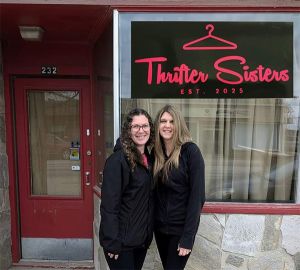
If you like thrift shopping and were disappointed to learn that New to You closed its doors, you won’t be disappointed for long. A new thrift shop, Thrifter Sisters, run by two residents, is opening up and getting ready to serve the tri-community.
“This all happened quickly and wasn’t something we really planned,” said Thrifter Sisters Co-Owner and Operator Karen Hall. “Conversations just developed after we learned of the sudden closure of New to You. We were both very concerned for the well-being of our community, especially with today’s current cost of living. The thought of not having a local thrift store is very damaging to our area.”
“We are both huge thrifters and love to save money,” said Thrifter Sisters Co-Owner and Operator Jasmin Titterton. “We’re always looking for the best deals and love to visit other thrift stores when we travel.”